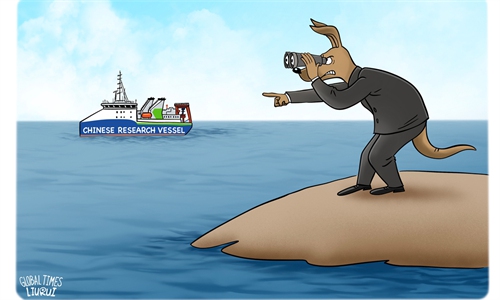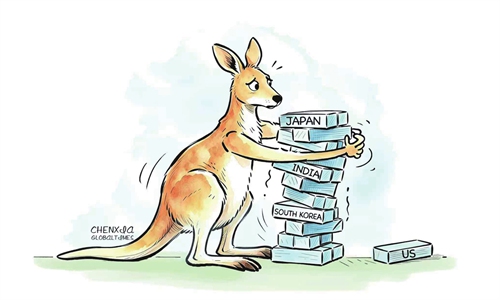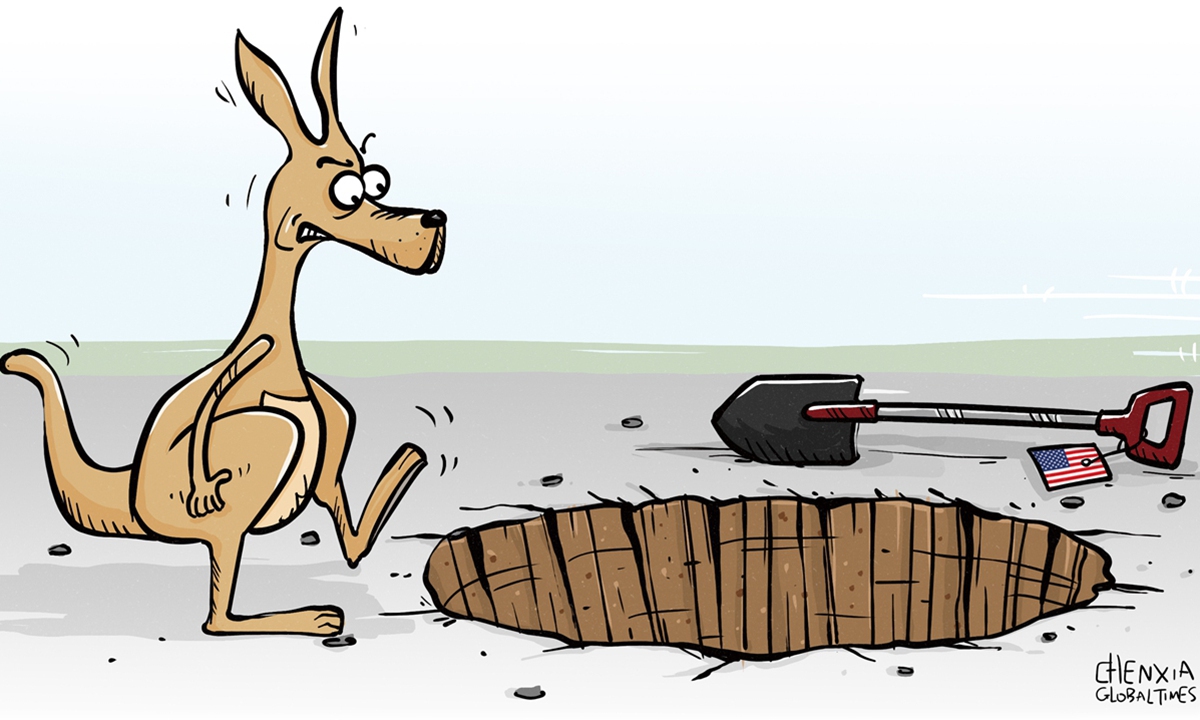
Australia US. Illustration: Chen Xia/GT
On September 13, Kevin Rudd, Australia's former prime minister and ambassador to the US until this March, wrote on social media: "Australia needs a world-class navy. And a world-class navy needs investment like AUKUS."
The remark appears to be related to naval modernization. Yet it raises a question Australia cannot avoid: When the ambition for a "world-class navy" is tied to AUKUS, and AUKUS is deeply linked to Washington's military posture in the so-called "Indo-Pacific" region, is Australia strengthening its independent defense, or placing itself more firmly on the front line of the US' strategy toward China?
What kind of navy Australia builds and what defense policy it adopts are sovereign choices for its people and government. No country should presume to make such choices on Australia's behalf. China's concern has never been with Australia maintaining reasonable capabilities for its own security.
The issue is the strategic narrative in which those capabilities are embedded, the regional arrangements they serve, and where they may ultimately lead Australia and the region.
Australian public debate has increasingly paired alarmist claims of a "Chinese military threat" with calls for a "world-class navy." The understanding of China's defense modernization is often detached from its policy context of safeguarding sovereignty, security, and development interests. Meanwhile, AUKUS nuclear-powered submarines, long-range strike systems, expanded northern bases, and deeper integration with the US military system are presented as the answer to Australia's security concerns.
Such arguments may sound like a call for defense autonomy. In practice, however, they risk leading Australia down another path: exchanging greater dependence on US strategy for a sense of security that may prove neither dependable nor risk-free.
China has never concealed its defense development and has consistently pursued a defensive national defense policy. Its defense spending as a share of GDP has long remained below the global average.
Yet some Australian politicians and commentators, when discussing regional security, focus almost exclusively on the scale of China's military capabilities. They ask far less about the implications of the US' worldwide military footprint, its longstanding forward deployments in the Asia-Pacific, and its repeated use of alliances and minilateral groupings to reshape the region's military landscape. Those realities are central to the security dilemma Australia is now facing.
Worryingly, this narrative justifies Australia's "denial strategy." Defense documents, though they don't name China, clearly reflect high-intensity Western Pacific conflict scenarios through long-range maritime denial, northern basing, submarines, missiles, intelligence sharing, and joint ops.
These capabilities are no longer tailored solely to defending Australia's coastline and homeland. They are increasingly compatible with US military operations concerning the Taiwan Straits, the South China Sea, and surrounding areas.
AUKUS deserves Australian scrutiny. Nuclear submarines, touted as a naval game-changer, face huge cost, timeline, and delivery doubts. Even if achieved, will they defend Australia or serve US power projection?
The real concern is not that Australia may possess a stronger navy. It is that some voices are increasingly equating a strong navy with deeper participation in the US strategy toward China. Under this logic, regional tensions become justification for military expansion, which in turn intensifies bloc confrontation. China is cast in advance as a threat, and Australia is fashioned as an indispensable link in containing it. In such a cycle, peace ceases to be a shared objective and becomes a slogan that can always be sidelined.
Australia's prosperity has benefited profoundly from regional peace, open trade, and stable expectations. China remains one of Australia's most important trading partners. This reality should not be erased by simplistic geopolitical imagination.
Australia has the right to security cooperation and to voice its concerns. But security should not rest on manufacturing hostility, widening confrontation, or accepting automatic involvement in conflict.
On the Taiwan question in particular, military intervention or preparations by external forces can only send dangerous signals, increase miscalculation, and raise the risk of loss of control.
Australia's core question isn't navy strength, but independent crisis intervention. History shows alliances don't remove risk; front-line allies often bear the first costs due to differing goals and circumstances.
China seeks respectful, equitable ties with Australia. Australia's naval choices are its own. However, Australia should consider whether such a military build-up would make it part of the US strategy against China, thereby harming its own interests.
RELATED ARTICLES