Several Chinese universities, firms offer 13-day breaks as Chinese travelers gear up for extended holiday period
By and Wang Xiaohan Published: Sep 15, 2026 01:54 PM

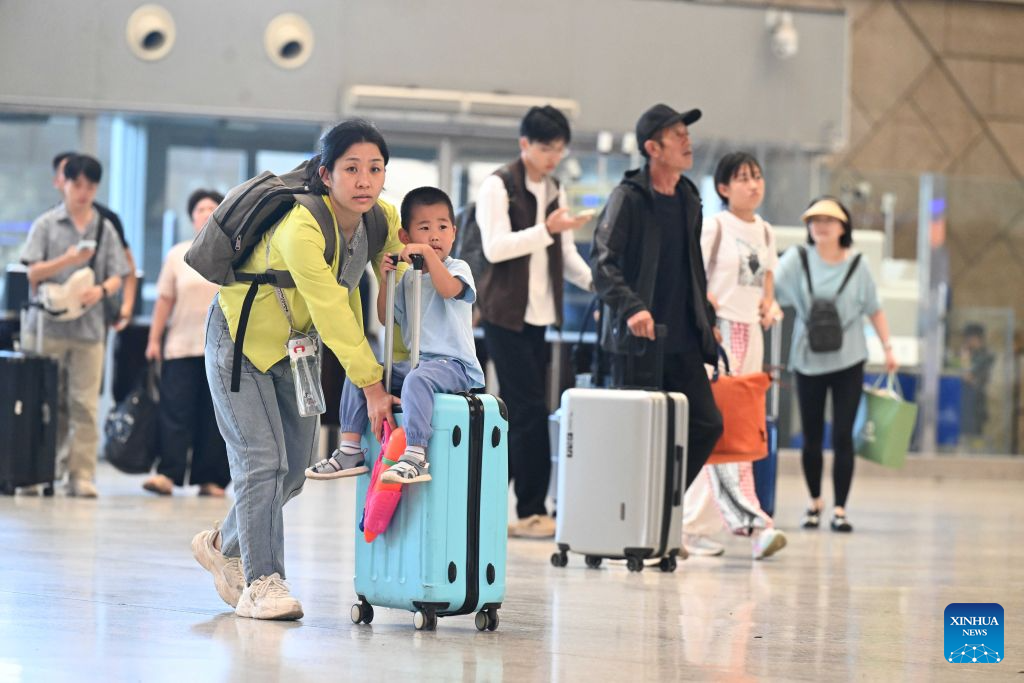
Passengers wait to check in at the waiting room of Shijiazhuang Railway Station in Shijiazhuang, north China's Hebei Province, Aug. 31, 2026. The 62-day summer travel rush officially concluded on Monday. (Photo by Chen Qibao/Xinhua)
As China counts down to one of its longest holiday periods of the year with the upcoming Mid-Autumn Festival and National Day holidays, dozens of universities and private enterprises have moved to offer students and employees an uninterrupted 13-day long break.Under the official 2026 calendar, the Mid-Autumn Festival runs from September 25 to 27, followed immediately by three workdays (September 28-30) before the seven-day National Day "Golden Week" kicks off on October 1. For standard office workers who want an uninterrupted break, bridging the gap requires using three days of personal paid leave.
However, for some students and workers, that might not be necessary. According to financial news outlet Yicai, more than 50 universities, including Shandong University of Arts and Nanjing University of Aeronautics and Astronautics, have officially merged the two holidays into a single continuous vacation running from September 25 through October 7.
Some private enterprises in cities like Shenzhen, Beijing, Kunshan, and Xiamen have also taken similar moves. One company in Hefei, East China's Anhui Province, made headlines in Hefei Evening News by offering 13 consecutive days off without salary deductions or makeup workdays, with management encouraging staff to "have fun and come back energized."
In a letter to parents posted on its website, Hubei Enshi College noted that making out-of-town students travel back and forth twice within a short window adds unnecessary exhaustion and travel strain.
A student from Jinzhong Information College told the Global Times that he is looking forward to a 10-day continuous break from September 25 to October 4. "A consecutive holiday is much better," he said. "It saves on travel expenses and makes the break far more enjoyable."
This move toward longer, integrated breaks aligns with broader national policy goals. China's 15th Five-Year Plan for expanding consumption released in July explicitly advocates for the strict enforcement of paid leave and the promotion of flexible, staggered holiday schedules around traditional festivals.
The policy push and extended breaks are already transforming travel patterns across the country. Data from Qunar shows that airfares on the first day of the Mid-Autumn break are 30 percent lower than on National Day, driving a 25 percent increase in travelers booking multi-destination trips to beat the peak surge. Travel platforms indicate that major airport hubs across China are preparing for a pre-holiday passenger surge starting as early as September 24.
Tongcheng Travel data obtained by the Global Times showed that Chengdu, Beijing, Kunming, Shanghai, and Chongqing rank among the top destinations, alongside Urumqi, Xi'an, Harbin, Shenzhen, and Guangzhou. Bookings for flights of more than 1,200 kilometers departing between September 25 and 30 have spiked significantly year-over-year, with trunk routes such as Shenzhen-Chongqing, Beijing-Chengdu, and Shenzhen-Shanghai leading demand.
This appetite for long-distance travel is also fueling a boom in boutique small-group tours, with product bookings jumping 120 percent year-over-year, a Tongcheng Travel report showed. Itineraries lasting five to eight days designed for small groups of two to eight people (capped at 10) have become the preferred choice.
RELATED ARTICLES