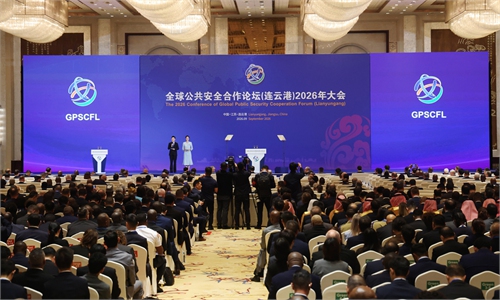
Global delegates gather for Beijing Xiangshan Forum
20th-anniversary event covers wide-ranging topics
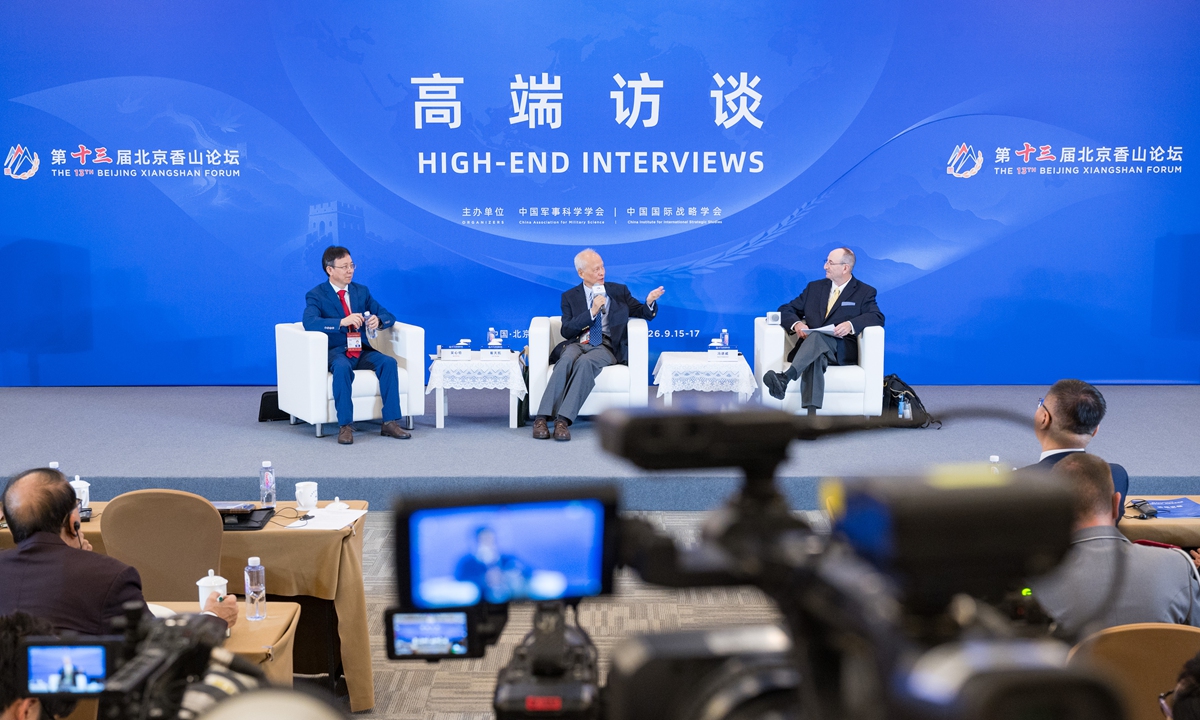
Cui Tiankai (center), former Chinese ambassador to the US, and David Finkelstein, Distinguished Research Fellow at the US Center for Naval Analyses, discuss China-US relations during one of high-end interviews at the 13th Beijing Xiangshan Forum on September 15, 2026. Photo: CNS Photo
Under the theme "Build Consensus on Stability, Advance Security Governance Together," the 13th Beijing Xiangshan Forum brought together around 200 experts and scholars, along with officials and military personnel on Tuesday for discussions ahead of its formal opening ceremony on Wednesday.
Official delegations from nearly 100 countries, regions and international organizations, along with Chinese and international experts and scholars, are attending the forum, which has drawn wide attention from media outlets and think tanks. China Global South Project said that as the forum marks its 20th anniversary, Chinese analysts are watching whether Beijing can translate its growing diplomatic profile into greater influence over international security debates.
"At a time when tensions among nations are increasing and opportunities for frank dialogue are becoming more limited, the Beijing Xiangshan Forum is a valuable platform where military officials, diplomats, and scholars from around the world can gather and exchange views," former Japanese prime minister Yukio Hatoyama said in an interview at the venue.
Attending the Beijing Xiangshan Forum for the third time, Lampros Stergioulas, UNESCO Chair on Artificial Intelligence and Data Science for Society and Professor of Data Science at The Hague University of Applied Sciences, told the Global Times that the global security landscape had changed dramatically over the two decades since the forum was established. We need more platforms like the Beijing Xiangshan Forum to bring people together for dialogue and create momentum for peace in a world beset by conflict, he said.
Wide range of topics
This year's forum features four plenary sessions and eight parallel sessions with discussions covering a broad range of key areas, including traditional and non-traditional security, global governance and regional flashpoints, military technology, and the international rule of law.
Eight sessions were held on Tuesday, covering issues including China-Japan relations, the South China Sea, China-US relations and conflicts in the Middle East.
Asked at one session about the state of China-Japan relations and how to overcome the difficulties facing bilateral ties, Hatoyama said relations were under downward pressure, with an important factor being Japanese Prime Minister Sanae Takaichi's erroneous remarks on the Taiwan question that departed from Japan's previous official position.
Hatoyama called Takaichi's erroneous remarks last November on China's Taiwan region "extremely regrettable." He said she should either "retract those remarks" or otherwise "communicate in an absolutely unambiguous manner."
The South China Sea issue was another focus. Rommel Banlaoi, president of the Philippine Society for International Security Studies, was surrounded by reporters, as China-Philippines relations and maritime tensions were also featured prominently in informal discussions.
"I'm here not only to represent the Philippines, but also to hear the thoughts not only of China, but also of other nations about the value of the Beijing Xiangshan Forum in building confidence and promoting cooperation among participating countries," he said.
AI governance
Alongside regional disputes, a session titled "Strengthening International AI Safety Governance" drew attention to the risks accompanying the technology's expanding use.
Senior Colonel Zhu Qichao, director of the Institute for Defense Technology and Strategic Studies at the PLA National University of Defense Technology, moderated the discussion with Vladimir Norov, former secretary-general of the Shanghai Cooperation Organization, and Obaid Al Ketbi, a former military general and former assistant minister of the UAE Ministry of Foreign Affairs and International Cooperation.
Norov welcomed China's initiative for a global AI cooperation organization. AI has become integrated into our economies and daily life, with countries developing their own AI ecosystems, making governance an increasingly serious issue, he said.
"We need a corresponding institution, an institution for human oversight, to supervise AI development and exercise better control over it. That is why we need a world AI cooperation organization. I think this is a very timely initiative to advance global AI governance," Norov said.
Al Ketbi called for a tiered approach to managing AI, particularly its military applications.
"First, governments must define clear red lines, especially for the use of AI in military operations. Multinational AI companies operating in conflict areas should also undergo security audits. We need transparency: who developed the technology, who is using it and for what purpose," he said.
He also urged closer international cooperation, with governments setting red lines, companies assuming responsibility and experts carrying out verification.
"We must ensure that security, sovereignty, accountability and innovation can all be achieved together. AI sovereignty and international cooperation are not opposing goals. This requires clear responsibilities and risk-based regulation, and we must work together to accomplish it," Al Ketbi said.
David Santoro, president and CEO of the Pacific Forum of CSIS, told the Global Times on Tuesday that although AI arms control was not yet possible, parties should strengthen engagement.
"The best thing we can do is engage in dialogue, so we can exchange insights on how we see that technology and what we do with it," he said.
Inclusive platform
The breadth of these exchanges reflected the forum's growing scale, influence and appeal, Wu Shicun, chairman of the Huayang Center for Maritime Cooperation and Ocean Governance, told the Global Times on Tuesday.
This year's gathering marked the 20th anniversary of the Beijing Xiangshan Forum. An exhibition at the venue traced the forum's evolution since 2006 across three stages: its formative years, its transformation and upgrading, and its renewed development and expansion.
Compared with its first edition, the forum had improved both in organization and in the caliber of participating experts, Wu said. It had become an important platform for developing countries to discuss security through Track 1.5 exchanges involving officials and nongovernmental participants.
"The platform is open, inclusive and equal, offering officials and opinion leaders from different countries valuable opportunities to explain their positions and proposals. Even the defense minister of a small developing country has an opportunity to speak," Wu said.
"This openness, inclusiveness and equality between countries, large and small, are what make the forum attractive."
RELATED ARTICLES