Photo: VCG
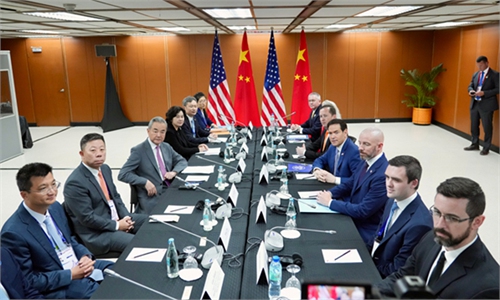
In accordance with the consensus reached during US President Donald Trump's visit to China in May 2026, Chinese President Xi Jinping is to pay a state visit to the US this fall. On this occasion, Member of the Political Bureau of the CPC Central Committee and Chinese Foreign Minister Wang Yi spoke by phone on Thursday with US Secretary of State Marco Rubio.According to the official Chinese press release, the two sides focused on in-depth discussions "on high-level interactions between the two countries" and exchanged views on the Middle East situation and other issues.
This actually reveals several noteworthy trends in current China-US relations: First, the two countries are preparing for the next phase of high-level interactions; second, both sides need to avoid disorder in their relationship; third, although the Taiwan question did not appear in the text of the press release, it remains a deep-seated variable that determines whether China-US relations can move forward steadily.
A single phone call cannot resolve the long-standing structural contradictions between the two countries, but it can calibrate expectations, delineate boundaries, and open up space for communication ahead of a new round of high-level meetings. For two major powers, such communication is essential in and of itself.
China-US relations have for some time generally moved forward along the track of constructive strategic stability charted by the two heads of state, Wang said. He emphasized that the head-of-state diplomacy is the "anchor" of China-US relations. The word "anchor" pinpoints the most critical issue in current bilateral relations.
Today's China-US relationship has long transcended the scope of ordinary bilateral relations; the two countries are deeply intertwined and interconnected across various fields, ranging from trade, the economy, science and technology, finance, security, to artificial intelligence, supply chains and global governance. Every escalation or de-escalation in bilateral relations rapidly reverberates through international markets, regional dynamics, and the strategic assessments of other nations.
As a result, the greatest danger in China-US relations is being swept up by sudden incidents, public sentiment, or even domestic political agendas in the absence of communication.
The path of constructive strategic stability charted by the two heads of state does not shy away from differences nor deny competition; rather, it emphasizes that even when interests between major powers clash, there must be rules for managing differences, channels for avoiding miscalculations, and red lines to prevent the situation from sliding into conflict. The significance of high-level interactions lies precisely in continuously solidifying these bottom lines and expectations.
According to the reports, the second China-US heads-of-state meeting of this year is expected to take place in the near future. Against this backdrop, the phone call between Wang and Rubio resembles a pre-meeting strategic consultation: Both sides need to confirm the agenda, exchange concerns, and create a relatively stable political and public opinion environment for future high-level interactions. In this sense, the first signal sent by this call is that both China and the US have a practical need to maintain dialogue and manage risks.
Wang said that the two sides should prepare for the next stage of high-level exchanges in a spirit of equality, respect and mutual benefit, strengthen communication, advance cooperation, manage differences, respect each other's core interests. This is not merely a set of routine diplomatic statements, but rather the fundamental condition for ensuring that China-US relations can proceed steadily and sustainably.
"Equality" means that no country can, by virtue of its hegemonic power alone, determine who deserves respect and who must be forced to make concessions; "respect" means that one cannot demand the other side stabilize the relationship while simultaneously continuing to cross the other's red lines; and "mutual benefit" means that one cannot merely emphasize its own interests while shifting the costs and risks onto the other side.
In fact, there exists competition as well as significant differences between China and the US, but competition must have boundaries and differences must be managed. The repeated ups and downs in China-US relations over the past period has already demonstrated that: Once strategic pressure replaces equal communication, zero-sum thinking supplants mutual respect, and "decoupling and severing supply chains" takes the place of mutually beneficial cooperation, the ultimate damage will extend beyond bilateral relations to harm the global economy and regional security.
During this meeting, the two sides also exchanged views on the situation in the Middle East - an issue that is equally of global concern. Currently, the Middle East is plagued by a complex interplay of conflict and humanitarian crises, with energy security, maritime security, and regional order all under threat.
As major powers with global influence, even if China and the US do not share entirely consistent positions, it is necessary for them to maintain communication to prevent the situation from further escalating.
There remains room for cooperation between China and the US. The key lies in ensuring that cooperation is not merely rhetorical, and that stability is not just a temporary tactical arrangement. A truly stable relationship must be built on mutual respect for each other's core interests and the proper handling of major sensitive issues.
The official statement on this phone call did not directly mention the Taiwan question. However, the fact that it was not included in the text does not mean the Taiwan question is unimportant; on the contrary, precisely because it is so sensitive and has far-reaching implications, it must be treated with the utmost seriousness in high-level communications between the two countries.
For China, the Taiwan question concerns national sovereignty and territorial integrity; it is the core of its core interests and the first and absolute red line in China-US relations. For the US, how it handles the Taiwan question will directly test whether it is truly willing to uphold the political foundation of China-US relations.
The one-China principle and the three China-US Joint Communiques are not diplomatic trappings to be picked and chosen at will, nor are they rhetorical tools to serve short-term political needs. If the US, on the one hand, talks about stability while, on the other, sends the wrong signals to "Taiwan independence" forces; if, on the one hand, it emphasizes risk management while, on the other, continues to strengthen military ties related to the Taiwan region, the "constructive strategic stability" will lose its foundation.
The danger of the Taiwan question lies in the fact that it has never been a mere disagreement in the general sense, but rather a major issue that could undermine the fundamental stability of China-US relations. Any attempt to use Taiwan as a bargaining chip in geopolitical games will exacerbate tensions across the Taiwan Straits and expose China-US relations to greater uncertainty.
It is worth noting that amid discussions surrounding the China-US leaders' meeting, people on the island have repeatedly asked one question: Will Taiwan be used as a "bargaining chip"?
This concern itself reflects Taiwan society's anxiety about the future. Taiwan's future must not be treated as a bargaining chip by external forces; nor should the interests of Taiwan compatriots be sacrificed by anyone as a cost in geopolitical games. The fundamental issues in cross-Straits relations must ultimately be faced and resolved jointly by the Chinese people on both sides of the Straits.
As seen in recent discussions on the island, more and more people are beginning to realize that pinning their security on external promises and their future on great-power rivalry inherently entails enormous uncertainty.
Every external force has its own interests to consider. Adjustments to US policy toward the Taiwan region are often influenced by a combination of domestic politics, its strategy toward China, regional deployments, and the international situation.
For Taiwan, what truly warrants consideration is not how to place bigger bets in the competition among major powers, but how to avoid becoming a pawn that is repeatedly exploited by external forces and can be moved at will.
What is most needed to maintain peace across the Taiwan Straits is to oppose "Taiwan independence" separatist activities and external interference, and to steer cross-Straits relations back onto the correct path of peaceful and integrated development. This is the rational choice that truly serves the fundamental interests of compatriots on both sides of the Straits.
The significance of this phone call between the US and Chinese foreign ministers lies not in how many issues that the two sides resolved, but in the fact that both sides are preparing for the next phase of high-level exchanges.
Given the current state of China-US relations, both sides should be more clear-headed. China hopes for the stable development of China-US relations and has always advocated resolving differences through dialogue. However, stability can never be maintained unilaterally, and communication must not serve as a cover for misguided actions.
If the US wishes to advance a constructive and stable strategic relationship with China, it must translate "equality, respect, and mutual benefit" into concrete policies, and - especially on issues involving China's sovereignty, security, and development interests - exercise caution in its words and deeds and strictly observe boundaries.
True stability must be demonstrated through action; true respect must stand the test on key issues. Dialogue is better than confrontation, cooperation is better than decoupling, and stability is better than turmoil - this is the shared expectation of the peoples of both China and the US, as well as the widespread expectation of the international community.
This phone call between the Chinese and US foreign ministers has sent a positive signal regarding high-level interaction and communication, as well as risk mitigation in bilateral relations.
Moving forward, it is even more important that high-level exchanges help both sides form a clearer consensus, particularly on upholding red lines and avoiding miscalculations regarding the Taiwan question. The "anchor" of China-US relations must ultimately be calibrated through the actions of both sides.
RELATED ARTICLES