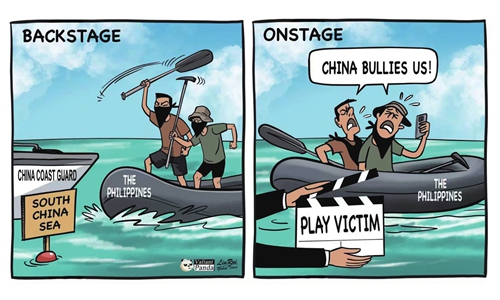
A shameless political double act exposes Teodoro’s true motives: Global Times editorial
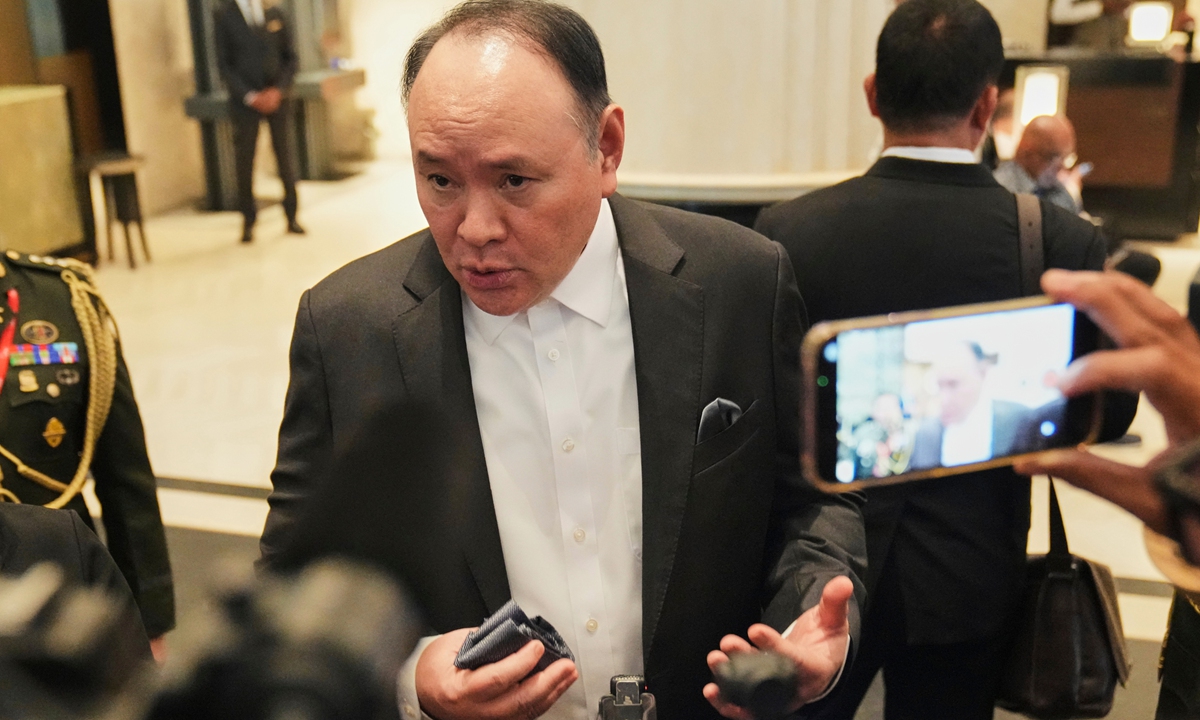
Philippine's Defense Secretary Gilberto Teodoro talks to the media as he attends the Shangri-La Dialogue, Asia's annual defense and security forum, in Singapore on May 29, 2026. Photo: VCG
On Friday, a Philippine vessel deliberately provoked China near Xianbin Jiao in China's Nansha Islands, cutting diagonally across the bow of the China Coast Guard (CCG) vessel and causing a collision. Judging from the disparity in strength between the two sides, as well as basic morality and rules, Manila's actions were simply "illogical." Why, then, does it repeatedly bring trouble upon itself? Beyond seeking to play the role of a "victim" before the international community, other factors may also be at work - including the personal interests of Philippine Defense Secretary Gilbert Teodoro.
Whether it is the reckless and dangerous ramming incidents in the South China Sea, the mass arrests of personnel at Chinese-invested steel plants on baseless charges, or collusion with "Taiwan independence" separatist forces to push for opening "representative offices" in the Philippines, Teodoro's fingerprints are all over them. In other words, Teodoro has moved from behind the scenes to center stage, eager to take the helm himself and orchestrate one provocation against China after another.
Why is Teodoro so zealous in pursuing an anti-China agenda? Beyond seeking to advance his family's business interests, there may be deeper and less savory incentives at play. On September 13, a Philippine senator publicly praised Teodoro for his "brilliant mind" and even floated the idea of a "President Gilbert Teodoro." Teodoro, for his part, accepted the praise with a seemingly "flattered" smile. This shameless political double act sheds new light on many of the Philippines' seemingly "illogical" moves.
Teodoro, who has little to show in terms of personal achievement, has hardly enjoyed a smooth political career. He suffered a crushing defeat in the 2010 presidential election and also failed in his bid for the Senate in the 2022 elections. His personal support in opinion polls remains at around 6 percent. With conventional channels for political advancement seemingly closed to him, it is hardly surprising that he would seek to cultivate an image of a "strongman" by playing up the "China threat."
Teodoro is also using the opportunity to build political capital for a potential presidential bid. Repeatedly invoking the so-called "China threat," he has pushed for deeper defense cooperation between the Philippines and countries outside the region. The Philippine military's relationships with external forces are deeply intertwined, and as defense secretary, Teodoro sits at a key node in this network of interests. The more tense the regional situation becomes, the more power and resources Teodoro can potentially wield. Put bluntly, peace is Teodoro's biggest obstacle, while conflict is his most lucrative business. In recent days, Teodoro has grown increasingly provocative toward China. Some analysts believe there may be an underlying attempt to drive a wedge in China-US relations. According to the consensus reached during US President Donald Trump's visit to China in May 2026, President Xi Jinping will pay a state visit to the US this autumn.
If Teodoro assumes that, amid high-level China-US exchanges, China would choose to "play it down" in response to Philippine provocations, then he has badly miscalculated. No matter when or where, China's position on its sovereignty over the South China Sea remains unchanged. Any attempt by the Philippines to cross the red line will only hit a hard rock. Whether by distorting facts or playing the victim abroad, Manila's anti-China politicians cannot change reality - only further expose their opportunistic nature to the international community.
It must be especially warned that the Taiwan question lies at the very core of China's core interests. Any attempt to skirt the red line on the Taiwan question will deliver a disruptive blow to China-Philippines relations. In pursuit of attention and external backing, Teodoro has shown a willingness to take risks on issues touching upon China's sovereignty and territorial integrity. Trying to link the South China Sea issue with the Taiwan question and openly challenge the one-China principle is nothing short of playing with fire. Should conflict ignite, Teodoro and even the Philippines as a whole will inevitably get burned.
Putting all the pieces together, the essence is clear: Teodoro is a political gambler who treats anti-China rhetoric as chips, the future of his country as a stake, and regional peace as a steppingstone. His constant agitation is not driven by any real threat to the Philippines' security, but by personal political interests that require the manufacturing of an enemy. He claims to be "defending the Philippines," but what he truly cares about are his own votes and money. He represents the kind of politician who survives in times of peace by creating crises, and in times of crisis by trading away national credibility for personal gain.
Teodoro may think he has calculated everything, but he has overlooked a basic truth: a pawn is ultimately just a pawn. What the Philippines truly needs is not a so-called "strongman" who drags the nation onto a war chariot and even pushes it toward the abyss of confrontation. Rather, it needs rational and capable leaders who seek good-neighborly relations and put development and people's livelihoods first. Teodoro's political gamble is destined to go nowhere, yet it is the Filipino people who should never have to foot the bill.
RELATED ARTICLES