Adopting NATO’s yardstick, Japan’s defense budget hike casts uncertainty over national trajectory
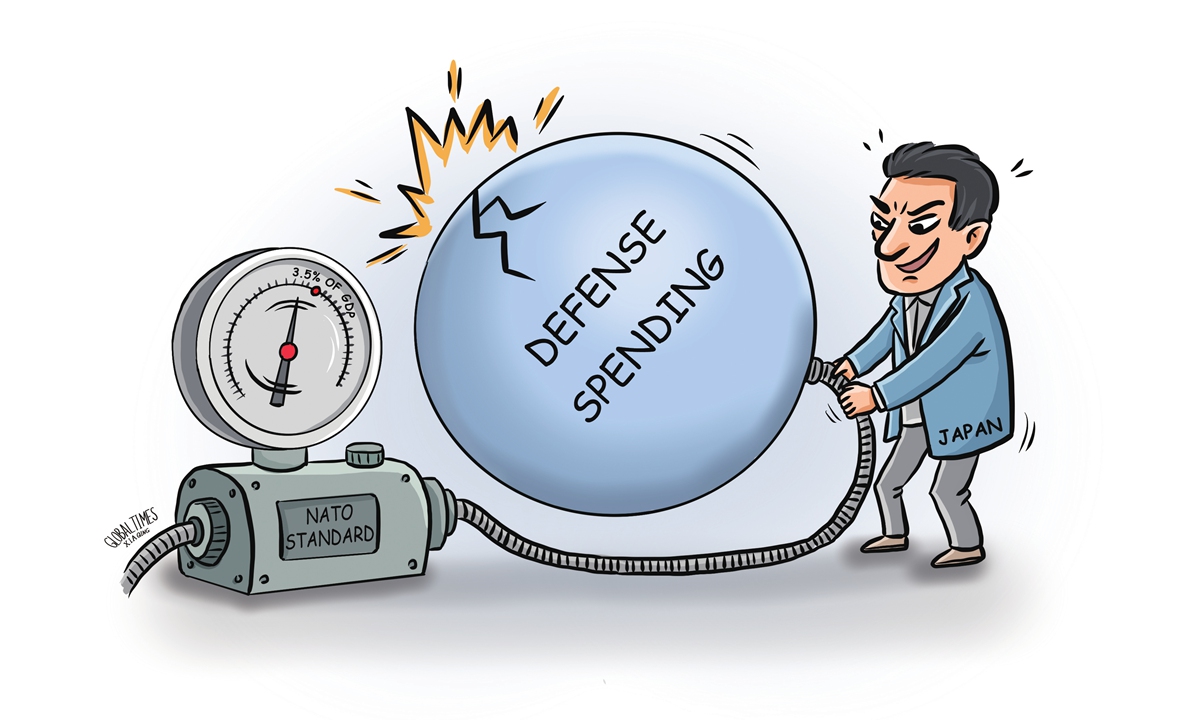
Japan, Nato Illustration: Xia Qing/GT
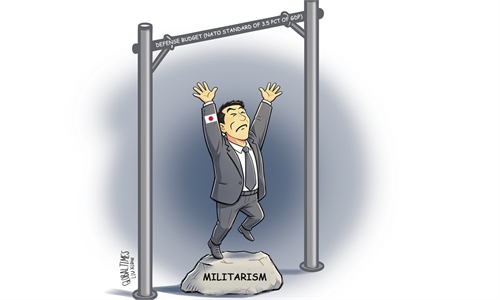
The Japanese government is reportedly considering a new mid-term defense spending target of 3.5 percent of GDP in line with NATO and other US allies. Japan's defense ministry denied that Japan had ever expressed such an intention to the US, claiming that its defense buildup is based on Japan's own independent judgment. However, people familiar with the matter revealed that some Japanese officials privately indicated that if the target were made public, they would deny its existence. The official denial therefore appeared more like a preemptive strategy than a clarification of the facts.
Markets reacted sharply. The yield on 10-year Japanese government bonds reached its highest level since 1996, while the yen temporarily weakened to 155.24 against the US dollar and defense stocks rose against the broader market trend. The market reaction suggested that investors did not accept the official denial. In light of Japan's continued military buildup in recent years, such reports did not come out of nowhere, but rather represented a logical extension of Japan's pursuit of becoming a major military power.
Since the end of WWII, Japan's defense spending had long been kept below 1 percent of GDP. In December 2022, the Kishida administration adopted three key security documents and decided to raise the ratio to 2 percent by 2027, a move widely regarded as a major shift in Japan's postwar defense policy. After Sanae Takaichi came to power, the process has been accelerated even further.
Based on Japan's defense spending of 11 trillion yen ($70 billion) in 2026 and an estimated GDP of 690 trillion yen, defense spending would account for approximately 1.6 percent of GDP this year. If Japan raises defense spending to 2 percent of GDP in the current fiscal year, the defense budget would need to increase by approximately 2.8 trillion yen. Raising it to 3.5 percent would require a much more substantial increase.
As early as June 2025, NATO held its Hague Summit, where members discussed targets for increasing military spending. The US had long urged its NATO allies to increase defense spending. The Trump administration publicly called for NATO countries to raise defense spending to at least 5 percent of GDP, and NATO members subsequently set phased targets through consultations.
The US has also pressured Japan to increase its defense spending. During then US president Joe Biden's visit to Japan in May 2022, the two countries issued a joint statement supporting Japan's increased defense spending and emphasizing the enhancement of its "defense capabilities" and "capabilities to counter missile threats."
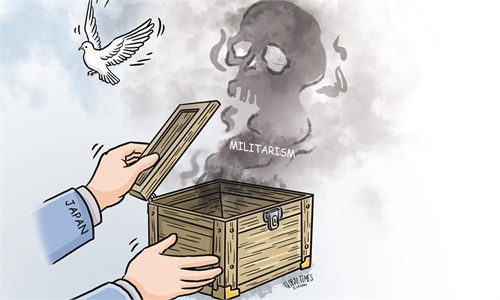
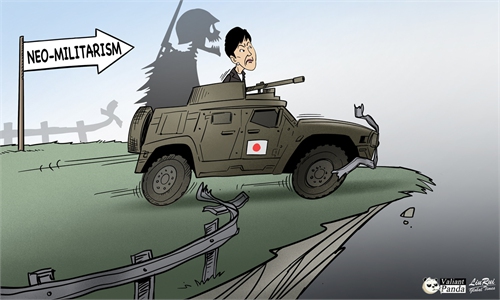
Japan's postwar practice of keeping defense spending below 1 percent of GDP represented an institutional constraint against becoming a major military power. Moving from 1 percent to 2 percent sends a signal that Japan seeks to bring its defense capabilities in line with the minimum level of its allies. A further increase to 3.5 percent would mean moving toward the core NATO standard and taking a major step toward becoming a military power.
For Japan today, raising defense spending to 3.5 percent of GDP would still present significant difficulties. The first question is where the funding would come from. The defense industry would also need to be adjusted to align with national defense policy, while industrial policy itself would have to be recalibrated.
Massive defense spending would profoundly reshape Japan's national security trajectory. Japan is currently adjusting its industrial policies with the aim of becoming a major producer and exporter of weapons, while also making large-scale purchases of US weaponry. Given its economic strength, continued military expansion could significantly unlock Japan's military potential and alter the balance of military power in the region.
What is particularly alarming is that Japan's rationale for increasing defense spending has consistently revolved around the alleged "threats" posed by Russia, China and North Korea. The Russia-Ukraine conflict and the situation in the Taiwan Straits, in particular, have repeatedly been invoked as justifications for military buildup. The "exclusively defense-oriented policy" has in practice been increasingly hollowed out, while the Japanese government continues to insist that possessing "counterstrike capabilities" does not alter that policy. This continuing divergence between rhetoric and action is itself a policy signal that warrants attention.
Under the pretext of "in line with NATO allies," pursuing a defense-spending ratio of 3.5 percent of GDP would break through the constraints of Japan's long-standing exclusively defense-oriented policy and push its security policy further toward unilateral militarization. Behind this lies a miscalculation of the regional security environment and growing reliance on military expansion as a strategic path. Simply benchmarking itself against external military alliances could leave Japan's Asia-Pacific strategy and national trajectory facing greater uncertainty.
The author is director and professor of the Center for Japanese Studies at Shanghai International Studies University. opinion@globaltimes.com.cn
RELATED ARTICLES