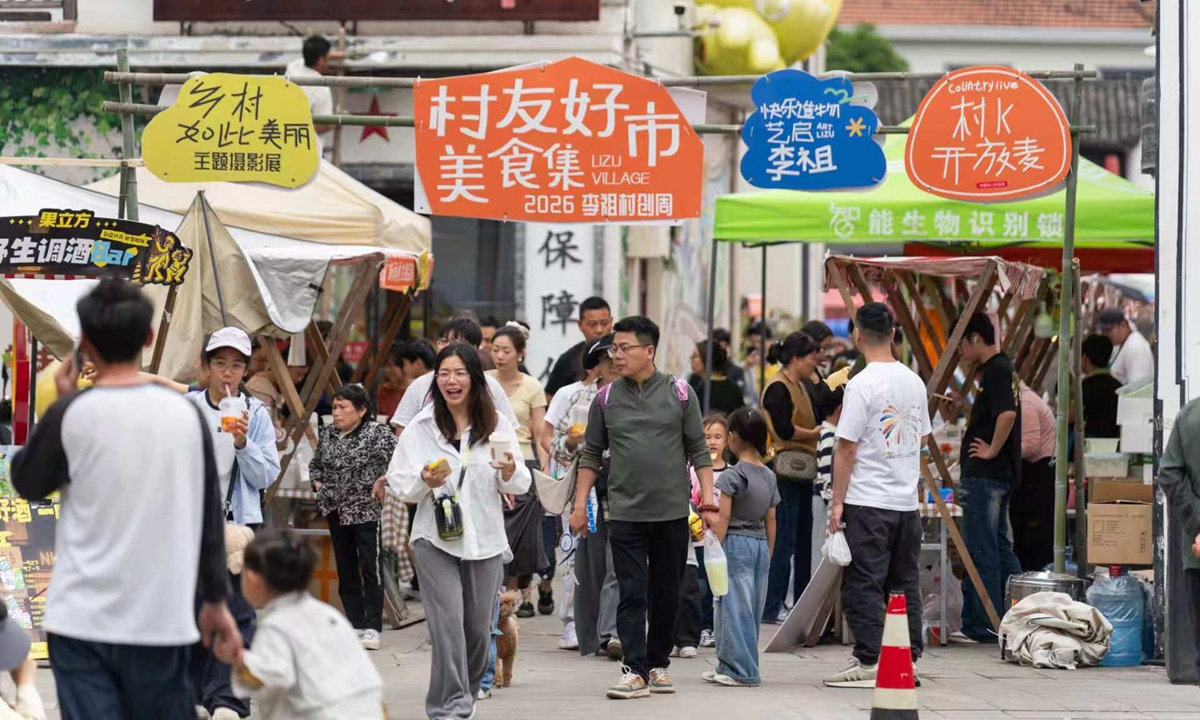
Visitors browse a local market in Lizu Village, Yiwu, Zhejiang Province, on May 2, 2026. Photo: VCG
Editor's Note:
China's rural revitalization is often discussed in policies and statistics. But what does it truly look like on the ground, especially in the eyes of foreign visitors? In this "Village Walk" series, the Global Times invites foreign visitors who have explored China's villages firsthand to share their stories. Through their perspectives, we capture the quiet transformations, the rich and vibrant local cultures, the sustainable development of rural industries, and the vitality among rural communities. This is the ninth installment of the series.
I was fortunate to be part of a delegation from the Centre for Africa-China Studies at the University of Johannesburg in South Africa that recently visited East China's Zhejiang Province. Our team had the opportunity to tour different places around the province, including the China-Africa Building, the Lizu village, the International Trade City in Yiwu, the breathtaking Wuzhou Ancient City and Buddha Pagoda, as well as the China-Africa Agricultural Science and Technology Innovation Park in Jinhua.
All these places offered us a profound glimpse into the Chinese history, culture and spirit. We left with a better understanding of where China is coming from and where it is headed. For me, Lizu village stands as an example of China's successful innovation in social governance which continues to play an important role in the country's modernization journey.
As our bus navigated its way into the village, what we saw defied our expectations of what a village should be. The roads were impeccable, the walking pavements were intact and clean, and the residents were warm and welcoming.
We learned from our tour guide that the village's history stretches back 500 years. The fact that it is still standing today is a testament to the resilience of its people and the effective governance of the government. The village has become a hub of thriving entrepreneurship, housing a wide range of businesses that have attracted scores of young people.
We saw a café that sources its coffee beans from Uganda, along with a sugar shop, a linen and cotton shop, and a tie-dye shop, among others, all run by energetic and enthusiastic entrepreneurs, both young and old. Our guide showed us a 100-year-old building that stands next to the aptly named Common Prosperity Square surrounded by various businesses.
The village has more than 70 shops and has become a tourist destination, attracting 1 million visitors annually. The story of Lizu is the story of China's successful modernization of social governance. The transformation began in 2003 when Zhejiang launched the "Thousand Villages Demonstration and Ten Thousand Villages Renovation" project. One of the most interesting institutional innovations in China's rural governance system was the introduction of the position of the Village CEO in 2019 as part of the country's rural revitalization efforts.
Supported by county governments and township officials, the Village CEOs have become a key component in rural modernization, overseeing spatial regulation, negotiating land-lease contracts and expediting benefit-sharing with the village collective committees. This initiative is an interesting way of reconciling the imperative of rural revitalization and development with the evolving governance landscape. Lizu village has benefited immensely from these policy reforms.
In the quest to promote human rights and the right to development, modernizing social governance is not an option; it is a necessity. China's journey in the modernization of social governance carries important lessons for Africa and the world as a path toward realizing the right to development.
In much of Africa, villages remain places frozen in time, serving as a painful reminder of a colonial past where colonial governments treated villages and development as two mutually exclusive propositions. Lizu village offers a guiding example of a comprehensive modernization process that does not just end in the urban areas but encompasses the rural areas as well.
The author is a postdoctoral research fellow at the Centre for Africa-China Studies, University of Johannesburg. opinion@globaltimes.com.cn
RELATED ARTICLES