A job well done: China and the US collaborate on the repatriation of cultural artifacts
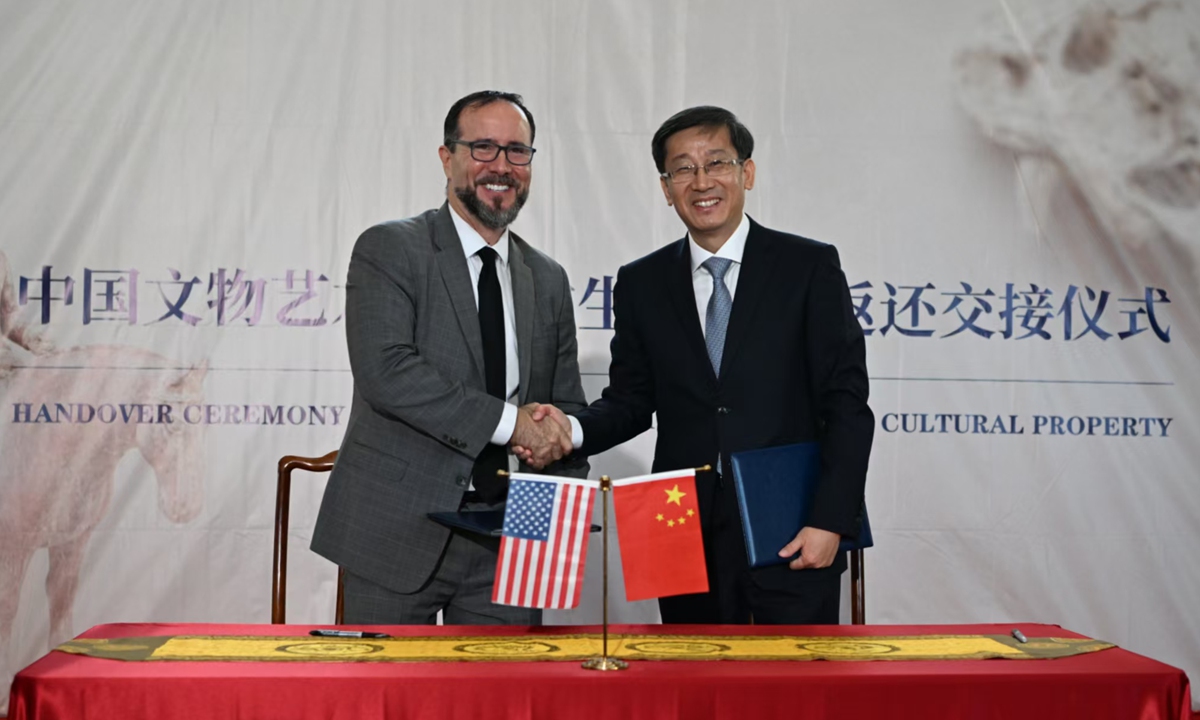
Photo: National Cultural Heritage Administration
After the return ceremonies in Washington and New York on Wednesday and Thursday local time, 64 Chinese cultural relics and paleontological fossils were handed over to China's National Cultural Heritage Administration (NCHA) by the US side. This returning batch comprises a wide array of precious and historically significant artifacts, including the torso of a bodhisattva statue from the Tianlongshan Grottoes, ancient sculptures, as well as dinosaur skeleton and egg fossils. All of these items were seized by US law enforcement agencies during their operations, and their successful return was achieved through close collaboration between the NCHA, Chinese diplomatic and consular missions in the US and relevant US authorities.Over the 17 years since China and the US signed their memorandum of understanding, the US side has returned over 20 batches totaling more than 700 pieces of cultural artifacts and artwork to China. From the national treasure Zidanku Silk Manuscripts, which had been illegally taken overseas for 79 years, to the return of various relics this time, as one treasure after another makes the long journey back home across the seas, China-US collaboration on the repatriation of cultural artifacts has delivered substantive outcomes.
The recovery of lost cultural relics is a global challenge. Once lost cultural artifacts enter the overseas auction market, they become entangled in complex property law barriers. By advancing artifact recovery through bilateral agreements, China and the US have forged an effective path forward. On January 14, 2009, China and the US signed their first intergovernmental memorandum of understanding on preventing the illegal entry of Chinese cultural relics into the US. Its core mechanism was straightforward: addressing each other's core aspirations in cultural heritage protection through institutionalized agreements, thereby building a "firewall" against the cross-border trafficking of illicit cultural relics. This precious commitment has been renewed three times - in 2014, 2019, and 2024 - transforming transnational artifact recovery, which is typically fraught with gaming and wrangling, into routinized, standardized, and pragmatic law enforcement cooperation. This has laid a profound foundation for deepening people-to-people and cultural cooperation between the two countries, while setting a positive example for the international community.
This also proves that as long as both sides maintain mutual respect, they can accomplish more major, practical, and positive things. Over these 17 years, China-US bilateral relations have experienced ups and downs and faced numerous variables, yet this cooperative channel for cultural property recovery has remained consistently open and has never stalled. Facts have proven that while China-US relations contain aspects of division and rivalry, differences should not become a reason for confrontation, and win-win cooperation remains the only correct choice for both sides. The increasingly mature cooperation on artifact returns serves as a vivid epitome of how China and the US have implemented the consensus reached by their heads of state, transcended differences, and engaged in pragmatic collaboration.
Looking ahead, hopefully the two countries will continue to deepen high-level consensus, refine implementation measures, broaden the horizons of cultural cooperation, and consolidate the foundation of mutual trust. Through broader and deeper cooperation, they can accumulate the depth of mutual learning among civilizations, nourish the fertile soil of bilateral friendship, and allow pragmatic collaboration to grow into a towering tree that supports the steady and sustained advancement of China-US relations.
RELATED ARTICLES