The Philippines stages provocations against China – what business does it have to do with Japan?: Global Times editorial
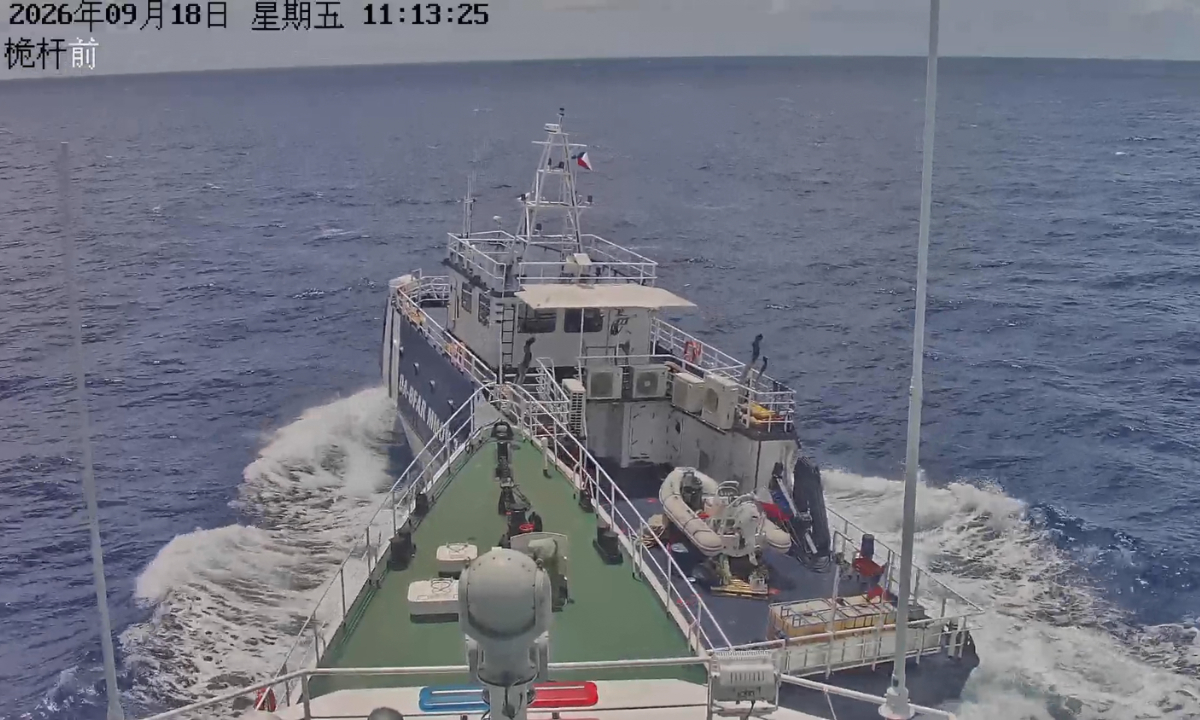
A Philippine vessel deliberately cuts across the path of the Chinese coast guard vessel Sanzhou'ao, causing a collision on September 18, 2026.
Japan's support for the Philippines has completely exposed its strategic intent to contain China, its ambition to break free from the constraints of its pacifist Constitution and its role as a regional "proxy" serving the US-Japan alliance. The South China Sea is not a "testing ground" for Japan's military expansion, nor will the countries surrounding the waters ever allow the region to become a breakthrough point for reviving Japan's old militarist dreams.Following the provocations and deliberate ramming of a Chinese coast guard ship by an official vessel from the Philippines in the waters near Xianbin Jiao on Friday, a bizarre supporter of Manila actually chimed in. The Japanese Embassy in the Philippines swiftly posted on social media to express "serious concern" over China's "dangerous actions," while hypocritically promoting its adherence to the "rule of law" and opposing "any action which increases tensions." This statement completely disregarded the facts, turned right and wrong upside down, and once again revealed to the world that a large portion of the murky waters in the South China Sea are stirred up by external countries.
Xianbin Jiao is an inherent territory of China's Nansha Qundao, and China holds indisputable sovereignty over it and its adjacent waters. Chinese coast guard vessels carrying out rights-protection and law-enforcement activities in waters under China's jurisdiction are entirely justified and lawful. The Philippines engineered a deliberate and violent collision, with ironclad evidence, clear facts, and unambiguous responsibility. Yet Japan, an external party, couldn't wait to back up the Philippine side, using the pretext of the "rule of law" as a fig leaf. Such "enthusiasm" is truly suspicious.
In fact, Japan is a classic example of the thief crying "stop thief." In exacerbating and escalating tensions in the South China Sea, Japan is guilty of at least "three major sins": assisting the US in making waves, emboldening Philippine provocations, and colluding with the Democratic Progressive Party authorities on the island of Taiwan to interlink the issues of the South and East China Seas with the Taiwan question. Japan has systematically infiltrated the Philippines through military empowerment, providing Manila with secondhand warships and reconnaissance equipment - nearly all of the main vessels frequently used by the Philippine Coast Guard in the South China Sea come from Japan. It is Japan that has given the Philippines the illusion of having a "backer" and sent the wrong signal that it condones the Philippines' arbitrary and reckless behavior in the South China Sea.
Have Japanese diplomats in the Philippines suffered from sudden amnesia? Following World War II, according to international legal documents such as the Cairo Declaration and the Potsdam Proclamation, the Chinese territory stolen by Japan, including the South China Sea islands, had already been legally and factually returned to China. Today, as a country systematically breaking through the constraints of its pacifist Constitution and massively expanding its offensive military capabilities, what position can Japan claim to be a "guardian of the rule of law"?
Japan's support has exposed its true nature. First, it has exposed Japan's strategic intent to contain China. The South China Sea is a core interest of China and the shared home of regional countries. By "backing" the Philippines and strengthening military cooperation, Tokyo's underlying objective is to push Manila to the front lines of confrontation and turn the South China Sea into a forward position for containing Beijing. Japan's peddling of military equipment to the Philippines is by no means an act of "charity." Rather, it is a geopolitical maneuver aimed at winning over the Philippines' support and joining forces to contain China, and it carries strong expansionist overtones.
Second, it has exposed Japan's ambition to break free from the constraints of its pacifist Constitution. Through a series of agreements with the Philippines, Japan is planning to ship lethal weaponry to areas surrounding the South China Sea and extend the operational radius of its Self-Defense Forces deep into the South China Sea, effectively treating the region as a "training ground" for its remilitarization. These moves have long overstepped the boundaries of "exclusively defense-oriented" policy. In truth, the neo-militarism attempts of Japan's right-wing government require continued tension in the South China Sea, persistent provocations by the Philippines, and the framing of China as an "external threat" to provide raw material for this narrative.
Third, it has exposed Japan's role as a regional "proxy" serving the US-Japan alliance. Japan's increased military support for the Philippines is, at its core, a move to align with the US "Indo-Pacific Strategy" and act as a vanguard. It seeks to leverage US backing to boost its own influence while also seeking geopolitical gains by stirring tensions in the South China Sea.
However, this "proxy" role will push both Japan and the wider region toward the dangerous precipice of escalating confrontation. Scholars from Indonesia, Singapore and other countries have already voiced concerns: Japan-Philippines military cooperation, operating outside ASEAN mechanisms, will erode the bloc's centrality and undermine its unity. It is evident that Japan's actions in the South China Sea are unwelcome among regional countries; for Manila to tie itself to the chariot of Japan's neo-militarism is akin to asking a tiger for its skin.
The South China Sea is not a "testing ground" for Japan's military expansion, nor will the countries surrounding the waters ever allow the region to become a breakthrough point for reviving Japan's old militarist dreams. We urge the Japanese side to face the facts and immediately cease meddling in South China Sea affairs or undermining regional stability in any form. China will continue to firmly safeguard its national territorial sovereignty and maritime rights and interests, ensuring that no external forces succeed in disrupting peace and tranquility in the South China Sea.
RELATED ARTICLES