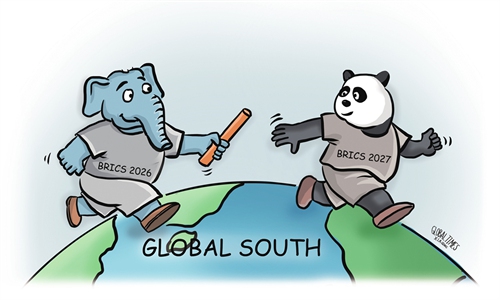
China-India cooperation Illustration: Xia Qing/GT
Over the past two years, there have been clear signs of a thaw in China-India relations, with positive signals steadily accumulating. But its pace and extent remain insufficient to meet the needs of economic development in both countries and the changing international environment. It is understood that after a prolonged period of strained relations, a slow process of rebuilding trust is needed in restoring the foundations for cooperation for a sustained détente.
Leader-level engagement can provide direction when bureaucracies remain trapped by accumulated distrust. The New Delhi summit marked the third meeting between the heads of state of China and India in three years. Guided by the understandings reached at their sideline meeting during the BRICS Summit in Kazan in October 2024, exchanges between the two countries resumed comprehensively at various levels and across different working departments. Both leaders met at the Shanghai Cooperation Organisation Summit in Tianjin in August, 2025, providing more opportunities for concrete moves on resetting ties. These positive developments have created relatively favorable conditions for a meeting between the two leaders on the sidelines of the BRICS Summit this September.
The experience of 2018 shows why summit diplomacy works. Following the Doklam standoff in 2017, bilateral relations went through a difficult period. Ultimately, the two leaders overcame the obstacles and met on the sidelines of the BRICS Summit in Xiamen in September that year, setting in motion a process of improving bilateral relations. What's important is that it was followed by four more rounds of direct interactions between the heads of state of China and India in 2018, including April in Wuhan, June in Qingdao, July in Johannesburg and November in Argentina. Four meetings within a single year helped chart a course for China-India relations at the time and contributed to a relatively rapid improvement in bilateral ties.
Experiences show that such diplomacy always works, but it requires political determination and forceful implementation of consensus. The central question is no longer whether China and India can resume dialogue. They already have. The question is whether both sides can use the current momentum to realize sustained implementation of agreements, further restoration of economic exchanges, greater predictability for businesses, continued management of the border dispute and regular high-level communication.
In international relations, the significance of leaders' meetings goes beyond face-to-face communication. The consensus reached, trust built and a series of policies subsequently implemented can work together to advance bilateral cooperation. In order to create favorable atmosphere for the leaders' meeting in New Delhi, both sides were acting. For example, in March 2026, India approved a policy change and allowed companies with Chinese ownership of up to 10 percent to invest in India through the automatic route. While the ceiling remains strictly capped at 10 percent and Chinese investors and businesses remain highly cautious about resuming large-scale investment in India, the signal itself is positive.
On August 1, the two sides officially resumed operations at border trade routes, including Nathu La Pass. On August 25, the 25th Round of Talks Between the Special Representatives of China and India on the Boundary Question was held in Beijing. The two sides reached further understandings on continuing to place the boundary question in its appropriate position within bilateral relations and on working to bring China-India relations back onto a healthy and stable track.
The meeting between the two countries' leaders in New Delhi is therefore more than just another bilateral encounter on the sidelines of a multilateral summit. It could become the next political marker in their continuous efforts to pull bilateral relations out of the shadow of the 2020 crisis. In particular, the four observations on promoting the steady and sustained development of China-India relations made by the Chinese leader and the favorable public perceptions of the bilateral relations received in both countries indicate the importance of direct interaction between leaders in calibrating the direction of bilateral ties, thus "starting afresh to making further improvements."
Next year will be China's BRICS chairmanship and it will effectively extend the current momentum of summit diplomacy when both sides have promised mutual support to each other. BRICS has thus developed into a platform for cooperation among Global South countries and China-India dialogue and cooperation within the BRICS framework will help enhance mutual trust through practical cooperation and lay a foundation for faster and more substantive development of bilateral relations.
The author is an associate professor at the Institute of International Studies, Fudan University. opinion@globaltimes.com.cn
RELATED ARTICLES