GT on the spot: From cattle to embroidery, how Ningxia turns local crafts into growth engines

A mountain in Xingsheng township, Guyuan, Northwest China's Ningxia Hui Autonomous Region Photo: VCG
At a cattle-breeding park in Xingsheng township, Guyuan, Northwest China's Ningxia Hui Autonomous Region, local yellow cattle, black cattle and imported Simmental cattle were leisurely walking around their pens on Monday morning.
Standing nearby, a local villager surnamed Yu was doing the math. The 50 cattle he is raising at the park are expected to bring him 100,000 yuan ($13,900) in income this year, more than he earned in 2025.
In the past, local farmers like Yu mostly raised cattle independently on their own land. Once the cattle were ready for sale, they were often sold directly to middlemen, leaving farmers with little room to negotiate prices and thin profit margins.
That began to change with the development of the Fujian-Ningxia cooperation program, under which a standardized breeding park with 12 cattle sheds was built locally. The facility has helped reduce the high costs and lack of standardization associated with individual farming, while also generating annual income for the village collective, with farmers receiving dividends.
An even bigger shift came after the local beef industry expanded further down the value chain.
Through a glass window, workers in dust-proof clothing and caps could be seen carefully cutting and vacuum-packing fresh beef at an agricultural and animal husbandry technology company's processing workshop.
Different cuts of beef are processed into products tailored to different consumer needs, adding value beyond simply selling live cattle.
"In the past, we just sold cattle. Now, we want to maximize the value of every animal," the company's general manager Guo Fangfang told the Global Times.
To fetch higher prices for beef, the company has to keep innovating in response to market demand. "When customers wanted chilled beef, we invited experts from an agricultural research institute to develop preservation technologies. When they wanted standardized beef brisket cuts, we developed uniform specifications," she said.
The approach has paid off. Guo said the company's revenue grew from more than 8 million yuan in 2023 to 40 million yuan in 2025. Its products have also moved beyond Ningxia and are now sold in major cities, including Beijing and Shanghai.
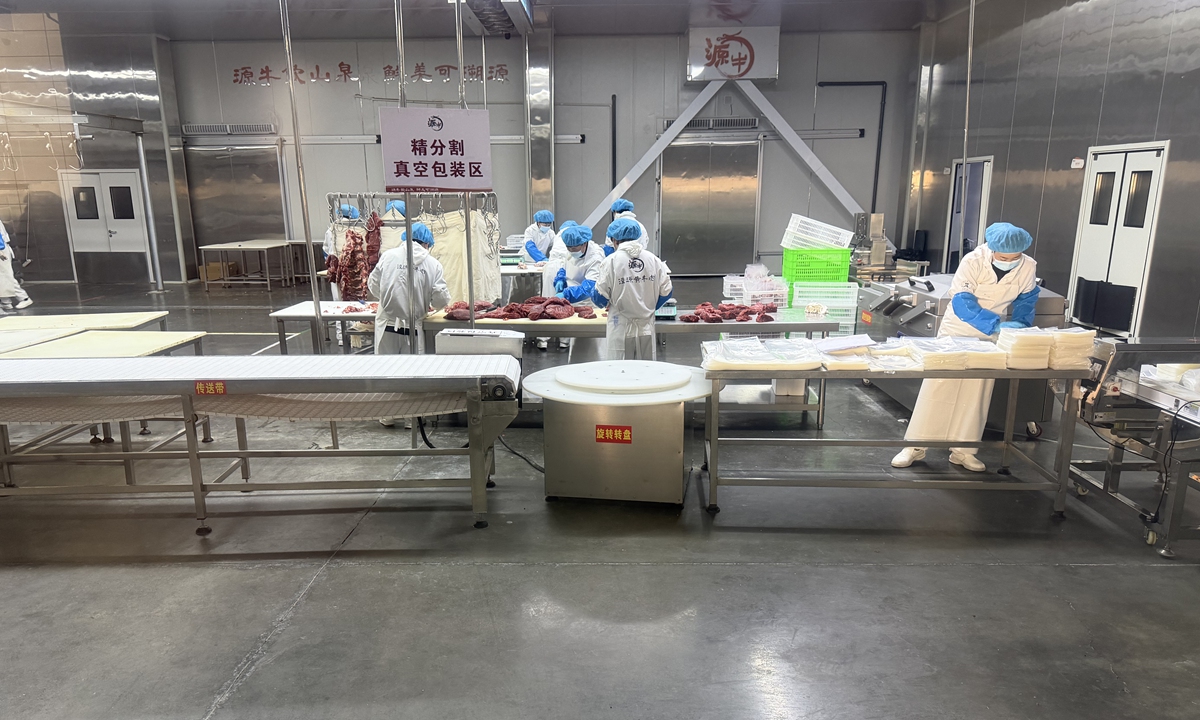
Workers in dust-proof clothing and caps cut and vacuum-pack fresh beef at an agricultural and animal husbandry technology company's processing workshop in Guyuan, Northwest China's Ningxia Hui Autonomous Region. Photo: Chen Zishuai/GT
As the industry chain expanded, farmers' returns have increased, with local processors now paying about 2 yuan per kilogram above market prices for cattle, local authorities said. In 2025, Guyuan had 1.112 million cattle and 40 beef-cutting centers, while the "Guyuan Yellow Cattle" and "Jingyuan Beef" geographical indications gained wider recognition.
Thanks to innovations in business models and digitalization, many local industries are undergoing upgrades.
At the Sihan Duixiu embroidery studio in Guyuan, embroiderers were livestreaming from their phones, showcasing traditional Duixiu works, cloth tigers and other cultural products featuring local intangible cultural heritage. On the other side of the screen, customers from Russia, the Middle East, Europe and the US were discovering the livestreams on RedNote and Taobao, placing orders directly and even requesting customized products.
Gao Guangjuan, founder of the Sihan Duixiu Culture Innovation and Development Company, told the Global Times that she learned the traditional craft from her parents-in-law. When she started the business in 2009, she had just three sewing machines and three embroiderers. The company now generates an annual output value of around 27 million yuan.
At major international exhibitions, including the China-Arab States Expo and the Shanghai Cultural Fair, overseas customers have shown strong interest in the products, reinforcing the company's confidence in expanding internationally, Gao said.
As the industry has grown, the "fingertip economy" has also provided new momentum for rural revitalization. Gao said local embroiderers can take raw materials home and work there, allowing them to earn an income while caring for children and elderly family members.
One illiterate woman in her 60s has even become a Duixiu embroidery instructor thanks to her skills, earning more than 4,000 yuan a month, Gao said.
The company now operates 12 community-based handicraft workshops and 22 studios combining intangible cultural heritage with tourism, and has trained more than 4,000 embroiderers.
Behind the expansion of such grassroots industries is growing policy support for skilled rural artisans and craft leaders. In recent years, Ningxia has provided funding, policy support and skill training to artisans who can pass on traditional skills while creating jobs. A nationally recognized rural artisan master studio or training center that creates jobs for at least 15 people from formerly impoverished or monitored households can receive a one-off subsidy of 300,000 yuan, while those helping such workers pass on skills and secure stable employment for at least six months can receive 5,000 yuan per person, People's Daily Online reported.
The result is a broader shift in how local resources are being used. In Guyuan, traditional crafts and agricultural products are no longer simply local specialties; they are being turned into businesses, expanded into longer value chains and, increasingly, translated into tangible gains for ordinary villagers.
RELATED ARTICLES