IN-DEPTH / IN-DEPTH
Immersive red culture experience at Loushan Pass helps the Long March spirit resonate across borders
Walking into History
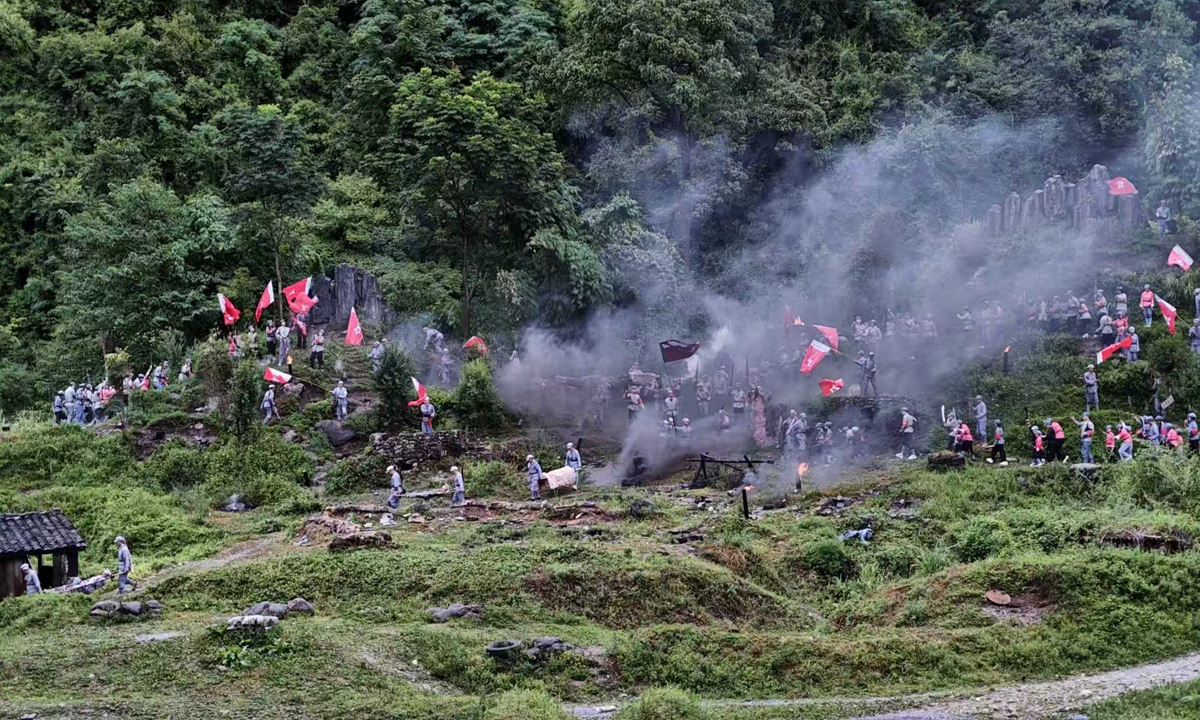
Actors and visitors perform in the immersive live-action production Victory at Loushan Pass at the foot of Loushan Pass in Huichuan District, Zunyi, Southwest China's Guizhou Province. Photos: VCG, Courtesy of Huichuan District Culture and Tourism Bureau
The first simulated gunshot cracked across a misty valley in northern Guizhou Province. Russian traveler Renata instinctively ducked.
Around her, smoke rose through the mountain air as shouted commands, explosions and the sound of running feet turned a steep path into a scene from a battle fought more than nine decades ago.
Renata was not watching from a theater seat. Alongside Chinese visitors and other overseas content creators, she was moving up the rocky trail at Loushanguan, or Loushan Pass, carrying a prop rifle and taking part in an uphill "charge." The blasts were controlled and the fighting was staged, but the mountain beneath her feet was the terrain on which the real battle unfolded in 1935.
"Everything felt so real," she later told the Global Times. Having traveled widely, she described it as one of the most striking and unusual experiences she had encountered.
The experience is part of an immersive live-action production titled Victory at Loushan Pass. Built around the natural topography of the pass, it combines reconstructed trenches and battlefield positions with dramatic performance, special effects and direct visitor participation.
Instead of standing outside the story, visitors join a pre-battle mobilization, help move simulated supplies and follow the action up the mountain.
Loushan Pass, in Huichuan District of Zunyi, Southwest China's Guizhou Province, occupies an important place in the history of the Long March. In February 1935, the Red Army fought for the pass in a key engagement of the Zunyi Campaign. The victory, achieved after the Zunyi Conference, is widely remembered as the Red Army's first major victory since the start of the Long March and as a turning point that helped reverse a difficult military situation.
The year 2026 marks the 90th anniversary of the victory of the Long March. The anniversary has brought renewed attention to how the history is remembered and passed on, especially among young people who increasingly encounter the past through short videos, travel and interactive cultural products rather than through books and exhibition panels alone.
Loushan Pass has long drawn visitors seeking sites associated with the revolutionary history of the Communist Party of China.
A 2025 Financial Times report on China's "red tourism" described visitors of different generations traveling to Loushan Pass and other sites around Zunyi, calling the pass the scene of the Red Army's first significant victory during the Long March. The newer immersive production has added another layer to that established memorial landscape: People do not merely hear about the route taken by the soldiers; they also climb part of it.
Why has a mountain pass nestled deep in the mountains of northern Guizhou prompted people of different nationalities and cultural backgrounds to "step into history"? How can red culture move from being taught to being experienced?
To explore these questions, the Global Times spoke with interviewees offering different perspectives. Their accounts show how this historic revolutionary landmark is finding new forms of expression that are taking the Long March spirit beyond China's borders and resonating with audiences worldwide.
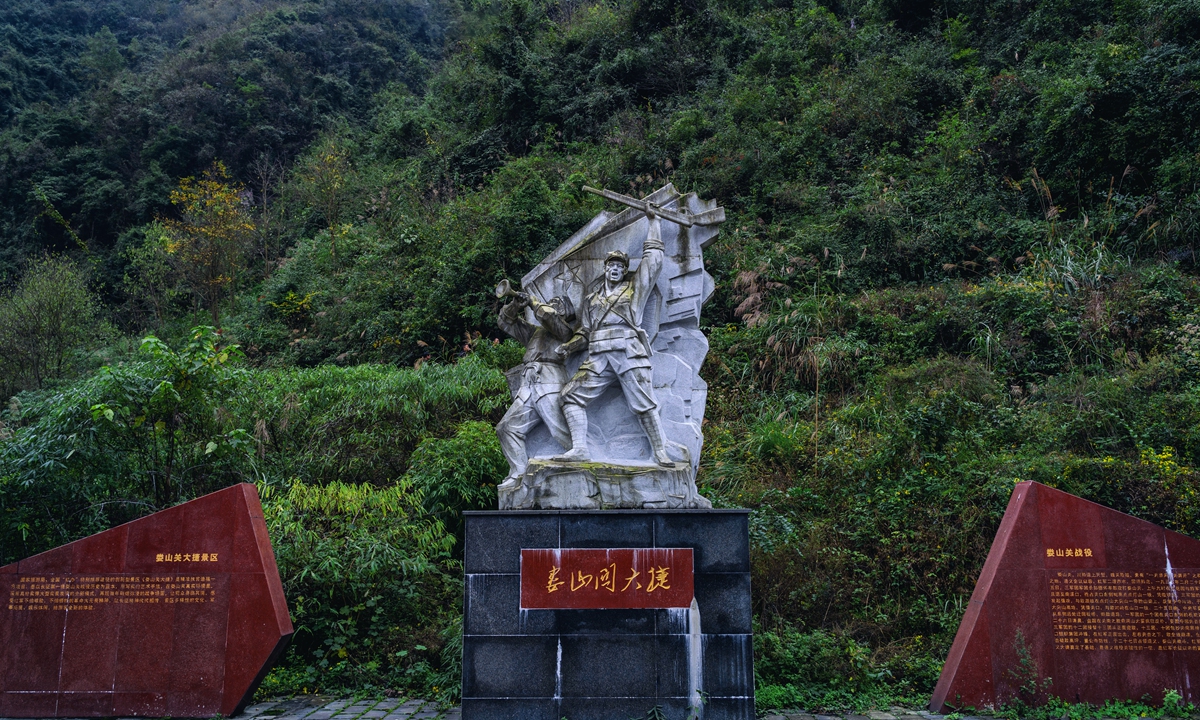
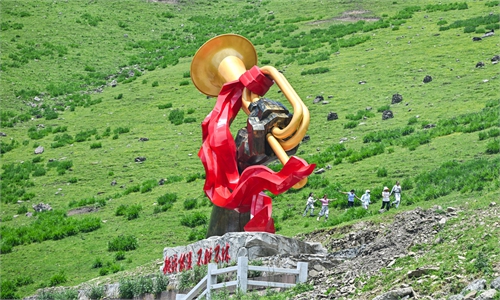
A sculpture commemorating the victory at Loushan Pass
When history becomes participatory
At Loushan Pass, the answer begins with the landscape. The production is staged outdoors, using the slopes and paths around the historical area rather than separating the story from its setting. Trenches and field fortifications have been reconstructed at full scale. Actors, controlled pyrotechnics and a scripted sequence lead participants through moments of preparation, transportation and battle.
The design changes the visitor's physical relationship with the past. A museum visitor may pause before a document, photograph or artifact. Here, participants listen for instructions, carry objects, move with a group and feel the strain of the climb. The production does not reproduce the danger of combat, but it uses movement, sound and collective participation to give historical information a bodily dimension.
Renata first came across videos of the experience on Instagram while traveling in Chongqing. The footage and its online popularity convinced her to make a separate trip to Zunyi. She had expected an unusual attraction; she did not expect the emotional journey that followed.
"Previously, visiting memorial halls or history museums meant looking at history through text and glass and passively receiving information," she said. "But at Loushan Pass, due to the vast mountain scenery, realistic artillery effects and a fast-paced battle plot, I experienced a rollercoaster of emotions. I went from nervous excitement to tearful sadness."
She said the warmth of the staff and other participants also mattered. It placed ordinary human contact alongside a heavy historical subject, making the episode feel less remote. The people around her were not simply an audience assembled for the same show; during the performance, they became a temporary group moving through the same sequence together.
Before the visit, Renata said she and many of her foreign friends knew little about either the Battle of Loushan Pass or the wider history of the Long March. Material on Chinese revolutionary history available on overseas social platforms was limited, she said, and what she did encounter often struggled to hold the attention of younger users.
After the experience, she began searching for historical material on the 1935 battle.
"I came to understand the significance of the campaign, as well as the Red Army's original aspiration and sense of responsibility in pressing forward from a desperate situation," she said. "Although my Chinese is limited, it did not stop me from being moved. The Red Army's fearlessness in the face of sacrifice and its unyielding resilience are precious qualities to which all humanity can relate."
Her visit did not end when the performance was over. Renata posted videos and practical travel information across social platforms. One post drew millions of views, and its comment section became a place where overseas users, history enthusiasts and scholars discussed the Long March.
Many young foreign viewers contacted her directly, asking for more details, wanting to experience the production for themselves. A growing number of overseas users were visiting Loushan Pass and voluntarily sharing their own understanding of China's revolutionary culture, Renata said.
The offline audience has grown as well. Zhu Jingbo, Party chief and director of the Huichuan District Culture and Tourism Bureau, told the Global Times that Victory at Loushan Pass was staged 129 times in the first half of 2026, with more than 1,000 visitors taking part in the immersive experience each day on average.
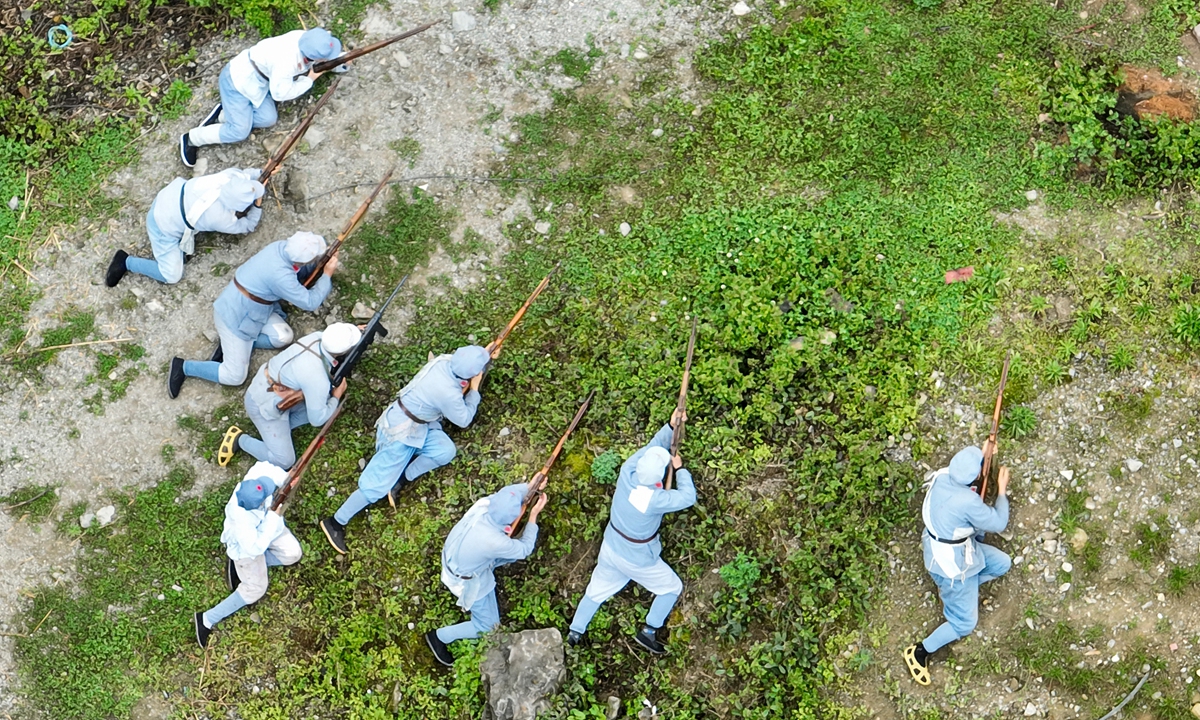
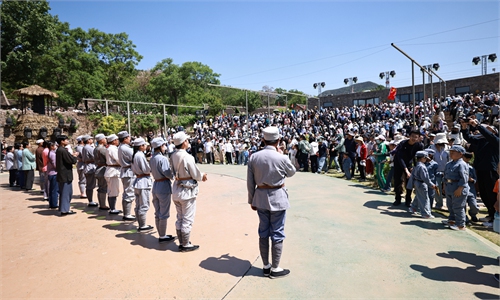
Actors and visitors perform in the immersive live-action production Victory at Loushan Pass at the foot of Loushan Pass in Huichuan District, Zunyi, Southwest China's Guizhou Province. Photos: VCG, Courtesy of Huichuan District Culture and Tourism Bureau
"We developed the immersive project because we did not want 'red history' to remain only in books and on exhibition boards, or the Long March spirit to become an empty slogan," Zhu said.
The production is one expression of a wider "red tourism plus" approach in Zunyi: Revolutionary heritage is connected with live performance, study tours, outdoor experiences, and other local cultural and tourism resources.
Its effect can be seen in Renata's own account. The explosions and movement first captured her attention; the questions raised by the experience then sent her back to historical records. The spectacle brought her to the mountain, but the context determined what she took away.
'Emotional awakening'
Zhu said staff working on the frontline of local tourism had noticed a change among international visitors. In earlier years, some arrived mainly out of curiosity or as part of a broader trip through Guizhou and knew little about the Long March. Now, he said, more overseas young people, scholars and military history enthusiasts are coming specifically to the site with questions already in mind.
Their accounts also widen the range of voices through which the story travels. When a foreign visitor explains the experience in another language and through the details that most affected them, the result does not read like a translated brochure. It begins with an individual encounter: a gunshot, a steep path, a moment of fear or the decision to look up what happened after returning to a hotel room.
Zhu said such accounts can help make Loushan Pass a window through which overseas audiences approach China's revolutionary history and the experience of struggle that shaped the country's later development.
Sun Jiashan, a research fellow from the Department of Chinese Culture Teaching and Research at the Central Institute of Socialism, described the project's popularity as a structural change in the way "red tourism" constructs a narrative.
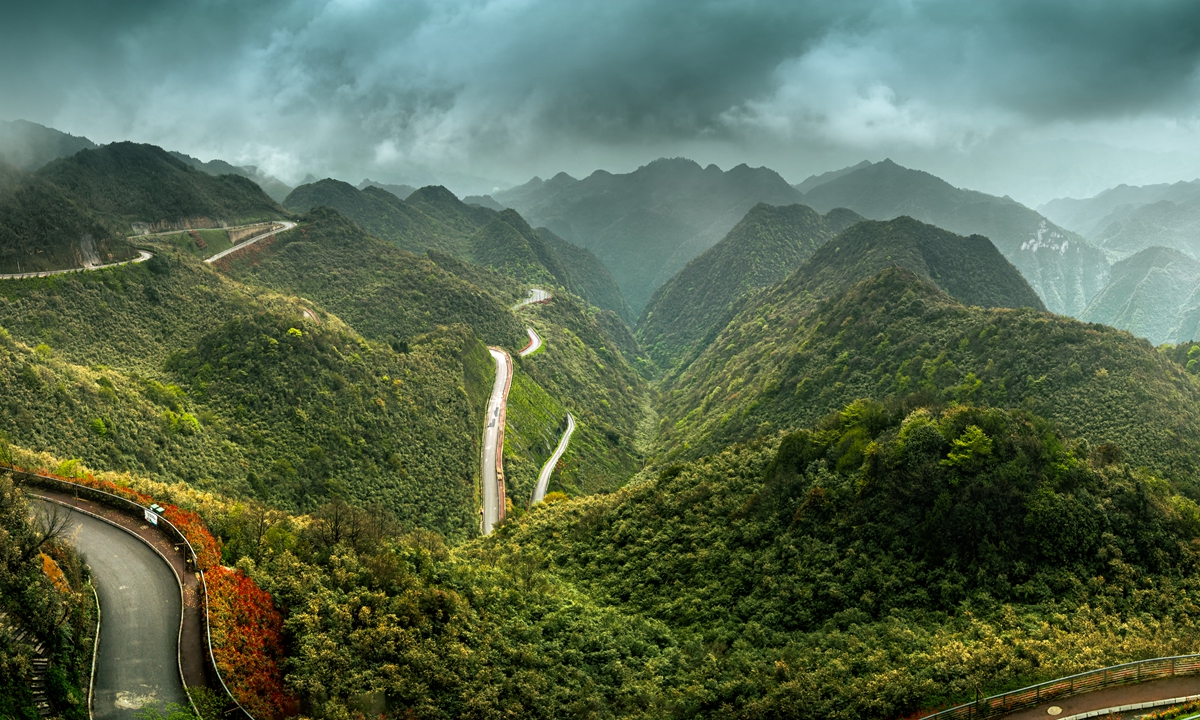
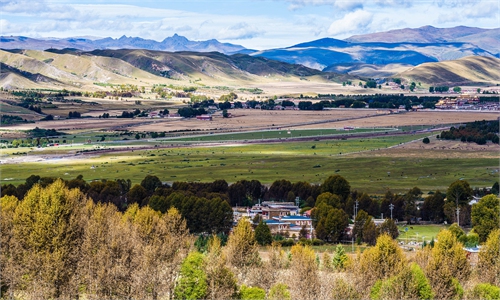
A view of Loushan Pass in Huichuan District of Zunyi, Southwest China's Guizhou Province
"Members of today's Generation Z tend to seek 'experiential identification,'" Sun told the Global Times. "The Loushan Pass model of 'real setting, interaction and plot' turns an abstract red narrative into a tangible scene in which people can participate. It transforms the Long March spirit from 'history that is told' into 'memory that is experienced,' reducing the instinctive distance that some overseas visitors may feel."Sun's assessment also points to a two-part task. Historical explanation supplies names, dates and consequences, while participation provides a point of emotional entry. At Loushan Pass, the performance, the historical landscape and the visitor's later research form successive parts of the same encounter.
Sun also pointed to the particular influence of personal storytelling. Because the storytellers are not merely repeating a prepared description, their accounts can carry a form of third-party credibility among their own audiences.
The values conveyed through those accounts - courage, resilience and the ability to keep moving in an apparently desperate situation - are not dependent on a visitor already knowing the full political and military history, Sun said.
"This shift from 'cognitive persuasion' to 'emotional awakening' is the key to the cross-cultural communication of the Long March spirit," he said.
From being 'seen' to being 'recognized'
The growing attention has also produced measurable benefits for the area. In the first half of 2026, the Loushan Pass scenic area received 209,700 visits and generated 16.93 million yuan ($252,775) in tourism revenue, an increase of 9.47 percent year-on-year, according to Zhu. The figures point to the economic role the heritage site now plays in the mountainous district.
Huichuan District now plans to make its red tourism products more appealing to young people, more accessible to international visitors and more sustainable as regular tourism offerings. Zhu said the district would further integrate the revolutionary resources of Loushan Pass with Hailongtun Fortress and the ecological landscapes and folk culture of northern Guizhou, while continuing to refine its immersive "red tourism plus" products.
But difficulties persist. Sun noted that many overseas visitors still lack the historical background needed to understand the site; immersive tourism products are difficult to standardize or reproduce without losing their connection to place; and the pursuit of online traffic may hollow out the values a project is meant to communicate.
"Only by continuously improving the international translation of historical context, raising professional standards in red tourism and holding fast to the core values of revolutionary culture can red tourism move internationally from being 'seen' to being 'understood' and 'recognized,'" Sun said.
That balance is visible in Renata's own journey. An Instagram video first brought her from Chongqing to Loushan Pass; the simulated battle then sent her searching for the history of the real one. Her video and travel guide are now drawing the attention of viewers who may have otherwise never heard the name Loushan Pass - including some already asking how to make the journey themselves.
RELATED ARTICLES