By 'showing presence' in Taiwan Straits, New Zealand's warships are playing with fire
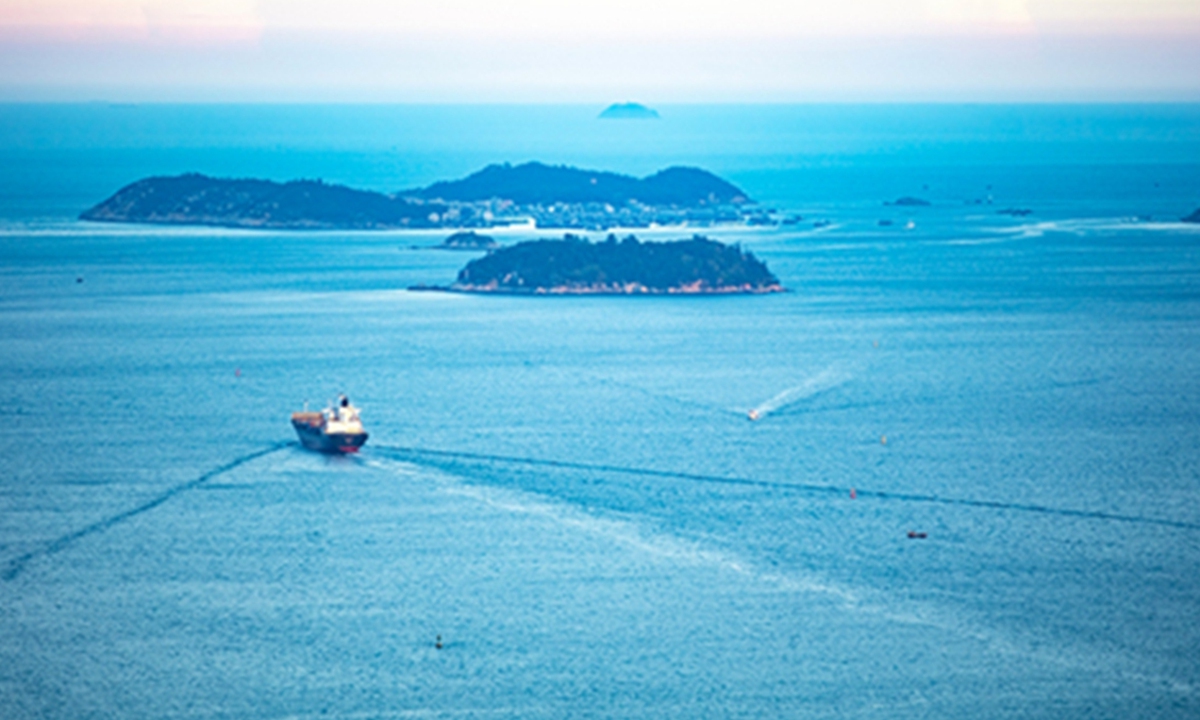
A view of the Taiwan Straits is seen from Xiamen port in East China's Fujian Province. File photo: IC
A spokesperson for the New Zealand Defence Force acknowledged on Monday that the naval frigate HMNZS Te Mana and the replenishment ship HMNZS Aotearoa recently sailed through the Taiwan Straits as part of a three-month deployment to the "Indo-Pacific" region. New Zealand attempted to defend the move by claiming it was conducted "under international law" and that it was "in international waters." Judging by New Zealand's recent performance on China-related issues, it is acting far beyond its bounds.There is no such thing as "international waters" in the Taiwan Straits, let alone a "showcase" for anyone's warships. The fact that New Zealand dispatched two naval vessels to the Straits to "show presence" is, in essence, playing with fire on issues concerning China's core interests and attempting to pledge loyalty to certain external powers. The same pattern is evident in South Pacific affairs: New Zealand recently incited Pacific Island countries to point fingers at China's routine missile test, and even signaled readiness to allow the Democratic Progressive Party authorities on the island of Taiwan to pay another visit to the host country during the upcoming Pacific Islands Forum. Fortunately, Pacific Island nations refuse to let another country define what constitutes a threat or security for them, leaving New Zealand stranded.
To be frank, putting these two New Zealand warships in the Taiwan Straits barely makes a ripple. The Aotearoa is already the largest vessel in the New Zealand Navy, with a full-load displacement of 26,000 tons and built by South Korea on commission. In the face of China's People's Liberation Army Navy, it hardly possesses any capital to flex its muscles. When these two warships transited the Taiwan Straits on Friday, the PLA tracked and monitored the vessels throughout their passage.
After the two vessels' transit, New Zealand Prime Minister Christopher Luxon said he was not expecting any backlash from China, the country's largest trading partner. The subtext of this remark is not that New Zealand is ignorant of the immense benefits bilateral trade brings, nor that it fails to grasp the weight of the Taiwan question, but rather that it assumes China will not take genuine countermeasures over it. Viewed this way, New Zealand is not lacking in awareness; instead, it is mistaking politeness for luck and treating goodwill as a gamble. New Zealand now needs to ponder a fundamental question: Does it want to be China's partner in cooperation, or a pawn for others in containing China? If it chooses the former, it should demonstrate respect and action; if it chooses the latter, it should not blame the Chinese side for pulling its punches.
History has repeatedly proven that those who play with fire on the Taiwan question will ultimately reap what they sow. China's resolve to safeguard its national sovereignty and territorial integrity is as steadfast as a monolith, and any attempt to test red lines through military posturing is doomed to failure. Hopefully, New Zealand will carefully weigh its own weight, refrain from actions that are neither graceful nor wise, and stop acting out until it is rebuffed by the Chinese side.
RELATED ARTICLES