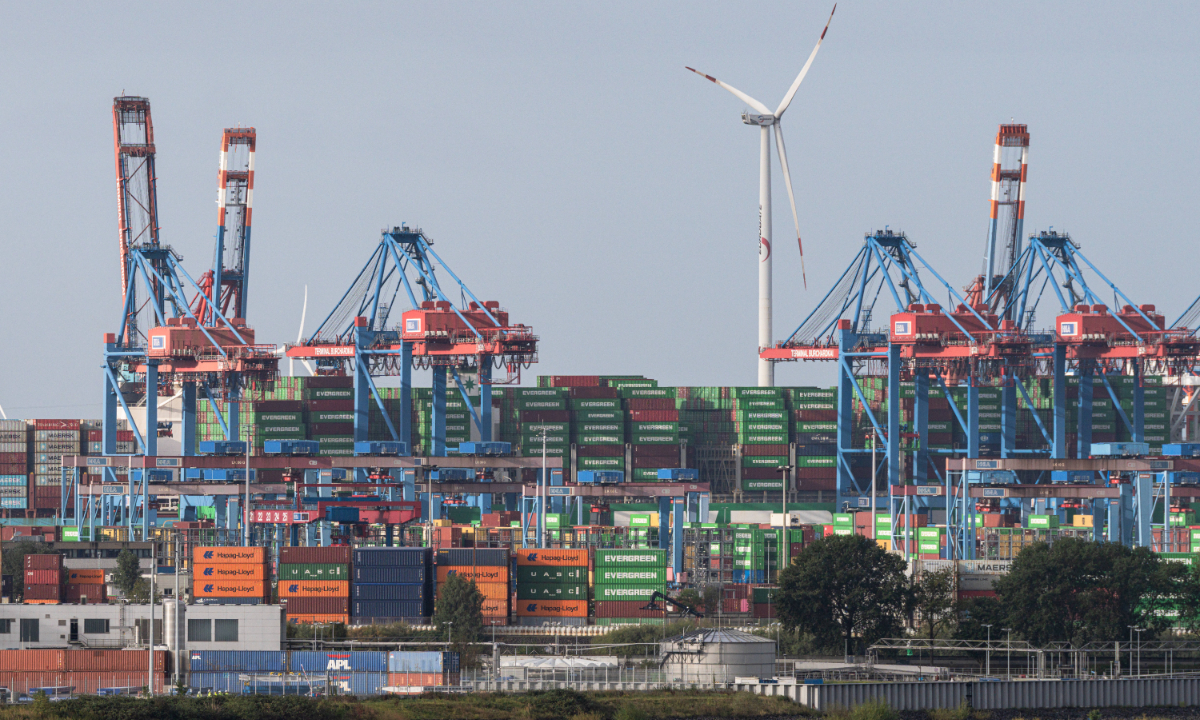
Container cranes, shipping containers and wind turbines at the HHLA Container Terminal Tollerort in Hamburg, Germany Photo: VCG
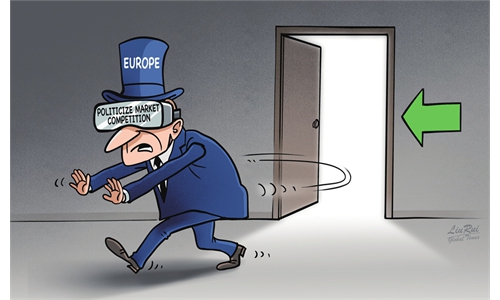
European Union (EU) think tanks have been amplifying the “China shock 2.0” narrative this year, portraying normal shifts in global trade and industrial competition as Chinese “overcapacity” in an effort to rally international opinion against China. At its core, the narrative blames China for problems rooted in Europe’s own declining industrial competitiveness – industrial hollowing-out, rising unemployment and shrinking export – to justify tougher trade restrictions against China.
Rooted in zero-sum thinking, the narrative looks abroad for answers to problems at home. It underscores the EU’s tendency to politicize economic and trade issues, frame them as security threats and turn them into weapons. This approach will do nothing to address Europe’s development challenges and only deepen its competitive decline.
Innovation drives China’s edge
China’s rapid progress in strategic and emerging industries, including new energy and artificial intelligence (AI), has eroded the monopoly advantages long enjoyed by developed Western economies. Some Western governments and think tanks have accused China of “industrial subsidies,” “overcapacity” and “unfair competition.” Such claims deliberately ignore a basic fact: China’s growing industrial competitiveness is built on sustained investment in innovation.
According to China’s National Bureau of Statistics and the Organization for Economic Co-operation and Development, China’s research and development spending rose from 0.9 percent of GDP in 2000 to 2.8 percent in 2025 – a gain of 1.9 percentage points. Over the same period, the EU’s R&D spending edged up from 1.8 percent to 2.2 percent, an increase of just 0.4 percentage points. The 3 percent target set in the Europe 2020 strategy has remained an unfulfilled promise.
Take the solar industry as an example. Through sustained technological innovation, China has gradually overcome bottlenecks in silicon purification, large-format wafers and other key technologies, building a complete solar manufacturing supply chain. Large-scale production has spread R&D costs across greater output, spurring further technological advances.
According to the International Renewable Energy Agency, the global levelized cost of solar photovoltaic electricity has fallen by more than 80 percent over the past decade. Economies of scale and technological advances across China’s integrated supply chain have been central to reducing the cost of the global green transition.
In new-energy vehicles (NEVs) and power batteries, Chinese companies continue to make breakthroughs in cathode materials, battery management systems and fast charging. Power battery energy density has risen by more than 50 percent since 2018, while production costs have fallen by more than 60 percent, laying a solid foundation for the NEV industry’s growth.
Automakers continually feed extensive road-test data and insights from real-world vehicle use back into R&D, developing distinctive technological advantages. While meeting demand at home, they are also building factories in Hungary, Thailand, Indonesia, Brazil and other countries, helping these economies expand new-energy production capacity and upgrade their industries.
Europe’s problems start at home
European think tanks claim that Europe, particularly Germany, is being hit by Chinese competition in global markets for cars, machinery, chemicals, aviation and clean-energy equipment. Yet the underlying problems are clear. Europe has been slow to upgrade its traditional industries and has fallen behind in emerging technologies such as new energy and AI. Geopolitical conflicts have driven up energy costs, while barriers within its own internal market have further weakened competitiveness.
High energy costs weigh heavily on Europe’s competitiveness. At a recent French business conference in 2026, European Commission President Ursula von der Leyen acknowledged that energy prices in Europe were two to three times those in the US or China.
According to a report from the International Energy Agency, electricity prices for energy-intensive industries in the EU averaged $107 per megawatt-hour in 2025. Despite falling 33 percent from their 2022 peak, they remained more than double the US industrial electricity price of $50 and roughly 50 percent above China’s $68.
These persistently high prices continue to undermine Europe’s competitiveness in manufacturing solar panels, wind turbines, batteries and electrolyzers. Together with high labor and raw material costs, they make European products 30–60 percent more expensive to produce than their Chinese counterparts.
Europe’s slow embrace of emerging industries and extensive restrictions have also held back industrial transformation. The EU has long prioritized regulation over development in new technologies, placing excessive emphasis on safety at the expense of innovation.
In AI, for example, the EU classifies autonomous driving and intelligent industrial systems as high-risk, requiring risk assessments at every stage, technical explainability and full data traceability. The threat of steep penalties leaves companies far less room to experiment. In the NEV sector, stringent rules on battery life-cycle carbon accounting, battery passports and supply-chain due diligence significantly extend the time needed to develop and launch vehicles and establish supply chains.
Europe has strong foundations in green development and semiconductors. Yet stringent regulation imposed before technologies reach the market stifles innovation and slows commercialization. Together with fragmented markets and limited venture capital, this has prevented Europe from capitalizing on its early start, leaving it increasingly behind China and the US.
‘China shock’ distorts reality
First, advantages of a large domestic market should not be equated with unfair dumping of excess capacity. Global demand for solar power, energy storage and NEVs is driven by the need to tackle climate change, not by China alone. Chinese exports respond to demand from countries pursuing their green transitions, rather than simply offloading so-called excess capacity overseas.
Domestic demand has long been the main driver of economic growth, accounting for an average of 93 percent of growth from 2013 to 2024, with consumption emerging as the single largest contributor. China itself is the world's largest market for new-energy products.
Second, industrial policy is a standard tool for industrial upgrading, not a practice unique to China. The EU itself has introduced numerous industrial support programs, with subsidies of various kinds totaling more than 1.44 trillion euros between 2021 and 2030. The US CHIPS and Science Act and Inflation Reduction Act likewise provide hundreds of billions of dollars in industrial subsidies.
By the same standards the EU uses to accuse China of distorting markets through subsidies, its own large-scale industrial support policies, along with those of the US, could also be labeled unfair competition. Applying different standards depending on the country in question exposes the political nature of the narrative, rather than an objective economic assessment.
Third, the narrative reflects a Cold War-era, zero-sum mindset. It overlooks the economic interdependence built through more than five decades of China-EU cooperation and the contribution Chinese exports make to European industry, particularly its green transition and efforts to contain inflation. By sourcing components from China, European companies can lower production costs, manufacture higher-value finished products and strengthen their global competitiveness. The two economies are therefore more complementary than the narrative suggests.
While mainstream EU think tanks have amplified the alleged harm from “China shock 2.0,” some European business leaders and researchers have challenged the narrative that places the blame solely on China. Germany is often portrayed as its biggest victim, yet research by the Kiel Institute for the World Economy attributes roughly 69 percent of its loss of export market share in third-country markets to competition from exporters other than China.
The evidence repeatedly shows that China is not the main source of the challenges facing European industry. As trade frictions intensify, China and the EU need to make better use of their trade and investment consultation mechanism, relevant working groups and exchanges between think tanks. Stronger communication can help establish a clearer understanding of the facts, prevent divisive rhetoric from driving policy and keep differences manageable.
Both sides should give substance to their new positioning as each other's “key trading partners for stability and balance.” A stable China-EU economic relationship would benefit growth and public well-being on both sides while bringing greater stability to the global economy.
The authors are with the Chinese Academy of International Trade and Economic Cooperation under China’s Ministry of Commerce.
RELATED ARTICLES