Does China’s widening trade surplus ‘crowd out’ other countries?: Global Times editorial
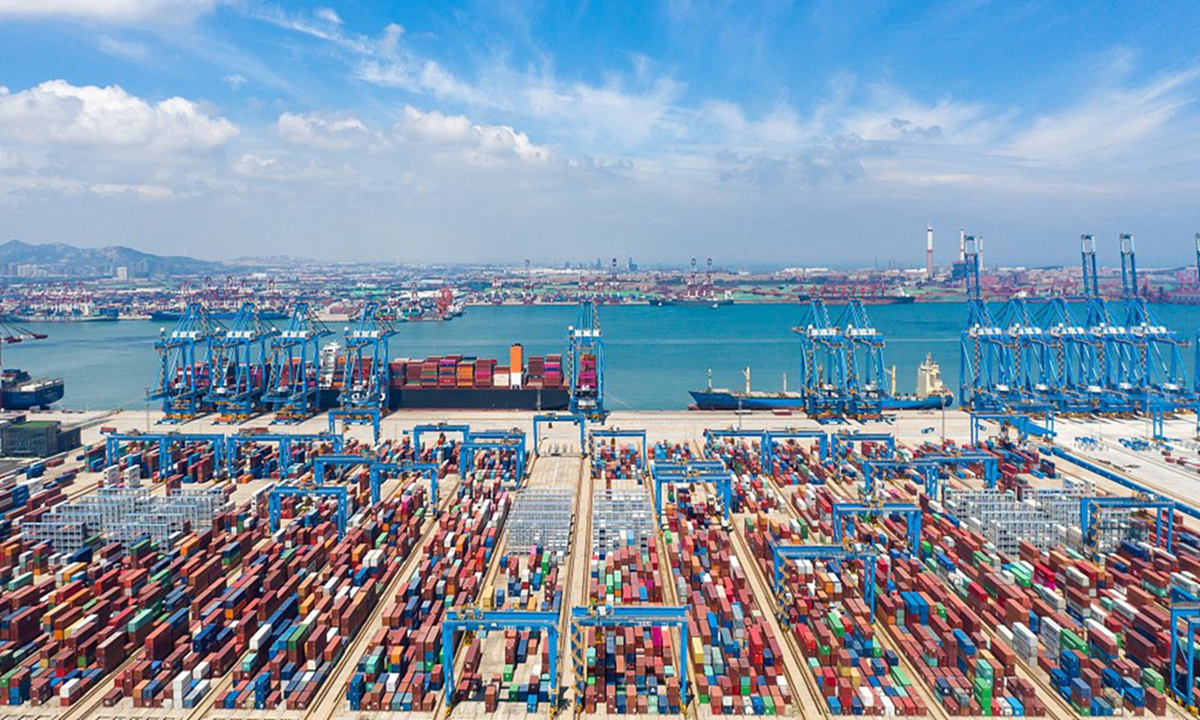
China trade economy File photo: VCG
Editor's Note:
Currently, China's economy is steadily advancing along the path of high-quality development, even as domestic and international circumstances become increasingly complex. Some Western media, due to misunderstanding or bias, have repeatedly questioned or even distorted China's economic development. Accordingly, the Global Times launches the "Q&A on China's Economy" column to publish opinion pieces to present facts and clarify perceptions.
Recently, China's customs authorities released August trade data, and many Western media outlets focused on the fact that "China's trade surplus exceeded $100 billion for the fourth consecutive month." Discussions over China's trade surplus have intensified in recent times. Michael Froman, former US trade representative and current president of the Council on Foreign Relations, recently wrote that China's trade surplus continues to expand, stating that "the world's ability to absorb Chinese overcapacity is approaching a breaking point," and went on to assert that this will lead to a global economic crisis.
It's true that China has a massive trade surplus, and certain groups feel anxious about this. For example, the competitive advantage China has gained through its comprehensive industrial chain has subjected domestic industries in the US and Europe to fierce market competition, naturally giving rise to a sense of crisis in related sectors. In some developing countries, there are concerns that the influx of Chinese goods will narrow their own path to industrialization. From a macroeconomic perspective, the academic community has long debated the issue of global current account imbalances. When global aggregate demand is weak, large trade surpluses tend to intensify market competition and fuel protectionist impulses among nations.
While these concerns are valid, the blame cannot be placed on China. The trade surplus is the result of the global division of labor and the combined effects of each country's savings and consumption patterns. It is not a goal that China has deliberately pursued. For many years, China has consistently expanded domestic demand, proactively increased imports, and actively promoted trade balance. The long-standing high consumption, low savings, and massive fiscal deficits in the US and Europe are themselves a major source of global imbalances, yet they are completely overlooked in these arguments. Moreover, the growing pains associated with the transition from old to new growth drivers are a challenge that all countries, including China, must face.
The fact that goods can be exported indicates that there are buyers in the international market. When a country produces more than it consumes domestically and meets the needs of other countries through trade, this is the foundation of the international division of labor. The sectors where China's exports grew rapidly in 2025 - including integrated circuits, machinery and equipment, and new energy vehicles - correspond to genuine new demand driven by the global energy transition and industrial upgrading, not arbitrarily excess capacity conjured out of thin air. They have enabled buyers in international markets to shift from "being unable to get the goods" to "being able to afford them," representing tangible incremental contributions to the world market.
The real issue lies in the fact that some are deliberately stoking and exploiting "surplus anxiety" over China, thereby politicizing and weaponizing this economic phenomenon and equating it with narratives such as the "China squeeze" and the "China shock." But the reality is this: Between 2012 and 2024, China exported over $30 billion in textile machinery to developing nations, helping some nations in Southeast and South Asia develop into major textile producers and exporters. China exports infrastructure, equipment, technology and investment to a wide range of developing countries, helping them improve infrastructure, foster domestic industries and pursue an industrialization path different from that of the West. If China's exports were truly "squeezing" other countries' manufacturing space, these facts would be impossible to explain.
Historically, trade surpluses have never been the "monopoly" of any single country, and no global economic crisis to date has been proven to have been triggered directly by trade surpluses themselves. Britain in the 19th century, the US in the 20th century, and Japan and Germany after World War II all maintained large trade surpluses for extended periods at different stages. Germany and Japan, for instance, at one point recorded current account surpluses exceeding 6 percent of GDP. The emergence of these surplus economies was, without exception, a result of shifts in the international division of labor during particular periods, rather than a harbinger of crisis. By contrast, history shows that attempts to "solve" trade surplus problems through tariff barriers and trade restrictions can intensify tensions in the global economy.
In fact, the concern that "the world's ability to absorb Chinese overcapacity is approaching a breaking point" points to a deeper problem: persistently weak global demand. The roots of this problem can be traced back to the 2008 global financial crisis. Lin Yifu, dean of the Institute of New Structural Economics at Peking University, recently pointed out that before the financial crisis, the growth rate of world trade was more than twice that of the global economy. After the crisis, global economic growth slowed, while trade growth fell below the pace of economic growth. The US, Europe, OECD economies and the global economy as a whole have all experienced prolonged weakness. Traditional industrial powers in the West have generally faced sluggish growth, industrial hollowing-out and imbalances in employment structures as manufacturing moved overseas. In other words, if the global demand "pie" is not big enough, it is not because China has taken a larger slice, but because something went wrong with the making of the entire "pie" after the financial crisis.
This also to some extent helps explain why the argument that China is the "source" of the next global crisis has gained traction among some in the US. In 2008, problems in the US housing market, coupled with the securitization of subprime mortgages, eventually led falling home prices to trigger a credit freeze and liquidity crunch, setting off a global financial crisis. American society has remained highly sensitive to how domestic imbalances in major economies can spill over into the rest of the world. Some have simply transplanted this logic onto China's manufacturing sector, drawing conclusions almost by reflex while overlooking the fundamental differences between the two economies in terms of their economic structures, growth drivers and development models.
Ultimately, whether the "next global economic crisis" feared by some US media outlets will materialize depends on whether the world's major economies can properly address industrial transformation, financial risks and insufficient demand. It also depends on whether the world can fend off the protectionist currents and continue to maintain openness and cooperation.
RELATED ARTICLES