COMMENTS / INSIDER'S EYE
As oil bills rise, why global co-op matters for India's clean energy transition
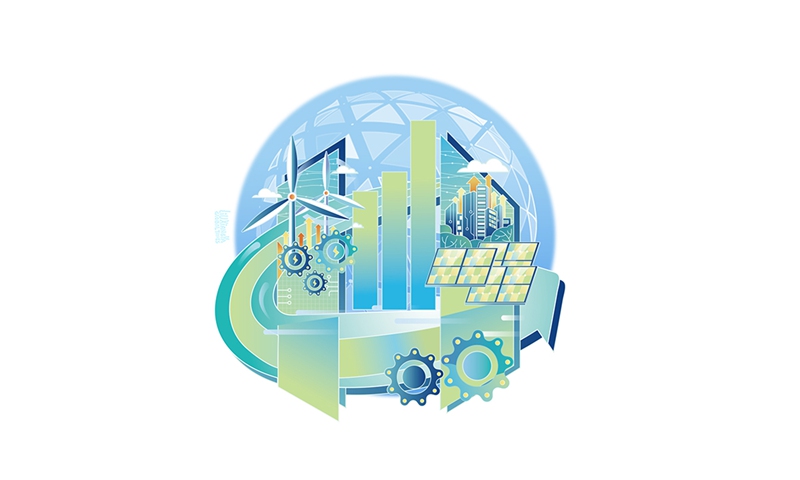
Global cooperation of clean energy Illustration: Liu Xiangya/GT
India is paying more for almost the same amount of imported oil. The Financial Express reported on Tuesday that while India's crude oil import volume fell 0.4 percent during the April-August period, the oil import bill surged 48.4 percent year-on-year to $74.8 billion as global oil prices remained elevated. The pressure was even greater in rupee terms, with import expenditure rising 62 percent.
What does this mean for India? One immediate concern is inflation. Anindya Banerjee, head of commodity and currency at Kotak Securities, said that crude oil staying above $100 per barrel could push India's retail inflation toward 6 percent by the next quarter, according to the Economic Times.
For many Indians, the impact of higher oil prices is felt not in the import bill, but in the rising cost of daily life.
This sensitivity to global oil prices partly reflects India's reliance on imported crude oil. Beyond this, as one of the world's fastest-growing economies, India's energy demand is likely to remain elevated as economic expansion continues, leaving the country more sensitive to fluctuations in global oil markets.
However, this sensitivity does not mean that the challenge cannot be managed. The more important question is how India can shift its energy mix while meeting the energy needs of a growing economy. Increasing the role of renewable energy could help India diversify its energy mix and strengthen its energy security.
India has already made progress in this direction. In recent years, the country has rapidly expanded its renewable energy capacity, particularly in solar power. Indian official data showed that the country achieved a total non-fossil capacity addition of 55.3 gigawatts during fiscal year 2025-26, reflecting the continued expansion of its energy transition.
Yet, the transition is not only about adding renewable capacity. It is also about building the capabilities needed to support a new energy system. On the supply side, expanding renewable power generation is only the first step. A more complete industrial chain - from raw materials and key components to manufacturing equipment - will be important, as the development of clean energy involves much more than final assembly.
On the demand side, the transition also depends on broader electrification across the economy. In areas such as transportation and industry, technologies including electric vehicles (EVs), batteries and charging infrastructure are likely to play a growing role. Moving toward a more diversified energy mix is therefore not only an energy challenge, but also a question of industrial capacity and supply chain development.
The transition involves complex supply chains, making it difficult for many economies to build every part of the ecosystem independently. Developing a resilient energy system requires industrial capabilities that take years to build, from technologies and manufacturing capacity to supply chains. For India, deepening integration into global supply chains can help accelerate the development of domestic capabilities, reduce the time needed to build new industries and strengthen energy security.
China has built considerable experience in several clean energy sectors, including solar and EV supply chains. With recent signs of greater economic engagement between China and India, clean energy deserves attention as an area where the two sides can achieve practical economic cooperation.
Such cooperation does not have to conflict with India's goal of building domestic manufacturing capacity. In many industries, stronger domestic manufacturing has developed alongside international supply chains, as access to competitive intermediate goods has helped local industries expand.
For India, the energy transition is not only about crude oil. However, the rise in global oil prices, along with the broader impact on the economy, should serve as a reminder of the importance and urgency of accelerating this transition. India has already made progress in clean energy development, and a more open environment for global cooperation would not come at the expense of domestic industries, but could help accelerate the process.
The author is a reporter with the Global Times. bizopinion@globaltimes.com.cn
RELATED ARTICLES