Takaichi’s open provocation further proves that the ‘enemy state clauses’ must not be removed
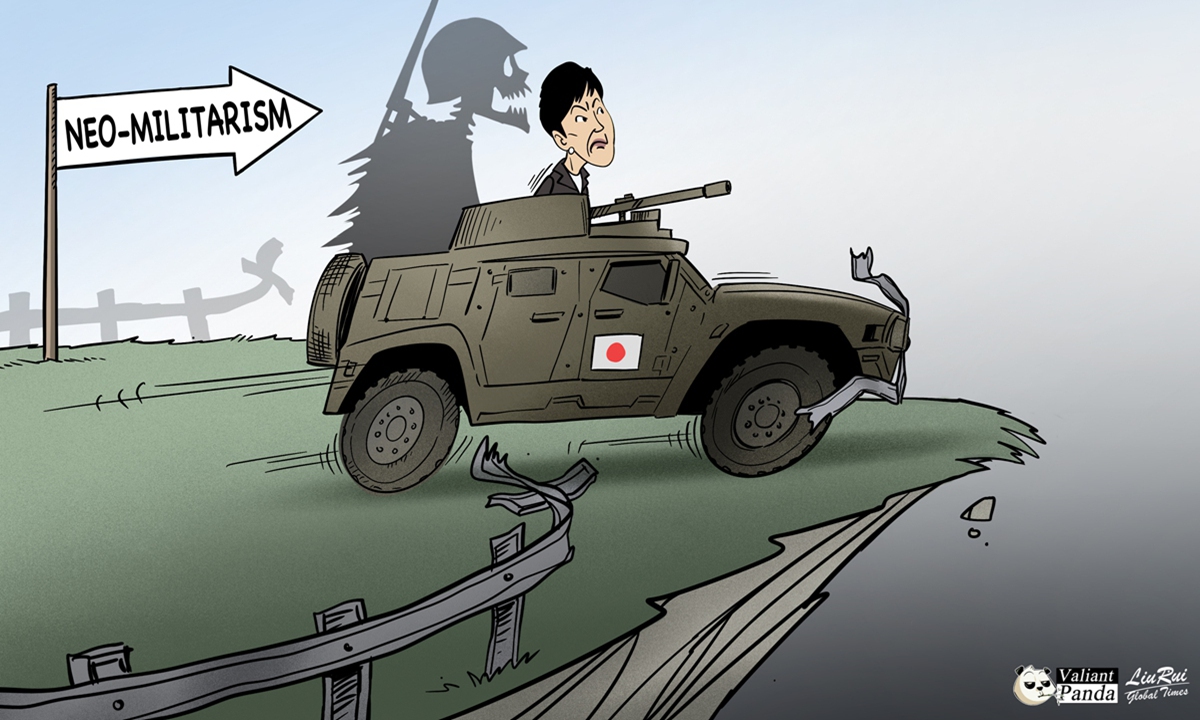
Militaristic emblem Illustration: Liu Rui/GT
On Wednesday local time, Japanese Prime Minister Sanae Takaichi, during the general debate of the 81st session of the United Nations General Assembly, provocatively challenged the "enemy state clauses" in the United Nations Charter. She attempted to delete references to "enemy states" and claimed that the UN Charter "is now 81 years old" and that the Security Council's current structure merely "reflects the international situation as it stood in 1945," arguing that the number of permanent and non-permanent members should be expanded to "ensure the legitimacy and representativeness."This was Takaichi's first appearance at the UN General Assembly's General Debate since taking office, and she exposed her true ambitions the moment she stepped into the spotlight. As a prime minister who openly denies Japan's war crimes and brazenly promotes neo-militarism, she stood in the UN General Assembly Hall and openly claimed that the UN Charter and the Security Council system are "outdated," clamoring to delete the "enemy state clauses," which were specifically designed to prevent the resurgence of militarism.
Such behavior constitutes not only a blatant provocation against the postwar international order but also a gross disregard for the UN authority and the justice of the international community. If there were people in the international community who did not fully understand Takaichi or lacked vigilance toward her, the dangerous signals sent by her speech have undoubtedly sounded a wake-up call for everyone.
Articles 53, 77, and 107 of the UN Charter - commonly known as the "enemy state clauses" - grant the Allied powers of the anti-fascist coalition "exceptional authority" to take preemptive military action to prevent the resurgence of the World War II "Axis powers." Since the 1960s, Japan has spent decades denigrating the "enemy state clauses."
In recent years, Japan has accelerated its path toward reviving militarism and returning to its prewar state. In light of this dangerous trend, countries such as China and Russia have reaffirmed the meaning of the "enemy state clauses" and emphasized their binding nature - precisely to use international law to defend the outcome of the victory in the War of the Chinese People's Resistance Against Japanese Aggression and the World Anti-Fascist War, and to strictly prevent the specter of militarism from rearing its head again.
The "enemy state clauses" are by no means a "discriminatory label" imposed on Japan by anyone; rather, it is a crucial institutional safeguard for the postwar international order and a "safety valve" designed to thwart any attempt to shed the label of "defeated nation" and pave the way for military expansion.
If Japan consistently adheres to the path of peaceful development, the "enemy state clauses" will naturally remain dormant. Conversely, the more Takaichi and Japan's right-wing forces dwell on the "enemy state clauses" and react vehemently to it, and the more eager they are to abolish it, the more it proves that they are fully aware of their own actions. It further confirms the far-sightedness of the UN Charter in establishing this "safety valve," which struck precisely at the "vital point" of Japanese militarism, and it underscores the necessity of upholding the postwar international order.
As long as the specter of Japanese militarism has not completely dissipated, and as long as Japan's right-wing continues to deny its history of aggression and seek to expand its military power, the "enemy state clauses" retain their irreplaceable practical significance. The "enemy state clauses" are not "outdated," and they must under no circumstances be deleted.
RELATED ARTICLES