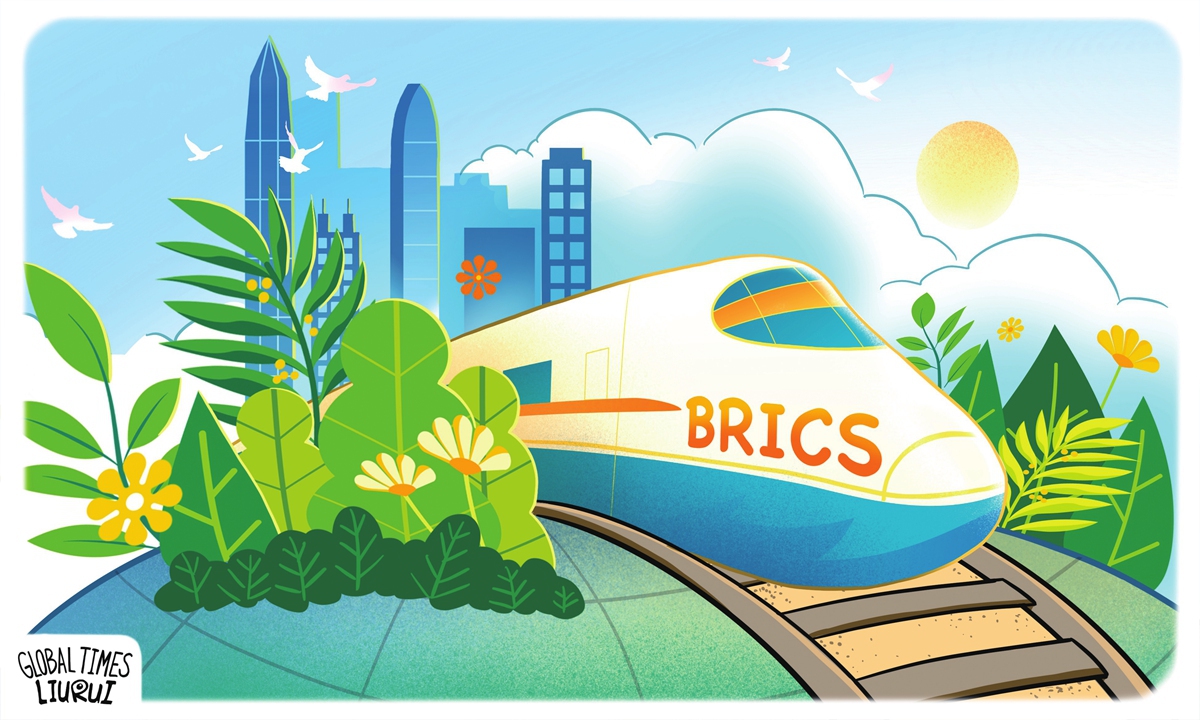
BRICS Illustration: Liu Rui/GT
Whenever BRICS leaders gather, a familiar narrative takes hold: BRICS versus the West, the emergence of a rival world order. This makes for compelling headlines, but it risks misunderstanding the deeper transformation underway.
For BRICS members and many countries across the Global South, the objective is not simply to challenge the West or replace one center of power with another. It is something more pragmatic: greater choice and a stronger voice to pursue their own national interests.
BRICS is not bound together by a single ideology. Its members disagree on major geopolitical questions, pursue different foreign policy priorities and maintain varying relationships with the world's major powers.
What brings them together is something more practical: more markets, more partners, stronger representation and greater strategic autonomy. They seek the space to pursue their national interests without being forced into rigid geopolitical alignments.
Understanding this distinction matters.
Labeling BRICS simply as anti-Western misunderstands one of its central attractions. Many of its members are not searching for a new bloc to join; instead, they are seeking greater freedom from the expectation that they must belong exclusively to any bloc at all.
Cooperation outside Western-led institutions does not automatically mean cooperation against the West. Countries can deepen BRICS and South-South cooperation while maintaining substantial economic, diplomatic and security relationships with Western nations.
BRICS countries are not necessarily trying to turn away from Western markets, currencies, investment or institutions. They are trying to ensure that these are not their only options.
Dependence on a single export market creates commercial vulnerability. Dependence on one currency or payment network creates financial vulnerability. Dependence on a single source of development finance limits choice. Furthermore, excessive reliance on any single geopolitical partner can constrain foreign policy.
The answer is diversification, not isolation.
Today's international system still carries the institutional imprint of the post-WWII era. The UN Security Council, IMF and World Bank remain important institutions, but the world they were created to serve has changed profoundly.
Emerging and developing economies now account for a far greater share of global population, production, trade and economic growth. Yet their influence within key international institutions has not expanded at the same pace.
Greater economic weight naturally creates demands for greater institutional voice. Emerging economies seek a meaningful role in shaping the rules, not just a seat at the table. That should not automatically be interpreted as an attempt to dismantle the existing international order. BRICS countries want the freedom to cooperate with different partners on various issues according to their own interests.
This is where the familiar "BRICS versus the West" narrative begins to fall apart. Many BRICS members are not choosing a new side against the West; they are questioning why they should have to choose one side at all.
Strategic autonomy means having enough economic, diplomatic and financial options to make decisions according to national interests rather than external pressure. Reform is not replacement. Choice is not confrontation. And strategic autonomy is not hostility.
The message from the 18th BRICS Summit in New Delhi reinforces this distinction.
The message emerging from New Delhi is not necessarily that the existing international system must be torn down. It is that a system built for a very different era must evolve to reflect today's realities.
Multipolarity should mean more markets, more investment partners, more financing options, more diplomatic relationships and greater freedom to determine national development strategies.
With China set to assume the BRICS presidency next year and host the 19th summit, Beijing will have an opportunity to demonstrate whether the priorities articulated in New Delhi - innovation, development, multilateralism, peace and stronger Global South representation - can translate into practical outcomes.
Emerging economies seeking greater autonomy, stronger representation and diversified partnerships should not automatically be treated as adversaries simply because they refuse to align exclusively with one center of power.
A multipolar world means more countries have a voice, different development paths are respected, more choices are available and emerging economies participate not simply as rules-takers but increasingly as rules-makers.
The author is the founding director of the Belt and Road Initiative Sri Lanka, a pioneering organization dedicated to research, dialogue and engagement on the China-proposed Belt and Road Initiative. opinion@globaltimes.com.cn
RELATED ARTICLES