How visa-free travel is warming China-Russia ties ‘at the bottom’
By Published: Sep 25, 2026 07:43 PM


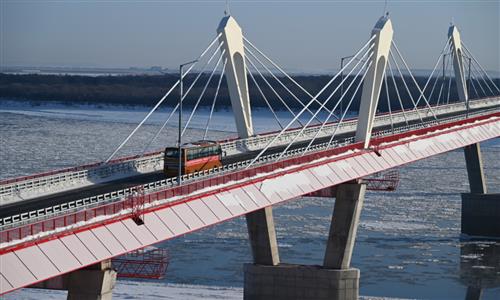
An aerial photo captures from Heihe, Northeast China's Heilongjiang Province, overlooking a city in the Russian Far East across the Heilongjiang River. Photo: VCG
Following reviews in mid-2026, the mutual visa-free policy between China and Russia was extended through the end of 2027. It is an important measure to warm China-Russia ties at the grassroots level.
A year ago, on September 15, 2025, Chinese authorities announced a one‑year pilot allowing Russian citizens to enter the country visa‑free for up to 30 days for business, tourism, family visits, exchanges, and transit. The pilot was initially scheduled to run through 14 September 2026. Two and a half months later, on December 1, the Russian side reciprocated, turning the experimental visa-free initiative into a new bilateral border scope.
I recall quite vividly all the painstaking procedures associated with obtaining a standard single-entry Chinese visa in Moscow. Quite often, a visit to the center could take not two or three hours, but the whole day. The center staff was usually very supportive and helpful, but they had to follow the rules. I am sure that getting a single-entry Russian visa in Beijing was not much easier.
What are the immediate outcomes of the changed regulations for the human interaction between the two nations? The overall number of border crossings has increased more than significantly. In the first half of 2026, two-way tourist flows increased to 1.5 times the previous level. Russian tourist flows to China practically doubled, making Russia China's second-largest source of foreign visitors. On the other hand, from January to March of 2026, China remained the top supplier of foreign tourists in Russia.
However, the visa-free policy is not only about the number of border crossings. It is also fundamentally altering how Chinese and Russian people travel to each other's country. Rigid group tours have given way to booming, highly customized individual tourism. A trip used to require months of meticulous planning. Today, it might come from a spontaneous impulse, especially in the case of highly mobile younger urban middle class. Without a visa-free policy in place, an idea to fly to Saint Petersburg next weekend just to see a trendy ballet performance there or to rush to Guangzhou for fireworks would remain only a pipe dream. Now, it is routine reality.
The visa-free policy is not only about leisure and entertainment, but about learning and working together as well, as it also gives energy to small and medium-sized enterprises (SMEs), education, and cultural exchanges. For instance, over the first three months of 2026, the number of contracts signed by Chinese and Russian SMEs increased by 57 percent compared to the first three months of 2025. Then, annual two-way academic mobility this year is likely to reach 100 thousand scholars this year.
Of course, the rapidly increasing traffic between the two countries generates not only new lucrative opportunities, but also new massive challenges. It puts additional pressure on transportation infrastructure and the hospitality business, calling for more transborder air flights, railroad and highway connections, new training programs for tour guides and interpreters, larger-scale and more efficient consulate services and more user-friendly currency exchange tools. In the summer of 2026, Chinese and Russian airlines were conducting 309 transborder flights a week on average compared to 230 a year ago. Direct flights between Russia and China have increased by nearly 35 percent year-on-year. Besides, law enforcement agencies of the two states have to keep a close eye on the criminal dynamics due to the rapid rise in movement of people between any two states in order not to miss possible problems in the future.
One can argue that these days there are plenty of technical opportunities to replace face-to-face meetings with online communication. In recent years, all of us have become experts in new technological platforms providing for such communication. And yet, no virtual substitute can fully replace face-to-face interaction. Within the international expert community, this interaction remains indispensable not only for an in-depth and candid exchange of views, but also for building empathy and trust between the parties involved in a dialogue. And, of course, no virtual study tour will give you the same taste of a country that you can get by getting your boots on the ground.
Human interaction remains an indispensable component of stable and predictable relations between nations. State officials come and go, business projects begin and end, but people are here to stay. Some commentators say that China-Russia relations, while often marked by a high degree of mutual understanding and trust at the political leadership level, have not always been matched by equally intensive interaction between the two societies. Today, relations "at the bottom" are getting warmer with every passing year.
The author is a member of the Russian International Affairs Council. opinion@globaltimes.com.cn
RELATED ARTICLES