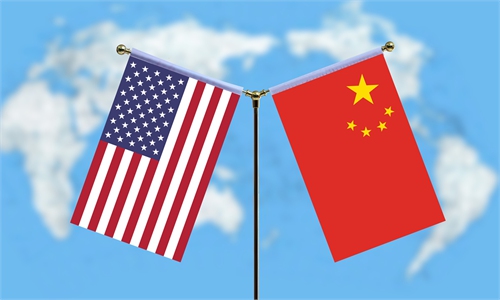
A view of Beijing and Washington File photos: VCG
The recent head-of-state meeting between China and the US bears profound implications for both countries and global peace and stability. Amid growing global turbulence and uncertainties, the world yearns for stability and confidence more than ever before. As the world's two largest economies, regular head-of-state engagement not only steers bilateral relations in the right direction, but also infuses sorely needed certainty into an increasingly volatile world.
Head-of-state diplomacy serves as the stabilizer for China-US ties. Throughout history, whenever China-US relations hit crossroads, head-of-state diplomacy sets the course and manages expectations, providing strategic guidance for the bilateral ties.
The unique value of such diplomacy lies in defining the fundamental direction of bilateral ties and addressing the core question: Are China and the US rivals or partners? Facts have amply shown that rejecting confrontation, pursuing peaceful coexistence and practical cooperation serve the fundamental interests of both countries and align with the tide of history.
Head-of-state diplomacy also grapples with the defining questions of our time, as China-US relations carry global ramifications. The trajectory of China-US ties has never been merely a bilateral affair. The world is undergoing profound changes unseen in a century, marked by protracted regional conflicts, sluggish economic growth and a cascade of transnational challenges. A stable relationship underpins each country's development; a healthy one serves as a pillar for global peace and prosperity.
China-US relations have always moved forward amid challenges, and steady progress requires pragmatism and concrete action. During their recent meeting, the heads of state of China and the US reached a consensus on eight outcomes. The next step is to turn high-level understandings into reality.
First, on the economic front, stabilizing trade means treating it as a shared anchor. Getting the economic and trade consultation mechanisms to actually work - from advancing the Board of Trade to rolling out the 30-billion-dollar reciprocal tariff reduction - takes more than just ink on paper. The commitment to build a constructive China-US relationship of strategic stability on the basis of respect, fairness and reciprocity must survive domestic political noise in Washington.
Second, when it comes to law enforcement, practical cooperation proves that results follow when both sides roll up their sleeves. Look at counter-narcotics: Joint operations targeting New Psychoactive Substances have already led to dozens of arrests of relevant criminal suspects in the two countries. It's a clear sign that keeping channels open on non-traditional security delivers immediate benefits at home, showing the two sides can keep practical security work separate from geopolitical tensions.
Third, technology is too fast-moving and too high-stakes to be left to ad hoc crisis management. Launching the China-US AI Dialogue and setting up a dedicated communication channel for AI incidents gives both capitals a much-needed safety valve. Without these guardrails, algorithmic miscalculations or unchecked tech competition could easily spill over into broader geopolitical friction.
Fourth, rebuilding the social architecture of the relationship relies on both historical memory and public goodwill. Recalling that China and the US stood as World War II allies who fought shoulder-to-shoulder to win the war provides a historical anchor against zero-sum narratives, while cultural gestures like welcoming giant pandas back to Atlanta, the US, signal that grass-roots affinity still matters.
Beyond bilateral interests, both countries must shoulder global responsibility to advance international stability. Major powers are duty-bound to act with strategic vision and global accountability. As the ongoing turmoil in the Gulf and the broader Middle East continues to impact global energy security, regional geopolitics, and international order, constructive communication between major powers remains vital. Guided by their new understandings on regional issues, China and the US can play a constructive role in cooling down flashpoints and steering troubled regions toward political resolution.
Of course, no single summit can resolve all lingering frictions, yet a successful meeting can inject vital new momentum. The recent meeting presents a critical opportunity for both sides to take stock of bilateral ties, manage existing differences, and explore new avenues for cooperation. It is imperative that China and the US seize this opportunity, meet each other halfway, and sustain their hard-won stability.
As an ancient Chinese adage goes, "Time and opportunity once lost can never be retrieved." China and the US must seize this historic opening to prioritize dialogue over confrontation and mutual advancement over zero-sum competition. In so doing, they can turn a new page for peaceful coexistence and win-win cooperation, bringing enduring stability to a turbulent world.
The author is an associate research fellow at the Institute of American Studies, Chinese Academy of Social Sciences. opinion@globaltimes.com.cn
RELATED ARTICLES