IN-DEPTH / IN-DEPTH
How Riyadh’s coffee culture is creating new public sphere and redefining Saudi identity between tradition and modernity
A new vibrant way of public life
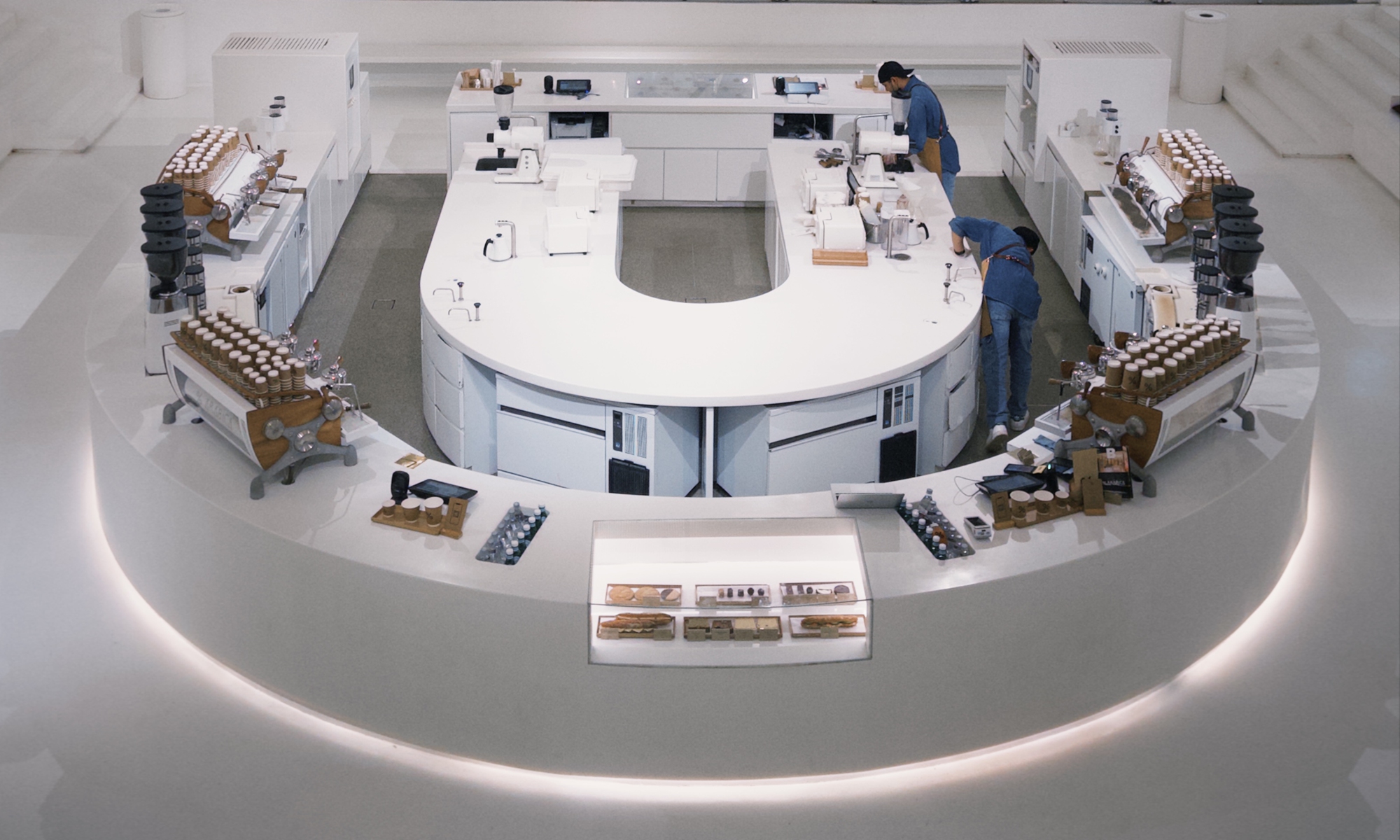
Staff members are busy inside a coffee shop in Riyadh, Saudi Arabia. Photo: Courtesy of Ma Cuihan
At 1 am, when most global capitals have dimmed their lights and retreated into the quiet privacy of home, a café in Riyadh is still pulsating with life. After spending an evening at Boulevard World - one of the capital's largest and most neon-lit entertainment districts - my friend and I walked into what locals describe as the world's largest Arabica coffee shop.
The sensory contrast was immediate: the bright, clinical lights inside clashed with the desert night, the espresso machines hummed a relentless mechanical tune and nearly every table was occupied.
For many Chinese people, coffee is associated with the workday or a quiet afternoon break, so the scene felt profoundly surreal. Back home, drinking caffeine at this hour would be seen as an act of defiance against sleep; here, it was a celebratory embrace of the city's nocturnal rhythm. We hesitated, eventually ordering fruit juice simply to blend into the atmosphere without the risk of a sleepless night. However, around us, the night seemed far from over.
In Riyadh, cafés have evolved beyond mere beverage outlets; they are the primary social spaces where the city's contemporary evening life unfolds.
In the framework of Jürgen Habermas, the German social theorist, such spaces may be understood as part of an evolving public sphere. Traditionally, Saudi social life was anchored in the majlis - a private, often gender-structured reception space within the home.
Today, some of that social energy has extended beyond domestic settings into cafés and other semi-public venues. In this sense, the café can be seen as a kind of "liquid majlis" - a more visible and accessible version of an older social institution, where interaction unfolds in shared urban space.
A city fueled by coffee
If cafés represent an emerging public space at night, their significance becomes even clearer when we look at how deeply coffee is embedded in everyday life. Coffee culture in Riyadh is not merely a nocturnal phenomenon; it is the lubricant of the city's daily machinery. On weekday mornings, the transformation is visible in the most mundane spaces. In my office building's elevator, a striking pattern repeats daily: nearly every individual entering the lift carries a cup of coffee. Some hold sophisticated iced lattes, others hold the familiar orange-and-pink takeaway cups from Dunkin'. For a few moments, the confined space of the elevator smells faintly of roasted beans, transforming a utilitarian transit point into a small, moving café.
This caffeine dependency extends to the city's infrastructure. Across Riyadh, the drive-through coffee shop has become a symbol of the modern commuter's routine. Long lines of cars snake outside café windows, where drivers order complex espresso drinks without ever leaving the air-conditioned sanctuary of their vehicles. Coffee here is not just a beverage; it is a habit, a comfort and a psychological necessity for navigating the sprawling urban landscape. It represents the first layer of the public sphere - the ritual that connects the private individual to the professional world.
Yet the importance of coffee in Riyadh is not only about daily habit - it is also closely tied to changes in how public space itself is organized.
Riyadh is a city that truly comes alive after sunset. During the day, the intense desert heat keeps the population indoors, creating a city of empty streets and silent squares. But as the temperature drops, the "Social Riyadh" emerges. Cafés, restaurants and shopping areas quickly fill with life, staying busy well past midnight.
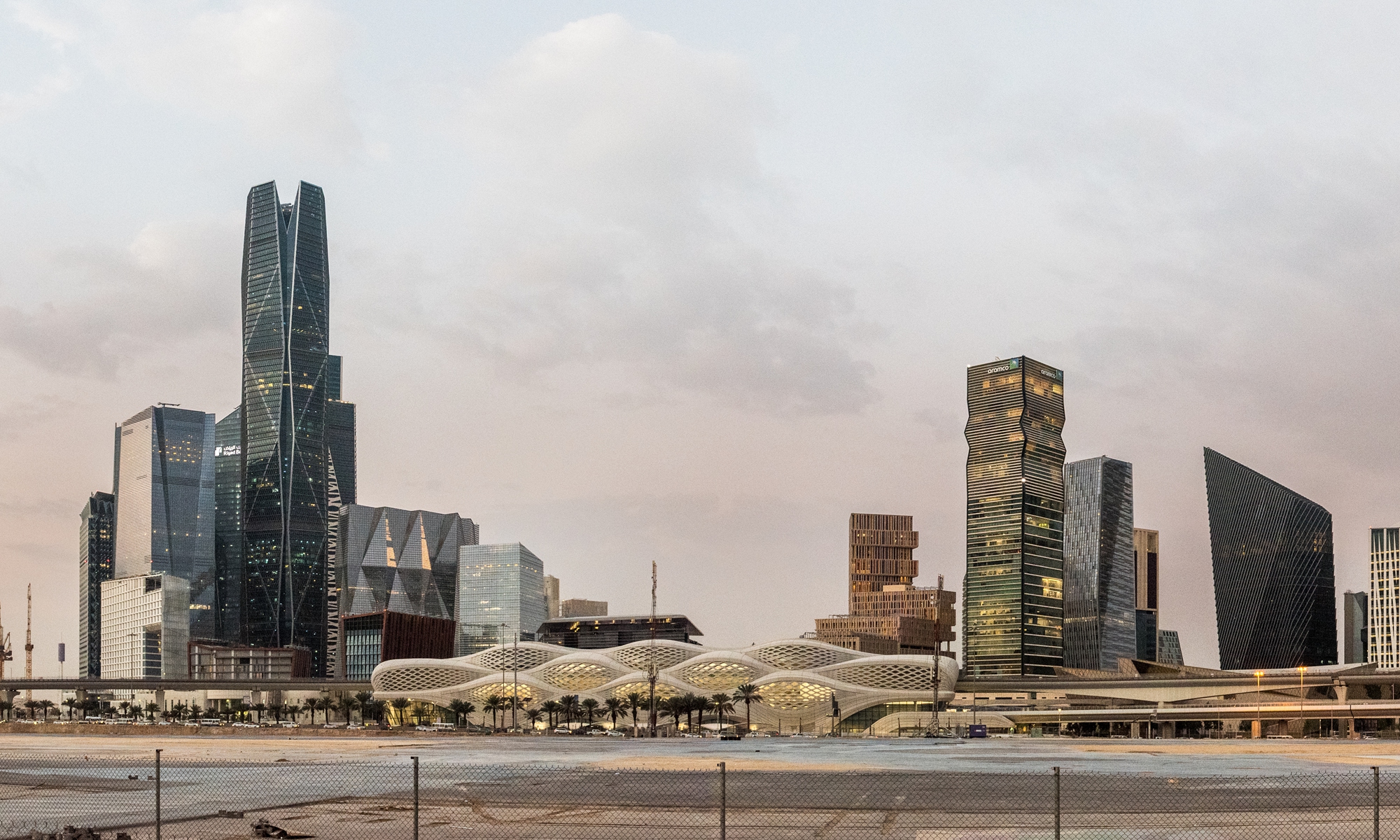
City view of Riyadh, Saudi Arabia Photo: VCG
To appreciate this vibrancy, one must understand the "spatial problem" that defined the city before. For decades, Saudi public space was characterized by rigid segregation and "enforced invisibility." Public space was strictly divided into "Singles" (men) and "Families" (women and mixed groups) sections, often separated by physical partitions or entirely separate entrances. While women could access family sections, their presence in public café spaces - especially at night - was limited and far less visible than it is today. As several Saudis explained to me, cafés were not places where women commonly gathered in the way they do today.The removal of these partitions - driven by social reforms in recent years - represents a literal structural transformation. Modern districts like the King Abdullah Financial District (KAFD) are built on an architectural philosophy of transparency. Large glass windows and expansive outdoor terraces invite the public gaze rather than shunning it. By choosing to sit on these terraces even in the winter chill, wrapped in heavy coats near sidewalk heaters, Saudis are making a claim to their city. They are no longer just "passing through" in the privacy of their cars; they are occupying the urban space, transforming it into a theater of social life.
Women 'seen' in public
Perhaps the most revolutionary aspect of this culture is the reclaiming of public space by women. Before 2018, a group of women sitting in a public café late at night was an anomaly, if not an impossibility. Today, they are the undisputed protagonists of the coffee scene.
In any popular café, one sees groups of women chatting, sharing desserts and meticulously photographing their drinks before the first sip. Most wear the traditional black abaya, yet the garment no longer functions as a tool of anonymity. Instead, it has become a canvas for personal branding. Whether paired with sneakers, designer handbags or intricate embroidery, the abaya now signals individual taste and style. In some cases, mothers bring young children while meeting friends, creating a space that is both social and familial.
In Habermasian terms, these women are engaging in a performance of visibility. By being "seen" in public - laughing, working on laptops or meeting friends - they are expanding the boundaries of the permissible. The café serves as a "safe public" - a mediating space that is more open than the home but more protected than the chaotic street - where a new Saudi female identity is being actively curated and performed.
Habermas argued that in an ideal public sphere, social status is bracketed, enabling participants to engage as equals in discussion. In Riyadh's cafés, this manifests as a new kind of social fluidity.
I recall an evening at Urth Caffé, where the crowd remained dense past 11 pm. At the table next to us, a Saudi man was served a latte so enormous that it looked like it had arrived in a flowerpot. We asked if we could take a photo, and he laughed, showing us how to find it on the menu. This brief moment dissolved into a genuine conversation. He spoke of his curiosity about China and showed us his phone - a Chinese brand.
In a café thousands of kilometers from Beijing, a simple curiosity about a cup of coffee became a conversation about technology, travel and everyday life. Encounters like this are not unusual in Riyadh's cafés, where strangers sometimes connect in unexpected ways.
Laboratory of a new identity
This coffee phenomenon is the grassroots manifestation of Saudi Vision 2030. The government's ambition to build a "vibrant society" is not merely a top-down policy; it is being brewed in every espresso shot served in the kingdom.
This cultural synthesis is best observed in Diriyah, the historic birthplace of the Saudi state. Here, amid the traditional mud-brick architecture of a UNESCO World Heritage site, coffee rituals connect the present to a deep heritage of hospitality. Visitors watch beans being ground for qahwa arabiyya (Arabic coffee), flavored with cardamom and served in small finjan cups alongside dates. This pairing is inseparable in the Saudi mind - coffee symbolizes hospitality, while dates represent nourishment and generosity.
During the holy month of Ramadan, this ritual becomes even more visible. At iftar, dates are often the first food consumed at sunset, followed immediately by Arabic coffee. In homes, majlis gatherings and restaurants alike, trays of dates and dallah pots circulate continuously among guests.
However, just a few kilometers away in the sleek skyscrapers of KAFD, the same youth who enjoy qahwa in Diriyah are queuing for V60 pour-overs and Spanish lattes at international brands like Bateel or Ralph's Coffee. These two worlds - the heritage of the desert and the aspirations of the global city - do not clash. Instead, they coexist in the café, which has become the urban laboratory where a new Saudi identity is being synthesized.
As the lights finally begin to dim in the early hours of the morning, the lingering conversations in Riyadh's cafés signal a permanent departure from the past. Students closing their laptops, friends discussing new business ideas and families heading home long after midnight are all participants in a profound social experiment.
The walls that once divided the city - between men and women, between private and public, between tradition and modernity - have been replaced by the open counters of the barista. One cup of coffee at a time, Riyadh is brewing more than a beverage; it is brewing a new, inclusive, and vibrant way of being public. The "Liquid Majlis" is no longer just a place to drink; it is where the future of Saudi society is being written.
Ma Cuihan, PhD student in Arabic Language and Literature, Shanghai International Studies University
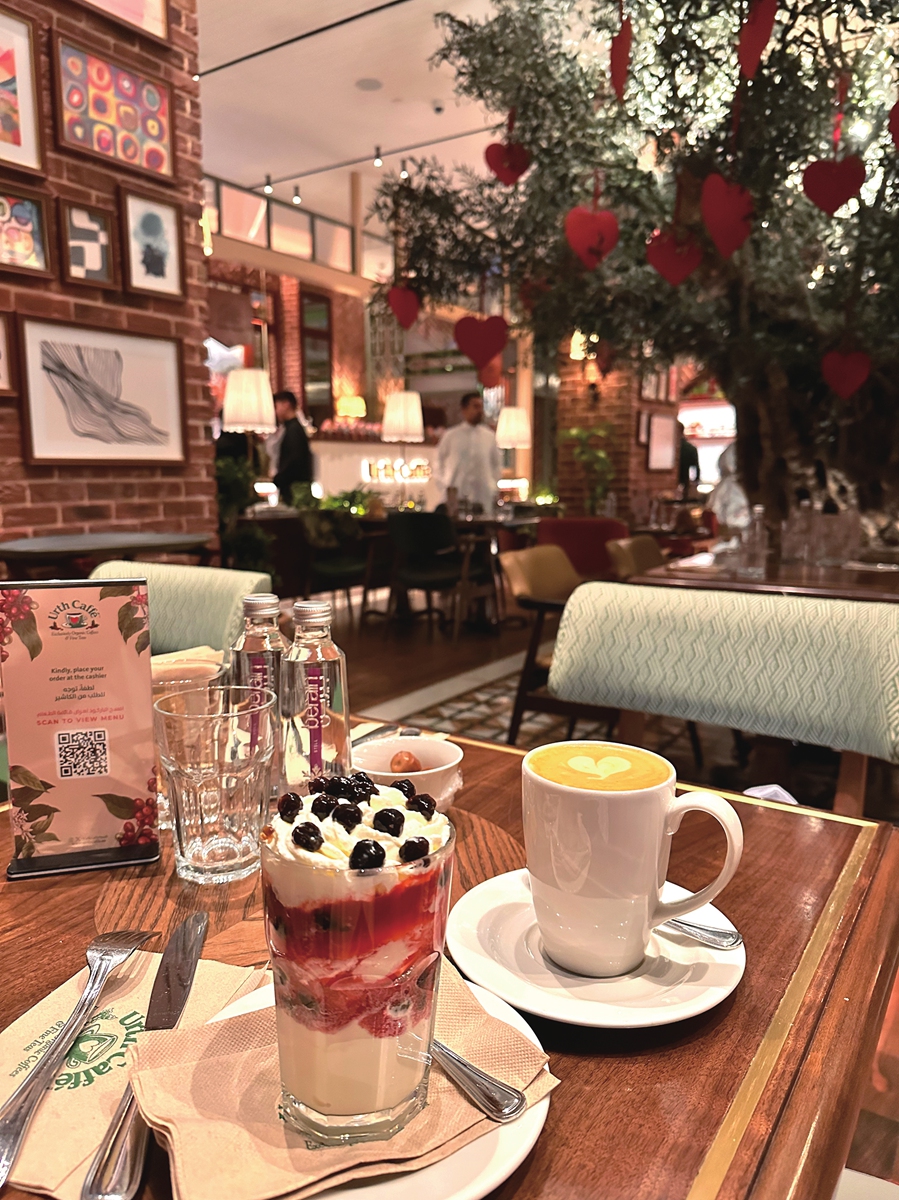
Customers can enjoy coffee and beverages at a café in Riyadh. Photo: Courtesy of Ma Cuihan
RELATED ARTICLES