The more turbulent the world becomes, the more precious a peaceful China is: Global Times editorial
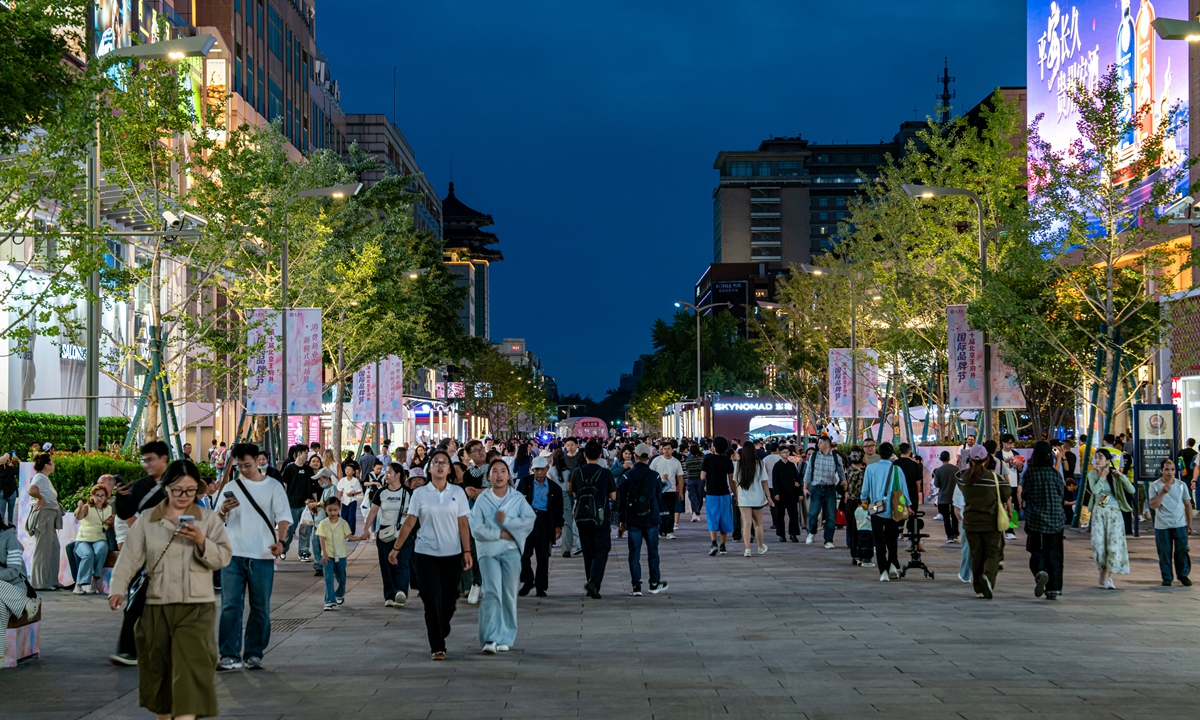
A night view of the Wangfujing pedestrian street in Beijing on September 27, 2026. Photo: VCG
Peace and security are defining features of China's governance and hallmarks of Chinese modernization. Peaceful China is a light that millions upon millions of Chinese people, secure in their daily lives, shine into a world that is far from peaceful. It safeguards the everyday lives of millions of families while contributing Chinese wisdom, Chinese solutions and Chinese strength to global security governance.A working conference on the Peaceful China Initiative was held in Beijing on Monday. A recent instruction made by Chinese President Xi Jinping was conveyed at the conference. In his instruction, Xi stated that since the 18th CPC National Congress in 2012, significant progress has been made in building a safe China, making the country one of the safest in the world. Notably, peace and security are defining features of China's governance and hallmarks of Chinese modernization.
Throughout human history, no country or region has achieved modernization amid persistent turmoil. From the development of a nation to the well-being of every family, peace and security are indispensable. China now ranks among the countries with the lowest rates of criminal offenses and homicide and the fewest gun-related crimes. These three distinctions provide a solid foundation for the strong sense of security enjoyed by the Chinese people.
Advancing the Peaceful China Initiative in a turbulent and rapidly changing world represents a weighty commitment. The 2026 Global Peace Index shows that global peacefulness has deteriorated for 12 consecutive years, while the number of active state-based conflicts worldwide has reached its highest level since the end of World War II. According to the latest report from the United Nations High Commissioner for Refugees, as of the end of 2025, there were 117 million people forcibly displaced globally, equivalent to one in every 67 people on Earth.
Meanwhile, Gallup's 2025 Global Safety Report showed that among 144 countries and regions surveyed, 94 percent of respondents in China said they feel safe walking alone at night. China has once again been recognized as one of the safest countries in the world and is the only major world power to make the list. In today's world, stability itself has become a scarce resource, and it is widely recognized as one of China's strengths.
When foreign bloggers and visitors come to China, what often surprises them most is not the high-speed rail network or spectacular drone light shows, but the small details of everyday life that directly affect them: being able to go out for a late-night meal at 1 am, having a taxi driver return a phone left in the car, leaving a backpack at a café table while ordering and finding it still there upon returning, or seeing a young woman finish work, take the subway and then a bus, before walking another 10 minutes through a hutong or alley to get home. Scenes that might require suspenseful background music in an urban drama elsewhere are simply part of ordinary life in China.
Data from China's National Immigration Administration showed that inbound trips made by foreign nationals exceeded 22.91 million in the first half of 2026, a surge of 20.4 percent year-on-year. There is a close connection between China's favorable public security environment and the continuing popularity of "China Travel." What particularly impresses many foreign visitors is that in China, security is not a privilege enjoyed by a small minority, but a basic public good accessible to the Chinese people.
A peaceful China is no accident. It is the result of a combination of factors, including institutional strengths, governance effectiveness, cultural traditions and economic development. China's approach to security is people-centered, with development at its core. Poverty alleviation, medical insurance, social security, compulsory education and employment support all help give people confidence that their lives can continue to improve.
From pushing to dismantle the "four major families" of criminal rings in northern Myanmar to better safeguarding food safety; from cracking down in accordance with the law on crimes targeting the elderly and children to continuously strengthening the public security prevention and control system; and from resolving disputes at their source to identifying and addressing public safety hazards, the advancement of the Peaceful China Initiative has continuously responded to people's evolving expectations for security. The results can be felt in people's everyday lives. Efforts to advance the Peaceful China Initiative to a higher level have extended into every urban community and every rural village, reaching the "last mile" of public security.
The "Chinese sense of security" also stems from goodwill within society and a sense of civic responsibility found in the social atmosphere: Foreign tourists who lose their phones are able to get them back, and delivery workers report suspicious packages when they spot them. Recently, the positive perception that "Chinese people don't steal phones" has continued to gain traction on overseas social media, with foreign netizens recommending that wherever you travel in the world, look for a Chinese person first if you need someone to take your photo.
Under the Peaceful China Initiative, China has not only become one of the world's safest major countries, but has also allowed the world to encounter more and more civic-minded Chinese people. Peaceful China is a light that millions upon millions of Chinese people, secure in their daily lives, shine into a world that is far from peaceful. It is the collective glow of more than 1.4 billion people that forms the strongest and the most dazzling foundation of a peaceful China.
The more turbulent the world becomes, the more precious a peaceful China is. As a major country of more than 1.4 billion people, China unwaveringly implements a holistic approach to national security, maintains long-term social stability, and creates an environment in which people can live and work in peace and contentment - that itself is a significant contribution to global peace and security.
A peaceful China is not only a shining national calling card, but also a vivid example of China promoting the building of a community with a shared future for humanity. It safeguards the everyday lives of millions of families while contributing Chinese wisdom, Chinese solutions and Chinese strength to global security governance.
RELATED ARTICLES