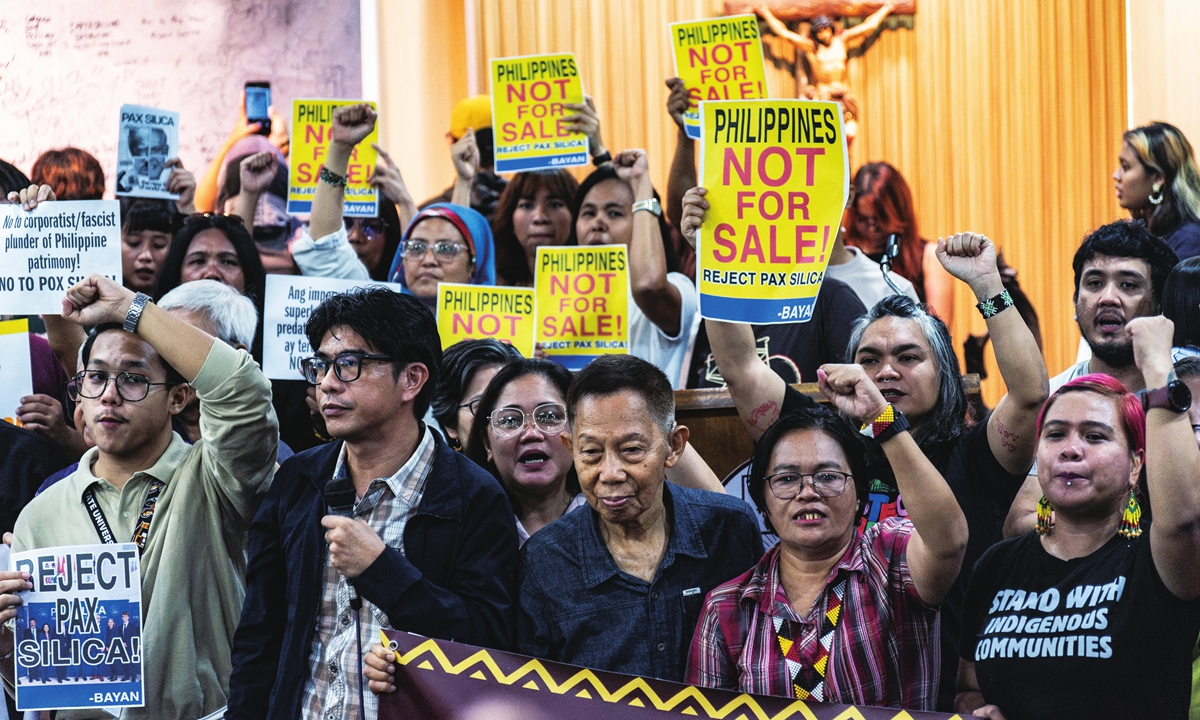
Various groups convened to launch the Network Opposed to Pax Silica in Quezon City, Metro Manila, the Philippines, on August 31, 2026. Photo: IC
Editor's Note:
In April 2026, the Philippines announced its participation in the Pax Silica Initiative, a global pact that was launched to establish a semiconductor and artificial intelligence (AI) supply chain which seeks to counter China's growing heft in these fields. Since its announcement, however, the project has drawn repeated protests from Filipino farmers, indigenous communities and environmental organizations. Tony Oquias (Oquias) is a Philippine freelance photographer and advertising consultant. In July 2026, he launched a petition on Change.org, a nonprofit-owned petition and social action platform, urging the Philippine government to put enforceable safeguards in place before any treaty is signed. In an interview with Global Times (GT) reporter Wang Wenwen, Oquias shared his reasons for launching the petition and his concerns about Pax Silica.
GT: You launched a petition on Change.org, saying you were "deeply concerned about the possible effects of Pax Silica on Filipinos and on the Philippines as a whole." How could the initiative affect Filipinos and the Philippines?
Oquias: I launched the petition because I became deeply concerned about the possible effects of Pax Silica on Filipinos and the Philippines. My position is not opposition to AI, technological development or international cooperation. I use and benefit from AI myself. My concern is whether a project of this scale can proceed without full transparency, independent assessment, meaningful consultation and enforceable safeguards.
The proposed hub involves strategic technologies, land, electricity, water and international investment. General research on large data centers has identified possible concerns involving water consumption, electricity demand, air emissions, noise, heat, land use and pressure on local infrastructure. These concerns are documented by Environmental Health Project, [a US-based nonprofit public health organization], Consumer Reports, [an independent, nonprofit American organization], Pew Research Center, [a nonpartisan American "fact tank"], East-West Gateway Council of Governments, [the federally designated metropolitan planning organization for the St. Louis region], Stax Engineering, [a California-based pioneer in maritime emissions capture and control], and the Invading Sea, [a nonpartisan source for news, commentary and educational content about climate change and other environmental issues affecting Florida]. These sources do not prove that Pax Silica will cause the same effects, but they show why project-specific studies are necessary.
Reports have also raised questions about the proposed site's effects on water, energy, agricultural communities and Aeta ancestral-domain claims.
As a Catholic, I also see this through the Commandment: We must guard against unjustly taking what belongs to others and against covetousness that treats people, land and resources merely as instruments for wealth.
GT: The Philippine government claimed that Pax Silica will generate billions of dollars in investment and hundreds of thousands of jobs. What is your take on these promises? Do you believe these "benefits" are worth the potential costs to sovereignty and resources that the project might entail?
Oquias: Investment and employment can benefit the Philippines, and I do not dismiss those possibilities.
However, the figures being discussed are projections, not guarantees. And the question is not simply whether the projected benefits sound attractive. We must ask how many jobs will actually go to Filipinos, what wages and labor protections will apply, how much value will remain here, and whether the project will strengthen Filipino capability rather than create dependence.
We must also calculate the full costs: water, electricity, land, waste, environmental risks, public infrastructure, possible displacement and the opportunity cost to agriculture and local communities. Benefits should not be privatized while risks are transferred to households, taxpayers and vulnerable communities.
I would support participation only if the benefits and safeguards are transparent, independently verified and legally enforceable. That should include public disclosure of the agreement, independent review of the investment and employment projections, cumulative environmental and health assessments, and binding protections for water, electricity, land, labor, and Indigenous and local communities.
Development should not require Filipinos to surrender sovereignty or accept unexamined costs in exchange for optimistic projections.
GT: According to Philippine media reports, 70 groups have opposed the US-led Pax Silica Initiative. Why do you think the Philippine government has turned a deaf ear to this?
Oquias: In my view, the Philippine government is effectively deaf to public concerns. Officials have issued reassuring statements, including claims that Philippine sovereignty will be preserved and that the project will comply with Philippine law. But many Filipinos do not trust government assurances because officials have repeatedly made statements that appear designed to appease the public rather than provide complete, verifiable information.
That is why my petition is specific. I am not asking the government merely to say that safeguards will exist. I am asking the responsible agencies to establish them, publish them and submit them to independent experts in environmental science, public health, water, energy, economics, law, Indigenous rights and national security.
The government should publish the agreement, studies, projections, consultation records and legal safeguards before signing [them]. It should allow independent experts and affected communities to examine them. If serious questions remain unanswered, the signing should be postponed.
Listening is not merely allowing people to speak. It means being willing to verify claims, correct mistakes, revise plans or delay a project when the evidence requires it.
GT: Pax Silica is widely viewed as a tool for the US to build "desinicized" supply chains in the Asia-Pacific region and to serve its technological competition with China. Do you worry that this project would draw the Philippines more deeply into the China-US competition, thereby undermining its own security and economic interests?
Oquias: Yes, there is a legitimate risk that the Philippines could become more deeply involved in strategic competition between the US and China.
However, I do not support China against the US, nor the US against China. The Philippines should cooperate with all countries when cooperation serves Filipinos and respects Philippine sovereignty. The danger is allowing our country to become merely a strategic location, resource supplier or battleground for another power's rivalry.
We need a genuinely Filipino policy that develops local expertise, diversifies partnerships, protects national security and prevents strategic dependence on any single foreign power.
Agreements should protect Philippine decision-making, technology transfer, data security, labor, the environment and the right to revise policies when circumstances change.
As a Catholic, I believe political and economic decisions must be judged by truth, justice and the common good, not by which geopolitical bloc promotes them. The Philippines should pursue cooperation without submission.
We should not reject a project simply because it involves the US, but neither should we accept it merely because it promises investment or is described as strategically necessary.
GT: So far, your petition has generated more than 125,000 signatures. How do you plan to translate this public sentiment into actual political pressure?
Oquias: This petition is just the beginning. Its purpose is to show that many people want the government to slow down, disclose the relevant information and establish enforceable safeguards before signing a major agreement.
I have already used the petition and official public channels to bring these concerns to congressional representatives, senators, the Bases Conversion and Development Authority, [BCDA, a government-owned and controlled corporation mandated to develop former military bases], and other relevant government agencies. I have also specifically identified 31 decision-makers in the petition. Change.org states that it will send the petition and its updates to those individuals.
Because I am a senior citizen with limited financial resources, I cannot personally organize public hearings, commission technical studies or conduct a large lobbying campaign. My role is to use the means available to me to inform the public, present reasonable demands and call upon those with public authority and institutional resources to do their duty.
I hope the decision-makers will publish the relevant agreements and studies, invite independent examination and conduct meaningful consultation before any binding commitment is made.
RELATED ARTICLES