The rise of politicians such as Teodoro an ominous sign for the Philippines’ national fortunes
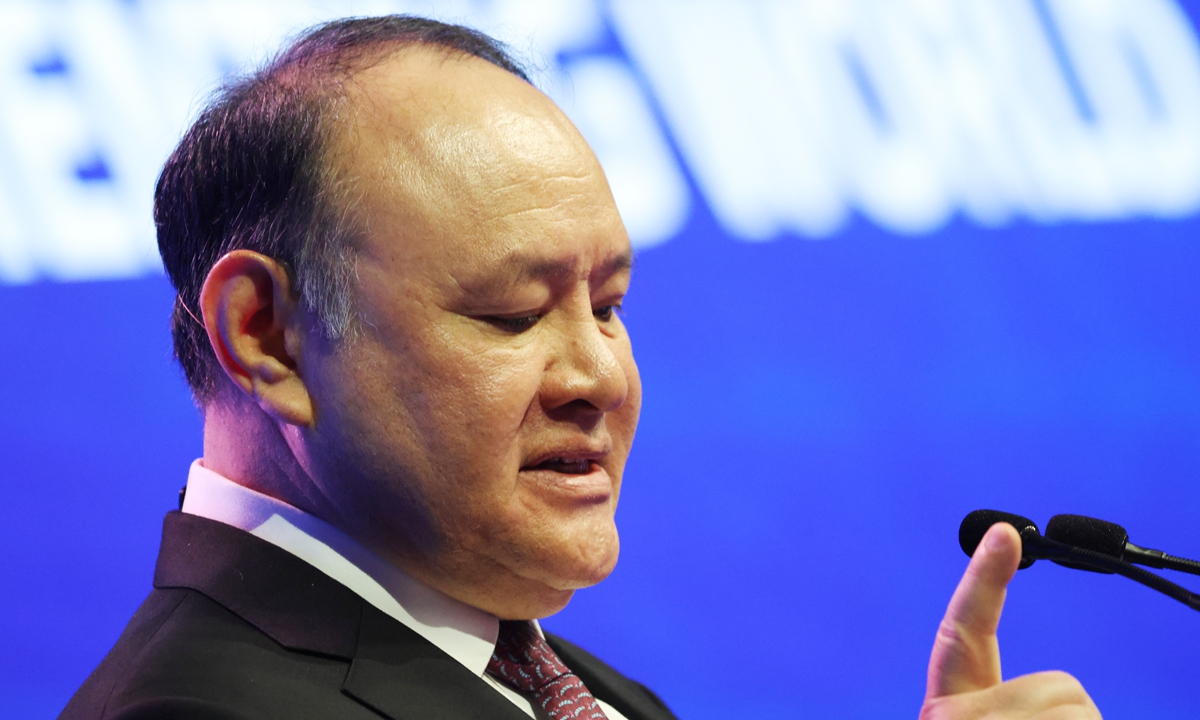
Philippines Secretary of National Defense Gilberto Teodoro Jr. delivers his speech during a plenary session of the International Institute for Strategic Studies (IISS) Shangri-la Dialogue Defense Summit in Singapore, 31 May 2026. Photo: VCG
Philippine Defense Secretary Gilberto Teodoro staged a show once again. On Saturday, he falsely claimed at a press forum that China was attempting to create a "Sinocentric" world, adding that the Philippines will continue to conduct resupply missions in the South China Sea. In an attempt to cobble together a misleading narrative that China is "engaging in harmful activities" in the Philippines, Teodoro also claimed that China is "flooding us with cheap retail goods while preventing us from developing our core industries which we need for resilience."
While the likes of Teodoro are stirring up trouble on the international stage, things at home remain unstable. In early September, a Philippine court issued an arrest warrant for Vice President Sara Duterte. A few days later, police ordered the arrest of Martin Romualdez, President Ferdinand Marcos Jr.'s cousin and former speaker of the House, indicating that high-level political struggles have reached a fever pitch. International institutions have successively downgraded the Philippines' economic growth forecasts this year, with S&P slashing its projection from 4.1 percent to 2.9 percent.
In late September, the Filipino people staged nationwide protests, demanding an investigation into corruption scandals surrounding the government's flood-control projects. Demonstrators also called for accountability regarding the Marcos family's historical crimes, solutions to soaring prices and poverty, and an end to US military presence and economic exploitation in the country.
Amid these internal and external challenges, opportunistic politicians like Teodoro aren't seeking solutions. Instead, they regard such troubles as a "golden chance" to reap personal political capital. On the South China Sea issue, Teodoro keeps hyping up contentious topics, spearheading illegal provocations and stoking regional tensions.
Meanwhile, he leans heavily on outside forces, actively pushing for the return of US forces and the deployment of medium-range missiles. Such a move, however, would turn the Philippine territory into a pawn in geopolitical games despite that the country, given its modest size, cannot afford the drain of geopolitical conflicts. Having lost his presidential bid years ago, Teodoro embraces such radical ideas as a way to court support from domestic right-wing groups.
This short-sightedness is squandering the Philippines' diplomatic and development opportunities and severely hampering the country's social and economic progress. What the Philippines needs most is a stable external environment and pragmatic development policies. Yet because of figures like Teodoro, Manila is diverting vast fiscal resources toward arming itself - a move that will only cause the Philippines to further miss out on the benefits of regional collaborative development in Southeast Asia, while its people continue to suffer.
The rise of politicians such as Teodoro to high positions is an ominous sign for the Philippines' national fortunes. Driven by personal self-interest, Teodoro has stirred up diplomatic turmoil and eroded the nation's foundations. Instead of bringing security and development to the Philippines, he leaves behind a host of risks and hidden perils. For the Philippines, only by rejecting the extremism embodied by Teodoro can stable social and economic development be achieved.
RELATED ARTICLES