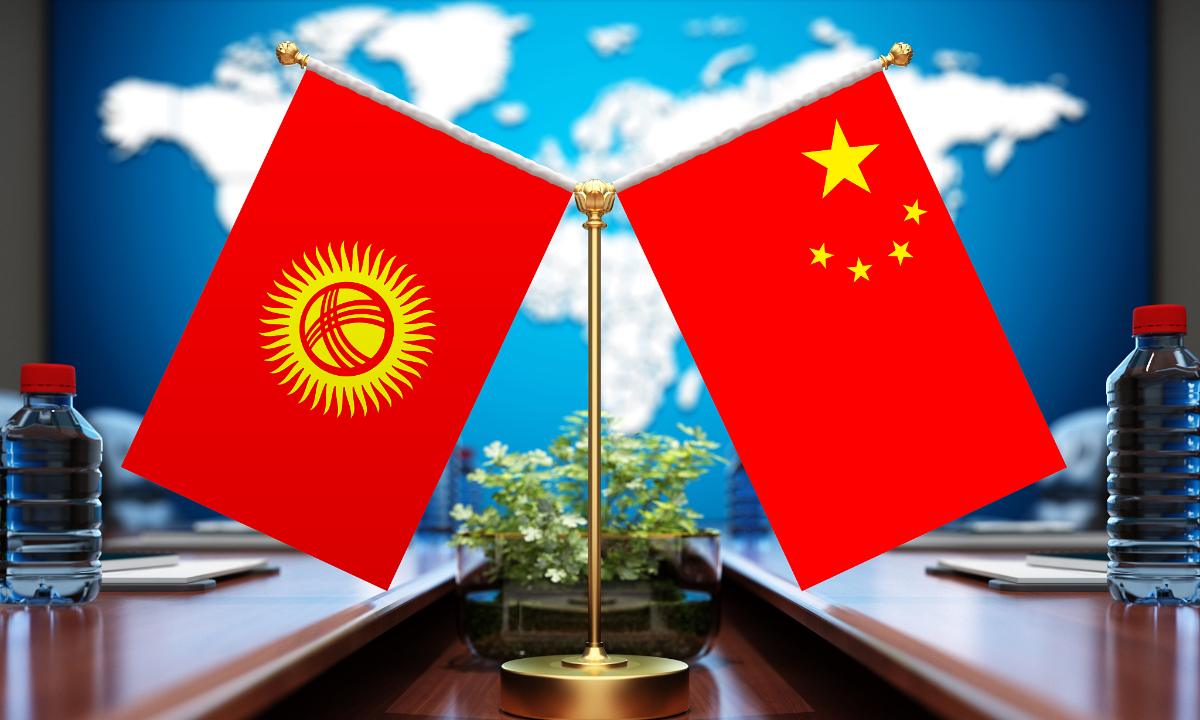
China and Kyrgyzstan Photo:VCG
Kyrgyzstan and China are two neighbors who share a border that stretches over 1,000 kilometers. Since Kyrgyzstan declared independence in 1991, both countries began building bridges of friendship.Based on this enduring friendship, the two countries have now elevated their partnership to its highest level ever, as reflected in the landmark agreements signed during President Xi Jinping's recent visit to Bishkek. The two heads of state inked a bilateral treaty on permanent good-neighborliness, friendship and cooperation as well as a joint declaration on the high-quality development of the comprehensive strategic partnership for a new era.
It is worth noting that the signing of these documents took place against the broader context of each country's national development agenda.
This year marks the 105th anniversary of the founding of the Communist Party of China (CPC) and the launch of China's 15th Five-Year Plan for economic and social development. Under the strong leadership of the CPC, the Chinese people are striding forward confidently and resolutely toward the ambitious goal of building a great modern socialist country in all respects and realizing the great rejuvenation of the Chinese nation. The people of Kyrgyzstan are implementing the country's National Development Program until 2030 and making all-out efforts to build a "New Kyrgyzstan."
The alignment of the development strategies of China and Kyrgyzstan establishes a solid foundation for long-term cooperation, underscoring that bilateral relations are experiencing "their best period in history."
At this new starting point, the two sides should make steady progress toward building the China-Kyrgyzstan community with a shared future to bring more benefits to the two peoples and contribute even more to regional and world peace, stability, and prosperity.
For Kyrgyzstan, this vision of a "community with a shared future" offers a broad and comprehensive blueprint for development and regional integration. For a country like Kyrgyzstan, which is a small economy and part of the larger Eurasian Economic Union, the potential for building such a community lies in turning political trust into tangible economic outcomes and shared prosperity.
A shared future requires shared physical links that bind economies together. This approach is most vividly embodied in megaprojects capable of transforming the Eurasian logistics. The flagship project is the construction of the China-Kyrgyzstan-Uzbekistan railway. It is viewed as a project of "strategic importance." For landlocked Kyrgyzstan and double-landlocked Uzbekistan, this railway represents a gateway to new transport corridors and access to markets in the Middle East and Europe, thereby opening up broad opportunities for economic diversification.
Beyond this "Iron Silk Road," cooperation extends to the energy sector. There are several projects in operation or in the pipeline, ranging from the construction of small hydroelectric plants to the development of green energy, digital technologies, e-commerce and agriculture, with China opening its market to high-quality Kyrgyz products.
The Kyrgyz-Chinese Investment Forum held in late August resulted in the signing of contracts worth over $300 million, which cover tourism, the oil and gas industry, and urban water management. Those contracts have demonstrated the practical interest of the business communities in both countries.
Physical links are supported by fair, mutually agreed-upon systems. Both countries are promoting fair trade and are in favor of reforming global financial institutions (like the IMF and World Bank) to give developing countries a greater voice. Kyrgyzstan and China are working together to harmonize technical, health and environmental standards so that goods and services can flow smoothly across borders.
All these serve to advance each country's development strategies which are rooted in the pursuit of national modernization. The blueprints of Kyrgyzstan and China are highly complementary across the abovementioned dimensions. Most importantly, such alignment carries profound implications not only for the two countries but also for Central Asia and the broader Global South.
In a region long shaped by great power rivalry and geopolitical complexities, this partnership offers a compelling alternative model of state-to-state relations - one grounded in mutual respect, non-interference and shared development rather than ideological alignment or strategic competition.
For Central Asian nations navigating a multipolar world, the China-Kyrgyzstan example demonstrates that bilateral cooperation can transcend traditional power dynamics, fostering regional stability through economic integration and infrastructure connectivity rather than military alliances or political dependency.
When neighboring countries align their national ambitions with regional and global imperatives, they contribute not only to their own prosperity but also to a more balanced, multipolar and just international order.
The author is director of the Institute of World Policy of Kyrgyzstan. opinion@globaltimes.com.cn
RELATED ARTICLES