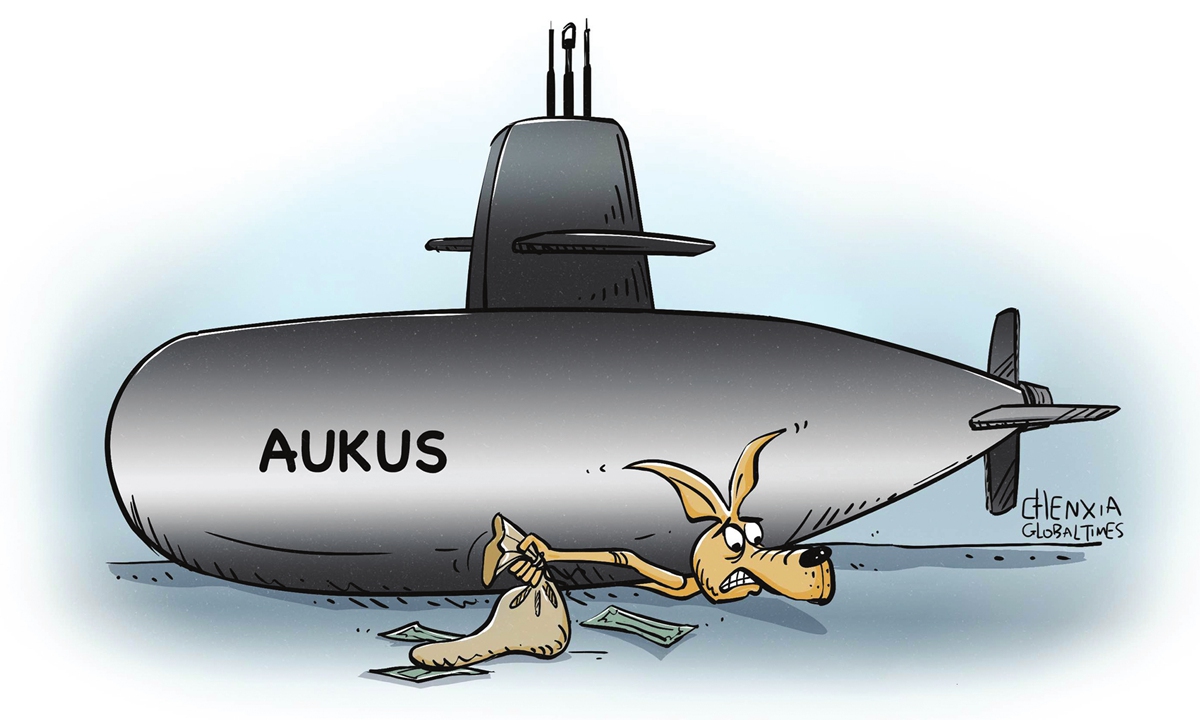
AUKUS Illustration: Chen Xia/Global Times
Five years since AUKUS was unveiled with considerable political fanfare, Australia has remarkably little to show for what was presented as a historic transformation of its defense capability. The country has committed vast financial resources, reoriented major elements of its defense planning and expanded facilities for US and British military operations, yet the nuclear-powered submarines at the center of the arrangement remain years, and in some cases decades, away. What was promoted as a bold investment in national security has instead become an increasingly burdensome undertaking marked by industrial bottlenecks, uncertain delivery schedules and deepening dependence on decisions made in Washington and London. The real question is no longer whether AUKUS is running behind schedule, but whether Australia has locked itself into a strategic architecture, whose political and security costs are materializing long before its promised military benefits.
Australian Defense Minister Richard Marles' recent visit to Washington further clarified the direction in which Australian defense policy is moving. Australia is moving from alliance coordination toward structural military enmeshment with the US, a process that steadily narrows Canberra's freedom of action and erodes the military autonomy that any serious middle power should seek to preserve.
AUKUS makes that problem especially stark. Australia is investing heavily in bases, training, maintenance facilities and nuclear-submarine support infrastructure before it possesses a nuclear-powered submarine fleet of its own, while the industrial capacity needed to deliver the program remains conspicuously fragile. The US continues to struggle to produce Virginia-class submarines at the rate required by its own navy, while British parliamentary scrutiny has repeatedly raised concerns over implementation, industrial capacity and program management. Canberra nevertheless proceeds as though future submarine transfers were effectively assured, although they remain contingent on production rates, political decisions and strategic priorities over which Australia exercises only limited influence. By assuming major financial and strategic commitments before securing the capabilities meant to justify them, Australia has taken on a disproportionate share of the risk while leaving crucial elements of delivery in the hands of its partners.
The asymmetry is embedded in the arrangement itself. Washington gains wider access to Australian territory, expanded military infrastructure, greater strategic depth across the southern Pacific and an ally whose armed forces are becoming increasingly integrated with the US military system. Australia, by contrast, assumes escalating expenditure, growing technological dependence and deeper exposure to contingencies shaped largely by US strategic priorities. The US retains considerable latitude to recalibrate its global commitments as circumstances change, whereas Australia is constructing fixed infrastructure and institutional dependencies that will be far harder to reverse. Calling this an equal partnership does not alter the underlying distribution of power or strategic discretion.
There is also a geopolitical reality that official rhetoric routinely seeks to obscure. When preserving a "free and open Indo-Pacific" is discussed, China is clearly central to the strategic logic sustaining AUKUS. Australia is not simply acquiring submarines or advanced military technologies. It is injecting an increasingly explicit military dimension into China-Australia relations and undermining the considerable efforts made in recent years to stabilize the bilateral relationship. The more closely Canberra is incorporated into US operational planning, the more vulnerable its relationship with Beijing becomes to strategic decisions made elsewhere and to confrontations that Australia may neither initiate nor be able to control.
The regional consequences are equally serious. AUKUS brings nuclear-powered submarines, long-range strike capabilities and increasingly integrated military planning into an Asia-Pacific already burdened by intensifying strategic rivalry, encouraging further military alignment, forward deployment and the competitive accumulation of advanced weapons systems. Far from insulating Australia from danger, this trajectory risks drawing the country closer to the very confrontation it claims to deter. Australia enjoys considerable geographical depth and has no compelling national interest in turning itself into a forward military platform in a confrontation between its principal security ally and its most important economic partner. Yet, as American forces, intelligence systems, logistics networks and submarine operations become more deeply embedded in Australia, the practical capacity of any future government to remain outside a conflict involving the US will inevitably diminish.
Therefore, five years after the establishment of AUKUS, Five years on, AUKUS should therefore be judged not by the grandeur of its political announcements but by the strategic position into which it is drawing Australia. The country is spending more, waiting longer and binding its defense establishment ever more closely to another power's military system while assuming greater risks in its relations with China and across the wider Asia-Pacific. The most serious danger is not merely that the submarines may arrive late or cost far more than expected, but that by the time they eventually enter service, Australia may have already relinquished much of the strategic independence they were supposedly intended to protect. If AUKUS continues along its present course, Canberra may ultimately discover that the price of becoming more useful to Washington has been to make Australia progressively less able to decide for itself when, where and for what purpose its military power should be used.
The author is director of the Asia Pacific Studies Centre at East China Normal University. opinion@globaltimes.com.cn
RELATED ARTICLES