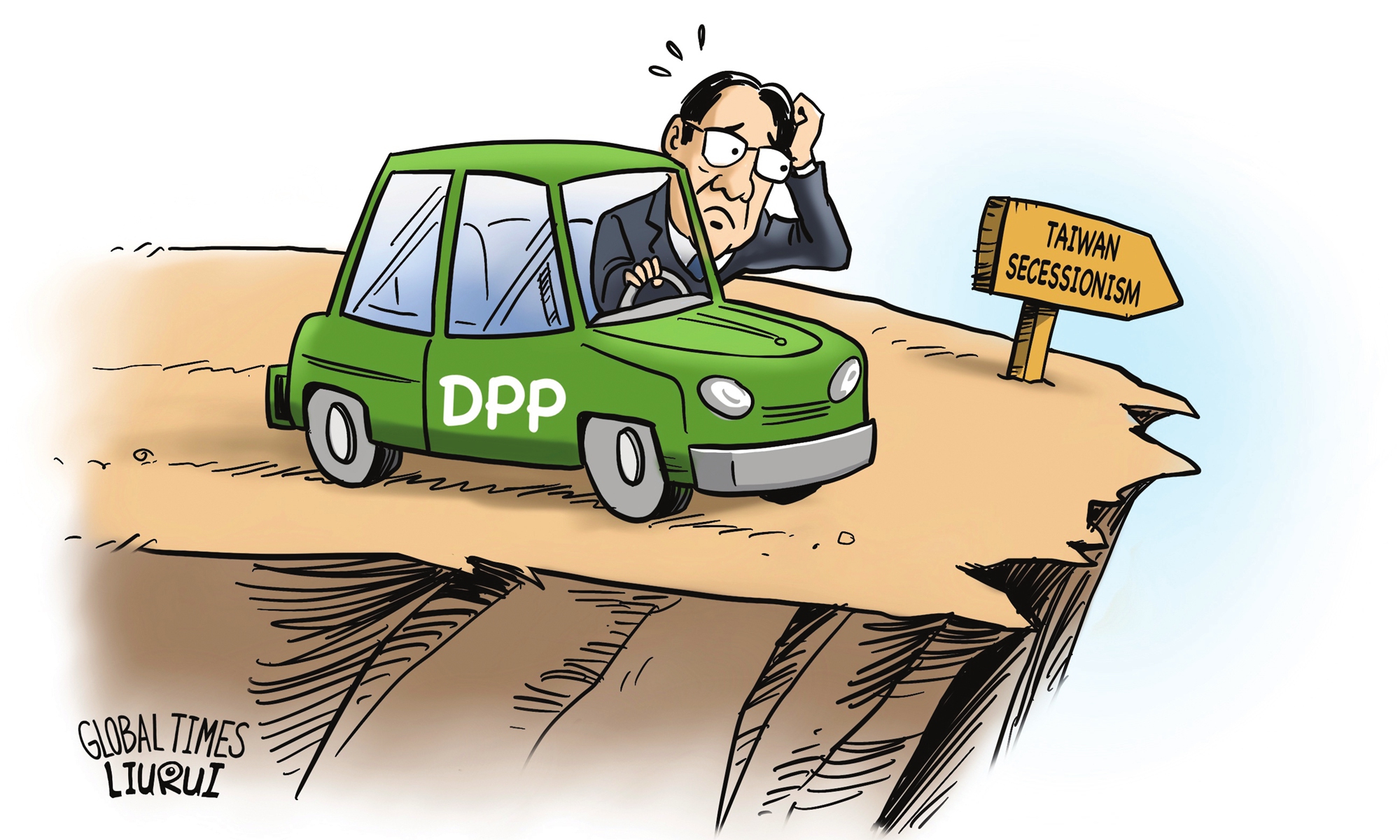
Taiwan DPP Illustration: Liu Rui/GT
In this year's so-called "Double Ten" speech, Taiwan regional leader Lai Ching-te portrayed the island of Taiwan as the "salt of the earth" and the "light of the world," calling for it to be built into a "city upon a hill."Yet the four major problems created under the Democratic Progressive Party (DPP)'s governance make Lai's rhetoric little more than self-congratulatory fantasy.
First, Taiwan's economy shows clear K-shaped polarization. In his speech, Lai highlighted economic growth and stock-market gains. In reality, nearly 80 percent of that growth has been driven by semiconductors, AI and related industries, while traditional sectors have long struggled. According to reports, exports in certain traditional industries have contracted for more than 10 consecutive months. Many small and medium-sized enterprises now receive only about 30 percent of the orders they once had, and factory equipment sits idle for long periods. Han Kuo-yu, head of Taiwan's legislative body, in his speech the same day, voiced concern that the Taiwan region is trapped in the predicament of "high-tech industries laughing all the way while traditional industries suffer."
Wages and savings are another source of widespread discontent. Taiwan's labor authorities report that about 17.2 percent of new entrants to the workforce still earn only the minimum wage. A survey by the job platform yes123 found that 77 percent of part-time workers save nothing each month and live paycheck to paycheck. Under high housing and living costs, most young people feel they simply do not have enough money. Taiwan People's Party Chairman Huang Kuo-chang criticized Lai's speech for having no sight of the real lives and hardships of ordinary people at the foot of the hill, pointing out that the wealth gap and the difficulties of traditional industries have been ignored.
Second, housing and living pressures far exceed the level of any "model" society. The house-price-to-income ratio is a key measure of affordability. The latest data from Taiwan's Ministry of Interior show an island-wide ratio of about 9.5 times. In Taipei it reaches 14.7 to 16 times and in New Taipei about 12.6 to 13 times. In both cities, an ordinary household would need 12 to 16 years of its entire income - with no spending on anything else - to buy a home. In terms of mortgage burden, Taipei residents spend more than 60 percent of monthly income on housing loans and New Taipei residents more than 50 percent.
Third, Taiwan's politics is highly polarized and the DPP authorities' governance capacity is low. The deep blue-green divide means the executive and legislative branches constantly check each other, making progress on livelihood bills difficult. In 2025, the DPP launched a large-scale recall campaign against all Kuomintang legislators in a manner resembling political witch-hunts; this year the DPP authorities have refused to implement laws passed by the legislature.
Poor governance has also increased the risk of industrial relocation. To avoid additional US tariffs on the island of Taiwan, many firms are shifting capacity to Southeast Asia, raising concerns about hollowing-out in central and southern industrial zones. Even the chip industry, long called the "sacred mountain" of Taiwan, has seen large-scale plant construction in the US, Japan and Europe. Massive outflows of both high-tech and traditional industries will seriously undermine Taiwan's future development prospects.
Finally, the DPP authorities' provocations against the Chinese mainland leave Taiwan island's security unprotected. In recent years, the Chinese mainland has actively promoted peaceful and integrated cross-Straits development, held the Straits Forum and the Shanghai-Taipei City Forum, and invited Kuomintang Chair Cheng Li-wun to visit mainland cities, all in an effort to stabilize the Taiwan Straits situation. Yet Lai's authority has repeatedly promoted a "new two state theory," hindered ordinary Taiwan people from traveling to or interacting with the Chinese mainland, and arbitrarily suppressed forces on the island that support cross-Straits reunification. These moves have made cross-Strait relations severe and complex, and peace in the Taiwan Straits difficult to guarantee.
In this year's speech, Lai once again ignored the facts, reversed right and wrong, hyped up the "Chinese mainland threat" and peddled the false narrative of "democracy versus authoritarianism." A spokesperson for the Taiwan Affairs Office of the State Council pointed out that Lai's 2026 "Double Tenth" speech was a true-to-form performance by a "pragmatic worker for Taiwan independence."
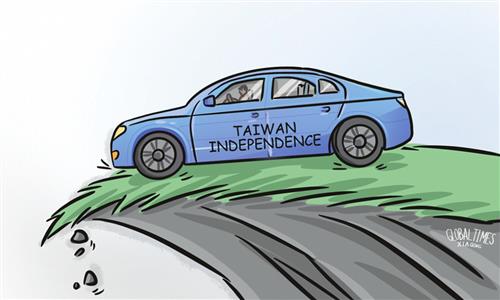
These four shortcomings make it impossible for Taiwan to become the "city upon a hill" Lai described. Only by genuinely returning to the correct path of the one-China principle - both sides of the Straits belonging to one China - can the authorities in Taiwan build a society that others truly envy.
The author is a research fellow at the Institute of Taiwan Studies under the Chinese Academy of Social Sciences. opinion@globaltimes.com.cn
RELATED ARTICLES