COMMENTS / INSIDER'S EYE
GT Voice: China's rapid progress in robotics offers South Korea opportunities
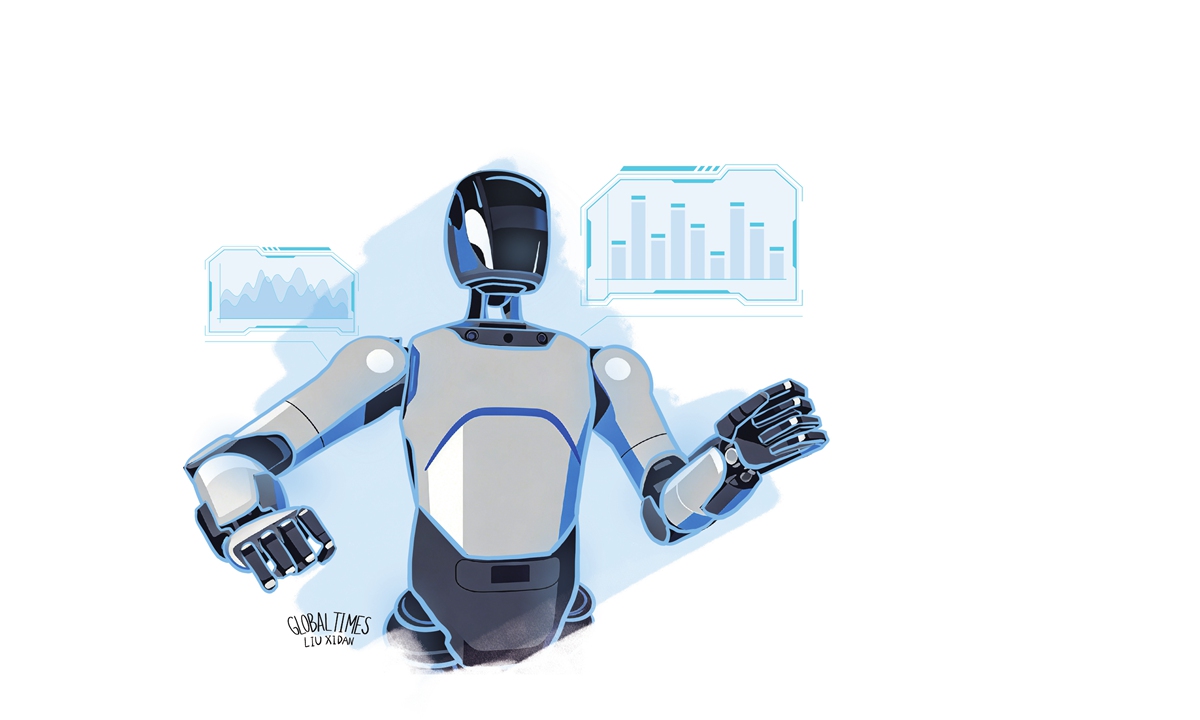
Illustration: Liu Xidan/GT
The economic potential of humanoid robots extends beyond the machines themselves. The Chosun Daily reported on Sunday, citing Counterpoint Research, that demand for DRAM chips used in the "brains" of humanoid robots equipped with artificial intelligence (AI) is expected to grow more than 20-fold by 2030.The projected growth has raised hopes that humanoid robots could become a new source of growth for Samsung Electronics and SK Hynix, top DRAM memory chipmakers in the world.
As humanoid robotics quickly develops and progresses, China has established a substantial presence in this field. Chinese media outlets have reported that more than 140 Chinese companies were researching and developing humanoid robots in 2025, while a widely cited market study estimated that robots made in China accounted for 84.7 percent of global shipments last year. The growth of China's robotics sector creates massive opportunities for South Korean DRAM suppliers.
Yet normal market competition with Chinese enterprises appears to be a concern in South Korea. In a separate article, The Chosun Daily reported that during the audit done by the country's National Assembly's Science, ICT, Broadcasting and Communications Committee on October 6, criticism was voiced that South Korea's investment in humanoid robotics lagged behind China's.
And, two humanoid robots made by Chinese companies were brought to the audit to illustrate the gap between the two countries. The robots walked into the meeting room, shook hands with a representative and performed a dance. The demonstration offered a glimpse of South Korea's concerns about the gap in robotics development with China.
China's advances in humanoid robotics offer greater opportunities for South Korean suppliers, but they appear to have raised concerns about the competitive gap too. Such mixed reactions reflect the complex responses that the rise of AI-driven smart industries can provoke.
Today, humanoid robotics is emerging as a new frontier in AI development. The sector will create greater demand not only for robots but also for high-end chips, sensors and other electronic components the robots could rely on.
Competition between China and South Korea seems to be inevitable, but it is only one part of a bigger picture. Humanoid robotics depends on a broad network of suppliers, creating opportunities for companies in the two countries to share at different stages of the supply chain. As China's industry expands, South Korean suppliers could find greater markets for their components.
And, China and South Korea bring different strengths to the evolution of humanoid robotics.
China's capabilities in robot manufacturing, supply-chain scale and real-world application scenarios provide a foundation for the industry's expansion. South Korea has accumulated expertise in semiconductors and electronic components used in these robots. The industry's growth could create more chances for greater complementarity, with expanding robot production potentially opening up additional markets for South Korean suppliers.
The humanoid robotics sector is just one example. The same logic applies to the broader AI industry, where advances are creating new products, new applications and new markets. Therefore, China's technological progress need not be viewed by South Korea solely as a competitive challenge. Instead, it could open up new windows for broader bilateral cooperation.
The greater potential for complementarity in high-end manufacturing is reflected in recent trade data. In September, South Korea's exports to China rose 122.7 percent to reach $26.01 billion, exceeding $20 billion for a fourth consecutive month. Semiconductors, wireless communication components and computers were among the main drivers of that growth.
These figures point to growing demand in China for South Korean products, suggesting that the expansion of China's AI-related industries is creating greater opportunities for South Korean component manufacturers.
As AI drives a new wave of high-end industrial development, South Korea's opportunity may lie not in viewing China's technological progress as a competitive challenge, but in finding ways to expand bilateral cooperation and share the greater benefits of cooperation.
RELATED ARTICLES