Houthi attack on Riyadh airport sparks fears of wider Mideast conflict
Latest clash signals a new phase of intense confrontation: expert
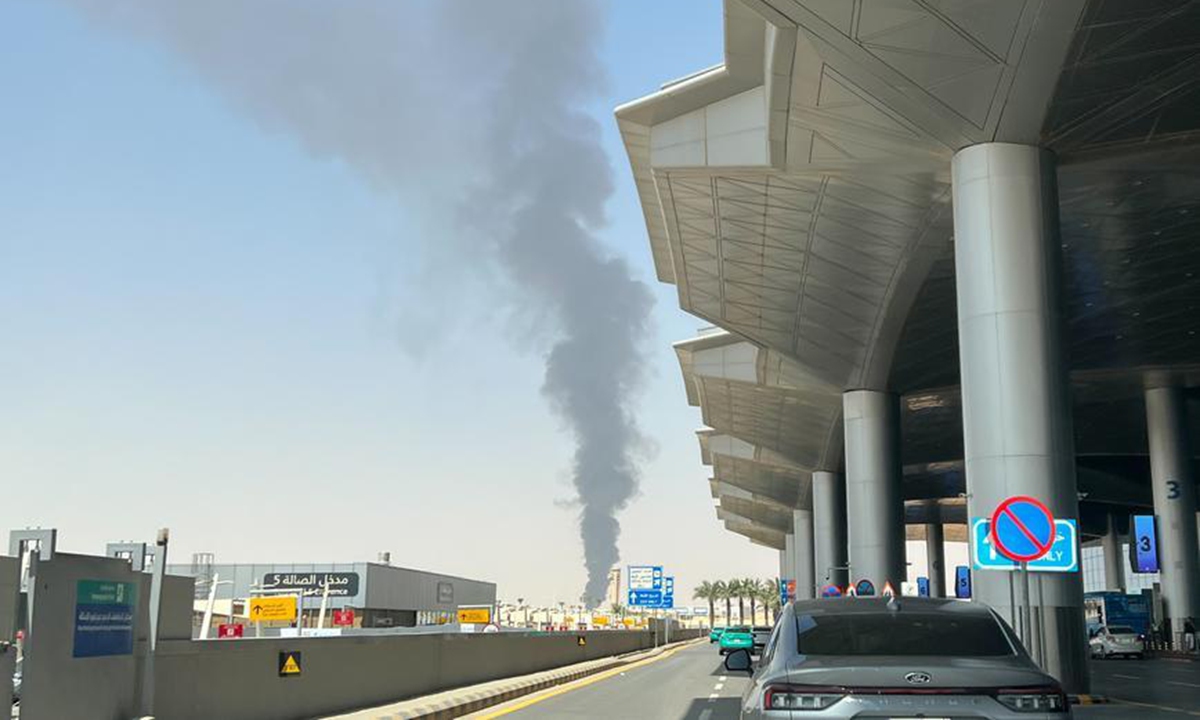
This photo taken with a mobile phone on Sept. 19, 2026 shows thick smoke rising near King Khalid International Airport in northeastern Riyadh, Saudi Arabia. Photo: Xinhua
An attack on King Khalid International Airport in the Saudi capital Riyadh on Saturday afternoon has reportedly left 12 people dead and 309 injured, triggering reactions across the region and beyond.
According to update by the Sweden Herald on Sunday night, explosions have been heard in central Riyadh, the Saudi capital, citing AFP reports. At the same time, the Houthi movement accuses Saudi Arabia of attacking the airport in Yemen's capital, Sanaa, the AP reported.
The attacks came amid an escalation in Yemen, where the Saudi-backed government forces are fighting the Houthis. Yemen's Houthi group has repeatedly targeted the airport in recent days.
According to a statement on social media platform X, the Saudi General Authority of Civil Aviation (GACA) said early on Sunday that the fatalities included four Saudi citizens and eight foreign residents - two Bangladeshis and one each from the US, Egypt, Jordan, Syria, Palestine and Sudan.
The injured are receiving necessary medical care at area hospitals, with some in serious condition, the authority said, adding that the material damage was still being assessed.
Chinese experts said that the escalation of hostilities, including Houthi attacks on Saudi airports, signals a new phase of intense confrontation, with the risk of simultaneous crises in the Red Sea and the Strait of Hormuz growing amid broader regional tensions in the Middle East.
Broader involvement
Reuters noted in its report that Saturday's attack, which is "the deadliest in the kingdom in more than a decade," occurred without warning.
Previously, Houthi attacks on King Khalid airport on Thursday killed at least three Saudi citizens, including a pilot, according to the GACA, Al Jazeera reported.
The Saudi-led coalition in Yemen has vowed to respond firmly to the Houthi attack. Coalition spokesperson Turki Al-Malki said early Sunday on X that the coalition's Joint Forces Command would respond firmly to what he described as a "terrorist attack" in accordance with international humanitarian law, according to the Xinhua News Agency.
Following the Saturday attack, the Houthi group said in a statement that it was ready for reciprocal measures with Saudi Arabia to keep airports, seaports and other facilities with humanitarian functions outside the escalating military confrontation, Xinhua reported.
Liu Zhongmin, a professor at the Institute of Middle East Studies at Shanghai International Studies University, told the Global Times that the intensification of hostilities, including Houthi attacks on targets such as Saudi airports, signals a new phase of high-intensity confrontation, even as the underlying tensions between the US and Iran remain unresolved. In this case, the risk of simultaneous crises in the Red Sea, Persian Gulf, and Strait of Hormuz is increasing, the expert noted.
The attack drew condemnation and statements of concern from multiple countries. Foreign embassies in Riyadh, including those of the US, the UK, Ireland and Canada, issued advisories on social media to their citizens in Saudi Arabia, according to Al Jazeera.
The Chinese Embassy in Saudi Arabia said on Sunday morning that no Chinese nationals had been reported killed or injured so far, urging Chinese-funded institutions and Chinese nationals in Saudi Arabia to remain firmly aware of potential risks, minimize non-essential outdoor activities, remain calm, and ensure their personal safety.
US President Donald Trump described the attack as "terrible" and said he "will be speaking" with Saudi Crown Prince Mohammed bin Salman, soon, according to the Al Jazeera report. He also said he was evaluating whether the US should join the war against the Houthis.
"We may. We're gonna look at it. We just found out about the recent attack, so we'll make a decision. We'll move very quickly," he said, the report cited.
The moves come in the wake of the Makkah Joint Defense Agreement signed by Saudi Arabia, Turkey and Pakistan in August, which stipulated that any armed attack against one of the three countries will be considered an attack against them all.
Sun Degang, director of the Center for Middle Eastern Studies at Fudan University, said that a more plausible scenario would be strategic-level cooperation between the three countries, including greater technical assistance to Saudi Arabia.
However, although the agreement is defensive in nature, Liu said that if the two countries militarily intervene in the Yemen conflict, the range of actors involved in the conflict would become even more diverse, and the scale of the conflict will expand, Liu said.
The US also faces a choice, Liu said. If Washington handles the matter in a low-key manner, more attention and resources will still be directed toward the strategic contest with Iran.
However, following the death of an American citizen, the US President may yet launch direct strikes against the Houthis, Sun told the Global Times. Despite Trump's reluctance to escalate the conflict in the Middle East, the US may be drawn in, potentially leading to further escalation.
From Hormuz to Red Sea
Since the US and Israel launched strikes against Iran in February, the focus of the Middle East conflict has been the US-Iran confrontation in the Gulf, Sun said. However, the recent focus has gradually shifted to the Red Sea, with Saudi Arabia and the Houthis emerging as the main parties. This shift from the Gulf to the Red Sea signals a potential escalation of the conflict, he said.
The expert added that the conflicts in the Middle East are interconnected. "The Houthis are supporting Iran in its confrontation with the US in the Red Sea. Whether it's in Gaza, Lebanon, Iran or Yemen, developments in one area can affect all other actors in the Middle East. A move in one arena can trigger changes across the entire region," Sun said.
A report from AP News highlighted that the attacks on Saudi Arabia, the world's top oil exporter, have rattled markets and the region.
Sun said that exports of fertilizers, energy and even helium could be disrupted due to the conflicts, posing a major challenge to global economic recovery.
Geopolitically, the links between the Middle East conflict, the Ukraine conflict and instability in other parts of the world are growing stronger. If more countries become involved in the Red Sea conflict, the current crisis could risk spiraling out of control on a much wider scale, he noted.
RELATED ARTICLES