Taiwan Lai Ching-te Illustration: Liu Rui/GT
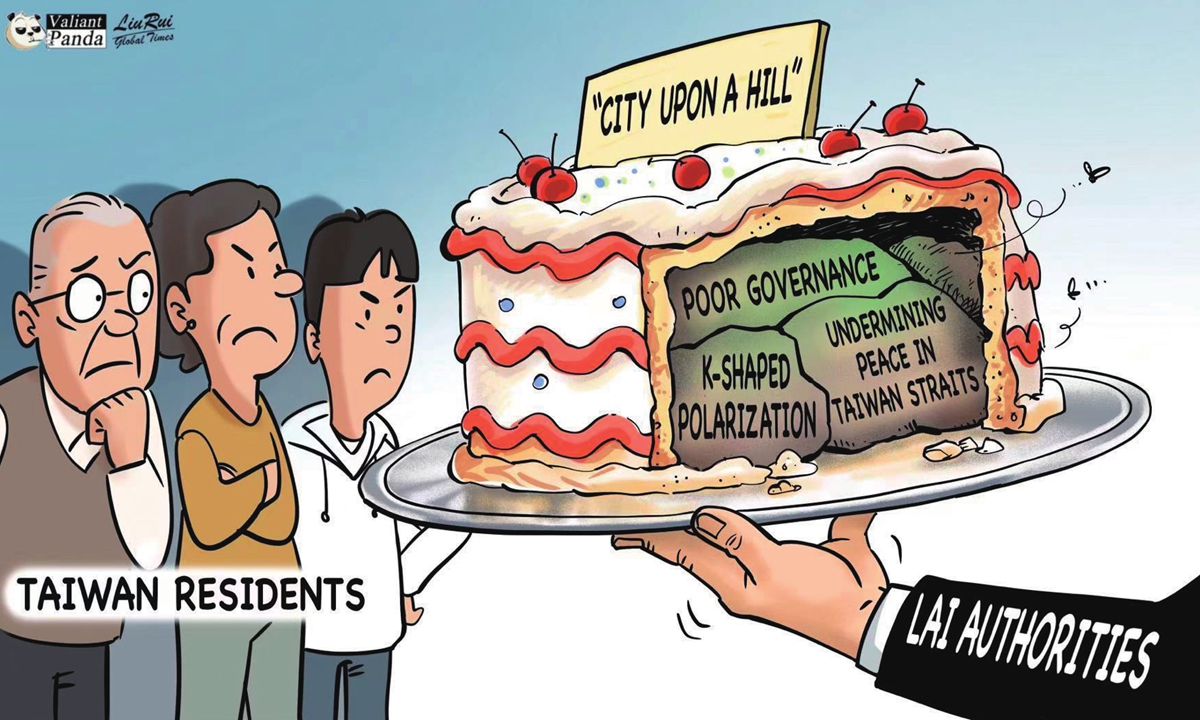
Taiwan regional leader Lai Ching-te deliberately crafted his "Double Ten" speech around the narrative of the "city upon a hill." Originally a political metaphor from the West, the "city upon a hill" symbolizes a moral benchmark and an ideal society. Lai referred to Taiwan as "the salt of the earth" and "the light of the world," describing an imaginary "city upon a hill." Yet on the ground in reality, it cannot find a single patch of soil on which to stand firmly.First, Lai attempted to use the imaginary "city upon a hill" to obscure the increasingly tangible skepticism toward himself. In his speech, Lai stated that "We welcome the US and China managing their competition through dialogue." The reality, however, is that the outcomes of the recently concluded China-US leaders' meeting dealt a severe blow to the Lai authorities' policy of "relying on the US to seek independence."
Lai's "Double Ten" speech was intended to cover up the growing skepticism toward himself, obscure the clear signal against "Taiwan independence" sent by the recent China-US leaders' meeting, and use a set of flowery rhetoric to gloss over the reality of his governance incompetence.
Second, Lai tried to use a fanciful "city upon a hill" to obstruct the increasingly close cross-Straits exchanges. In his speech, the Taiwan regional leader claimed to "cherish peace" and is "open to exchanges," but the reality is that he has gone to great lengths to hinder cross-Straits exchanges.
Starting September 1, the Lai authorities, while extending the existing ban on group tours to the Chinese mainland, have tightened restrictions on self-organized mainland-bound tour groups and study delegations. All of these actions lay bare the Lai authorities' sheer double standards.
Third, Lai aimed to hype up the Democratic Progressive Party's prospects in the "nine-in-one elections" by invoking the "city upon a hill." When referring to the "nine-in-one elections," Lai stated that "political parties may compete, and opinions can differ." The reality, however, is that the Lai authorities have mobilized prosecutors, investigative agencies, administrative resources, online propaganda teams, and recall mechanisms to systematically suppress opposition candidates from the Kuomintang and the Taiwan People's Party, thereby restricting their campaign activities.
This fully confirms the characteristics of "fake democracy, real dictatorship" as pointed out by Han Kuo-yu, head of Taiwan's legislative body. While Lai touted democratic values, he has turned the electoral system and the judiciary into weapons to crack down on opposition forces.
Fourth, Lai was challenging the one-China principle with his fanciful notion of a "city upon a hill." In his speech, Lai claimed his authorities would serve as "a stabilizing force the international community can trust," asserting that increasing investment in defense was "not to provoke" and does not mean "to abandon dialogue." The reality, however, is that Lai has labeled the Chinese mainland an "aggressor," claimed that the mainland is altering the status quo across the Taiwan Straits and continuously exaggerated the threat posed by the mainland.
The Lai authorities have significantly expanded their defense budget, diverting massive financial resources to arms procurement at the expense of budgets for people's livelihoods. It is precisely the persistent provocations by Lai and other "Taiwan independence" separatist forces that escalate the risk of conflicts across the Taiwan Straits.
Fifth, Lai attempted to distort and undermine the historical and legal implications of the China-US consensus by invoking a fanciful "city upon a hill" metaphor. In his speech, Lai claimed that "there must be no tolerance for distorting the history of WWII," yet the reality is that he constantly and deliberately distorts the historical narrative through "de-Sinicization," asserting that it was the Republic of China that "fought alongside the US" and promoting the separatist rhetoric that the two sides of the Taiwan Straits are "not subordinate to each other."
Nonetheless, the fourth point of consensus reached at the China-US leaders' meeting last month - which noted that China and the US were allies in WWII and fought side by side to win the war - reveals the truth and deals a crushing blow to the Lai authorities' "de-Sinicization" maneuver and its "Taiwan independence" historical perspective.
Lai's "city upon a hill" claim is merely an attempt to "boost his own morale" out of insecurity. As China-US relations continue to stabilize, people from all walks of life both on and off the island remain pessimistic about the prospects of "Taiwan independence." Lai should not delude himself into thinking that by relying on Western political rhetoric, he can continue his "Taiwan independence" political maneuvers filled with false promises and the distortion of facts.
The author is a research fellow at the Institute for Taiwan, Hong Kong and Macao Studies of the Shanghai Institutes for International Studies. opinion@globaltimes.com.cn
RELATED ARTICLES