Joint efforts by both China and S. Korea enable return of Qing Dynasty stone lions, museum curator
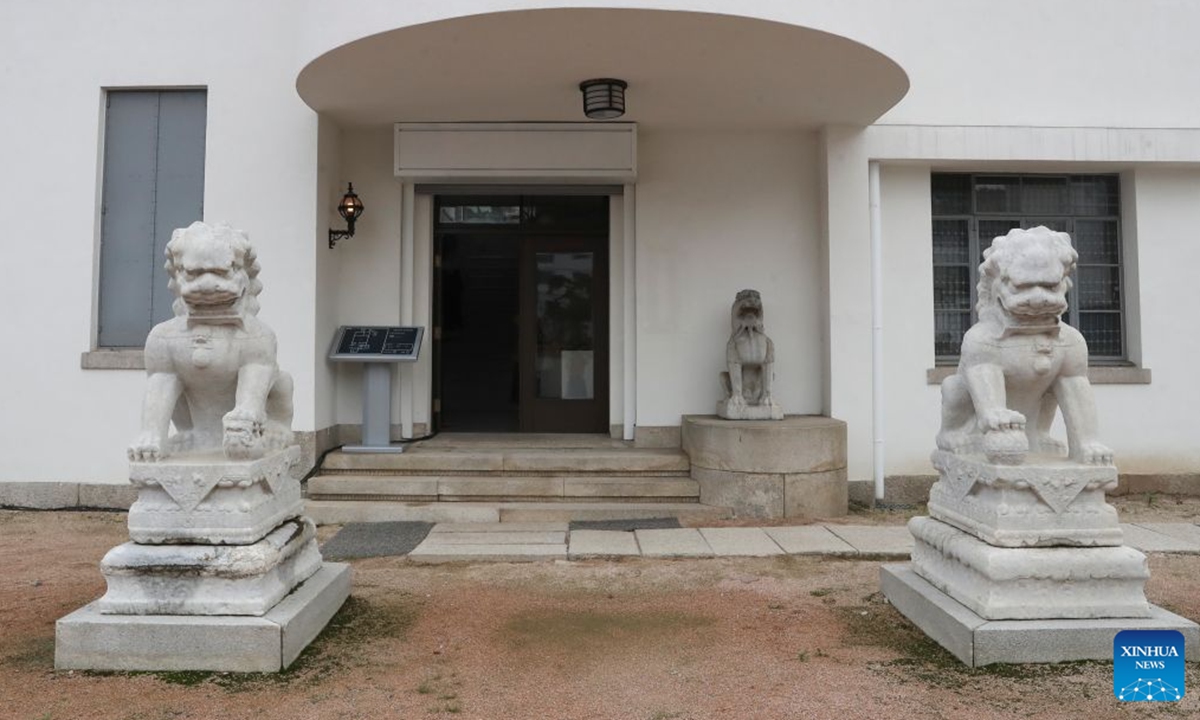
This photo taken on July 23, 2026 shows a pair of Qing Dynasty stone lion sculptures returned by South Korea to China at the Kansong Art Museum in Seoul, South Korea. Photo: Xinhua
Proactive joint efforts by both China and South Korea have facilitated the return of a pair of Qing Dynasty stone lion sculptures to China this year, a curator at the National Museum of Korea told the Global Times, noting that despite broader challenges in securing the return of cultural artifacts held overseas, the case demonstrates what bilateral cooperation can achieve.
A handover ceremony for a pair of Qing Dynasty stone lion sculptures returned by South Korea to China was held in July at the Kansong Art Museum, according to the Xinhua News Agency. At the ceremony, China's National Cultural Heritage Administration (NCHA) formally received the stone lions from the National Museum of Korea.
The stone lions were purchased in 1933 by Jeon Hyeong-pil, founder of the Kansong Art Museum, at an auction held in Osaka, Japan, by the Yamanaka & Co. art dealership. From the museum's opening in 1938 until their return, the sculptures were displayed at the entrance to Bohwagak, the original name of the Kansong Art Museum.
Jeon always regarded the stone lions as Chinese cultural relics and expressed his wish that they should one day be returned to China. In December 2025, the National Museum of Korea, acting on behalf of the Kansong Art Museum, began consultations with the NCHA on their return, eventually reaching an agreement.
Discussing the process with the Global Times, Eom Chaehyeon, associate curator of the Cultural Relations and Publicity Division of the National Museum of Korea, said that the large number of cultural artifacts taken overseas from China and Korea made their return on a comprehensive scale difficult.
The return of the stone lions was made possible through the initiative of the Kansong Art Museum, Eom said. She explained that individual collectors or institutions holding such artifacts may have opportunities to return them, and that both countries should actively express their willingness to move the process forward when those opportunities arise.
"Both Chinese and South Korean sides were actually very proactive and agreed to move forward with the process, making it possible through their joint efforts," Eom said.
Speaking at the handover ceremony in July, Rao Quan, vice minister of culture and tourism and head of the NCHA, said the return of the stone lions was a practical step in implementing the consensus reached by the Chinese and South Korean leaders on expanding people-to-people and cultural exchanges.
China is willing to take the return of the stone lions as an opportunity to further expand long-term and in-depth cooperation with South Korea in the field of cultural heritage, he said.
The South Korean side also said the return was made out of deep respect for Chinese history and culture and symbolizes the strong mutual trust between the two countries. It expressed hope that it would open a new chapter in bilateral cooperation on cultural heritage, further enhance mutual trust and friendship, and inject fresh momentum into broader cooperation in economic, social and other fields.
"As more cases like this arise, countries should cooperate more actively. This requires sustained exchanges and networking between the two sides," Eom said.
While transferring cultural artifacts is a major undertaking, ongoing people-to-people exchanges would make it easier for both sides to explore cooperation when opportunities arise, Eom added.
Despite the complex political, economic and diplomatic dynamics in East Asia, cultural exchanges should always continue, she told the Global Times. "Culture should serve as a bridge for South Korea and China to maintain friendly relations."
RELATED ARTICLES