Illustration: Liu Xiangya/GT
China's Ministry of Foreign Affairs announced two countermeasures on Monday against Paraguay's Minister of Information and Communication Technologies Gustavo Emigdio Villate Samaniego and Belize Minister of Foreign Affairs and Foreign Trade Francis Fonseca. Both decisions target specific individuals and explicitly set out the measures to be taken: the freezing of their movable and immovable assets and other property in China; the prohibition of transactions, cooperation or other activities with them by Chinese organizations and individuals; and the denial of visas and entry into China, including Hong Kong and Macao.
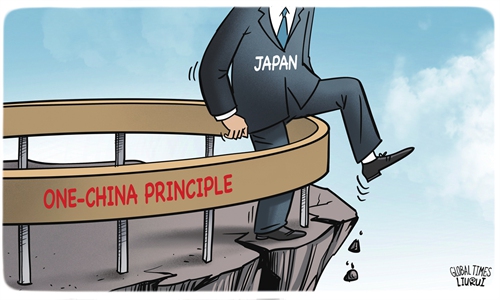
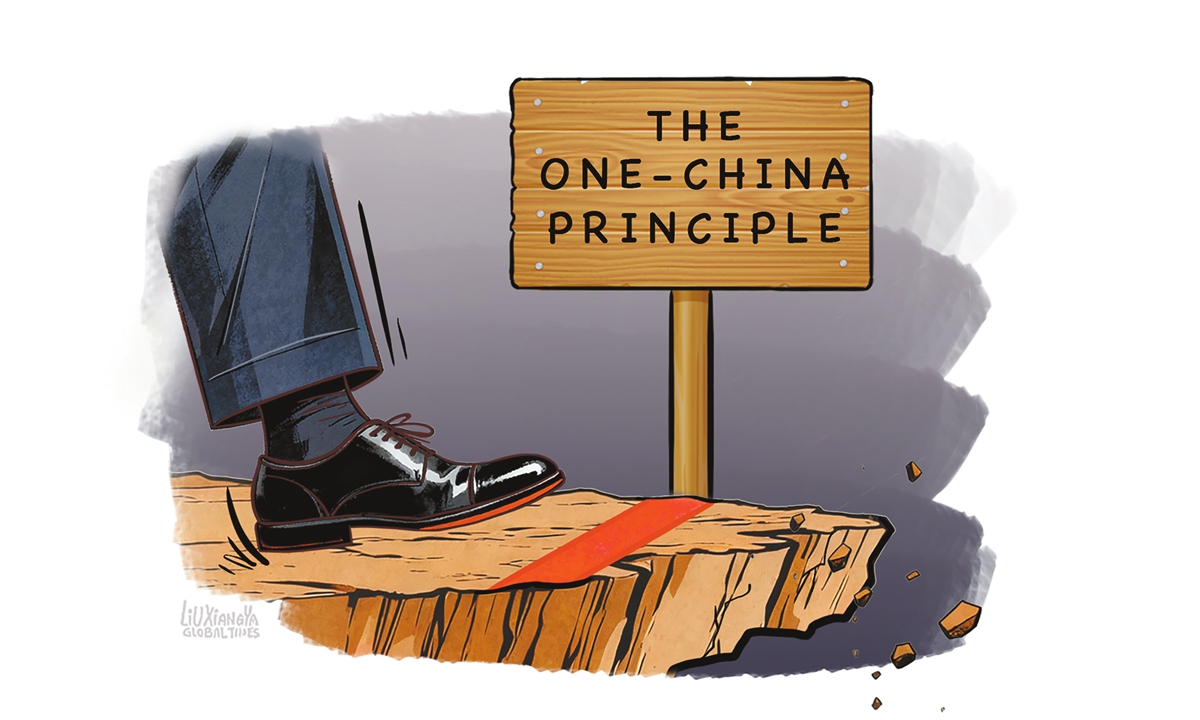
These two decisions have drawn attention not only because the countermeasures are clear and forceful, but also because they correct a long-standing misperception: Some external forces mistakenly believe that the Taiwan question can be repeatedly maneuvered through diplomatic rhetoric, and that while they support the Taiwan authorities in maintaining "diplomatic relations," individuals will not face any consequences. Now, the countermeasures have named specific individuals and drawn clear boundaries.
Tie specific words and deeds to respective responsibilities
The two decisions explicitly state that certain politicians, out of self-interest, have stubbornly supported their country's maintenance of "diplomatic relations" with China's Taiwan region and have repeatedly taken words and deeds that harm China's core interests on China-related issues. Countermeasures shall be imposed in accordance with relevant provisions of the Anti-Foreign Sanctions Law of the People's Republic of China. The legal basis, targets and measures of the countermeasures are crystal clear. This means that a stance on the Taiwan question is no longer merely a statement made in diplomatic settings that can be adjusted at any time. Those who make concrete choices must bear the consequences of their decisions.
At the same time, the decisions target specifically designated individuals. No inference should be drawn that China has imposed sweeping, state-level countermeasures against Paraguay or Belize. Clarifying this point is essential to accurately understanding the weight of these measures. China has clearly expressed its position and defined the scope of the countermeasures. The clearer the boundaries, the less likely the outside world is to misjudge the situation.
No bargaining on core interests
The Taiwan question concerns China's sovereignty and territorial integrity. Regarding this question, certain foreign politicians each have their own agendas: Some hope to secure political gains by maintaining ties with the Taiwan authorities, while others seek to turn their statements on Taiwan into tools for projecting influence. There may be all manner of such political calculations, yet China's core interests are by no means bargaining chips.
Some may naively assume that preserving the status quo across the Taiwan Straits allows them to continue testing the limits. Today they extend political support to the Taiwan authorities; tomorrow, they seek to ease tensions through economic and trade cooperation with the Chinese mainland or friendly rhetoric. The two countermeasures have sent a clear message: On issues involving China's sovereignty, politicians' public words and deeds will inevitably carry political consequences, and cooperation with China must respect Beijing's core concerns.
To mitigate risks, stop wrongful tests first
Countermeasures will prompt those involved to reassess the costs, but what truly needs to change is the flawed political logic of treating the Taiwan question as a political tool. If external forces continue to send wrong signals to "Taiwan independence" separatist forces, they will easily fuel the latter's expectations of so-called external support, thereby escalating risks in the Taiwan Straits. And ultimately, it is the people in Taiwan who will bear the brunt of those risks.
Therefore, when assessing whether a party sincerely wishes to develop relations with China, one must not only listen to how it paints the prospects for cooperation but also observe how it handles issues involving China's sovereignty. Respect for China's core concerns must be reflected in concrete words and actions.
The two countermeasures send a clear and powerful message: The Taiwan question cannot be manipulated, traded away or tested. Those aligning themselves with "Taiwan independence" separatist forces are heading down a dead end - one that leads to forfeited development opportunities and growing isolation from the international community.