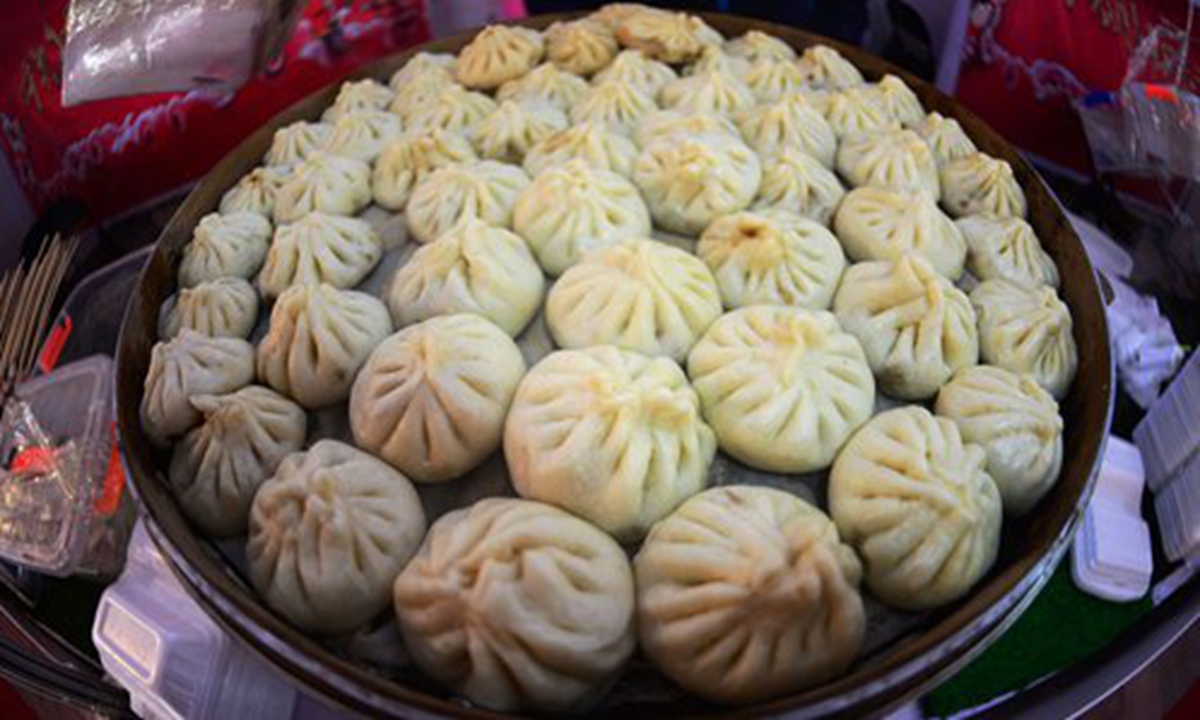
Baozi (steamed buns with filling) Photo: IC
On October 17, a foreign blogger shared a video on social media: At the Chinese Cultural Festival in Copenhagen, Denmark, a local young man named Peter sold Sichuan-style braised pork buns from a tricycle. A queue stretching hundreds of meters lasted a full nine hours.His revenue exceeded 50,000 yuan in a single day. Even uncooked braised pork buns were snapped up by diners. This is by no means an isolated case. In recent years, an increasing number of authentic Chinese flavors have garnered countless fans worldwide.
It is a thought-provoking scene.
Back in the mid-20th century, many of the first wave of Chinese to venture abroad made their living relying on the "three blades" - a kitchen knife, a pair of tailor's scissors and a barber's razor. Of these, the kitchen knife carried the greatest weight.
Contract labourers from Guangdong, Fujian and other regions travelled far to North America to pan for gold, build railways, or "head south to the Nanyang." Born in shabby shacks, early Chinese restaurants at first served nothing but familiar hometown flavors for Chinese labourers.
When the "Canton Restaurant" opened in San Francisco in 1849, its early menu featured dishes such as "chop suey," characterized by the stir-frying of offcuts and vegetables in large, filling portions. For a long time, overseas Chinese food was merely a livelihood for low-income immigrants, confined to Chinatowns, and even labelled as cheap and marginal. Back then, Chinese cuisine going global was a survival necessity for those who left their hometowns behind.
Over the past century, Chinese cuisine's global expansion has gone through multiple phases of evolution. After China's reform and opening-up, time-honored brands such as Quanjude began venturing overseas. Around 2010, chain restaurants including Haidilao rolled out systematic global layouts. In recent years, affordable street foods such as Yang Guofu's spicy hotpot have made powerful breakthroughs into mainstream markets.
Peter's story, however, is that of a foreigner who learnt the art of making braised pork buns in China, brought this "Chinese carb delight" back to Denmark, and saw it become a huge hit. It demonstrates that Chinese cuisine is no longer merely a "source of nostalgia for overseas Chinese," nor does it need to exist in the adapted form of "American-Chinese food." The "authentic Chinese flavor" is a selling point in its own right. This shift resonates with trends such as Chinamaxxing currently sweeping across overseas social media platforms.
This is partly attributable to the growing Chinese diaspora overseas. More importantly, as China's overall national strength keeps rising, global interest in and goodwill toward China have increased markedly. Chinese food is no longer just about "filling one's stomach" or "trying something new." It has evolved into a lifestyle and aesthetic choice that people actively seek out and savor time and again. Meanwhile, the traditional wisdom embedded in China's dietary philosophy is gaining worldwide recognition.
For a long time, Western cuisine, with its elegant plating, individual serving rituals and standardized system, was to some extent synonymous with "sophistication." Today, however, a quiet transformation is taking place at the dining table.
Chinese food thrives both in the bustling street markets and on the finest dining tables, boasting profound cultural heritage. This may be why Chinese cuisine truly wins over the world: It has not become more like Western food. Instead, the world, including Western audiences, has grown willing to understand and embrace it for what it truly is.
RELATED ARTICLES