EU Illustration: Xia Qing/GT
The recent EU summit once again focused on Ukraine. Although EU leaders pledged continued support, divisions among member states have deepened. In the early stages of the Russia-Ukraine conflict, external security pressures forged consensus on sanctions against Russia, aid to Ukraine, and defense buildup. However, this unity was largely an expedient response to the crisis rather than a lasting strategic consensus.
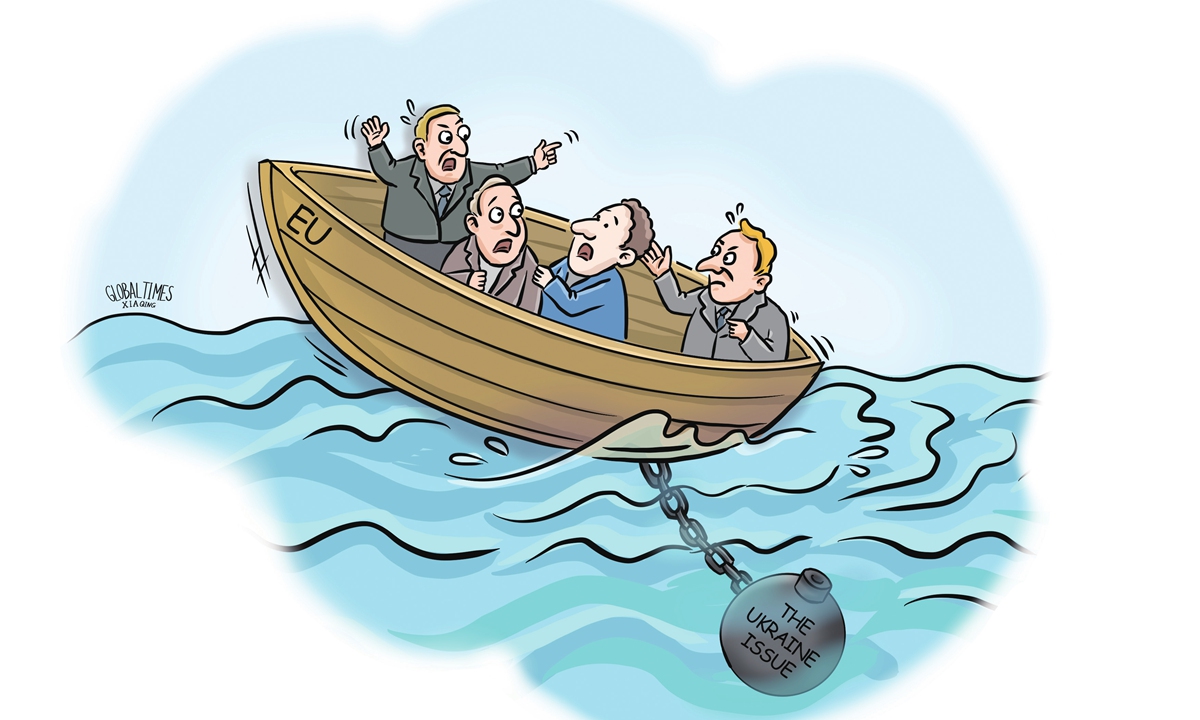
As the conflict drags on, economic costs, domestic pressures and divergent security priorities have eroded that unity. The Ukraine issue has evolved from a unifying cause into a stress test of EU cohesion and collective action. The conflict is not only a crisis for Ukraine but also for Europe, challenging its security, economic order and internal governance.
First, institutional shortcomings expose the bloc's governance dilemma. The unanimity requirement in EU foreign and security policy allows individual member states to obstruct collective action. In August, Belgium retaliated its opposition against an EU plan to use frozen Russian assets to support Ukraine's economy and war effort. Meanwhile, Slovakia, under Prime Minister Robert Fico, rejected military assistance to Ukraine and the EU's confrontational approach toward Russia. These differences expose the EU's dilemma of "unity in rhetoric, division in implementation": Member states publicly pledge support for Ukraine but pursue divergent approaches on funding, asset management, military assistance and relations with Russia.
Second, shifting public opinion is eroding support for Ukraine. The prolonged conflict has profoundly reshaped the political landscape of EU member states, serving as a major catalyst for the rise of populist and right-wing forces and intensifying political divisions across Europe. Public support for Ukraine has gradually weakened, with "Ukraine fatigue" becoming increasingly widespread. According to a Bertelsmann Foundation poll, 47 percent of EU citizens support Ukraine joining the bloc in the coming years, while 53 percent oppose accession within that timeframe. Such divisions constrain governments' policy choices and undermine a common European position.
Third, economic pressures have deepened internal divisions. Continuing aid, refugee accommodation, refugee accommodation costs and changing trade patterns have increased fiscal pressure and competing national interests. These pressures vary significantly across member countries. Germany and France, as major supporters of Ukraine, continue to shoulder substantial assistance and refugee-related costs, adding to mounting fiscal deficits and debt burdens. Italy and France, already heavily indebted, face growing competition between aid spending and domestic priorities such as social welfare and infrastructure investment, prompting a more cautious policy stance.
At the end of 2025, Hungary, Czechia and Slovakia withdrew from funding and guarantee arrangements for a proposed 90 billion-euro loan to Ukraine, forcing the EU to rely on a coalition of willing states rather than a unified 27-member framework. At the recent EU summit, Ukrainian President Volodymyr Zelensky requested an additional 70 billion euros in support for next year. Growing financial demands could further intensify disputes over burden-sharing.
Finally, the US-Russia diesel deal has further exposed strategic divisions across the Atlantic. Recently, the US eased its sanctions on Russian diesel without adequate consultation with European partners. European officials feared the move would provide Russia with additional revenue for its winter offensive. After bearing much of the economic cost of sanctions, Europe now faces a US policy shift that undermines the unified Western sanctions framework and further erodes trust within the transatlantic alliance. The episode highlights Europe's strategic dilemma: It seeks to safeguard its security interests in Ukraine but remains heavily dependent on US security support, leaving it in a relatively passive position within the transatlantic relationship.
Ultimately, the Ukraine issue has become a key factor shaping Europe's stability and development. The EU's early consensus on Ukraine has gradually been eroded by economic costs, shifting public opinion, political polarization and divergent national interests. Institutional deadlock at the EU level, divisions in public opinion, and economic fragmentation have compounded one another, making it increasingly difficult for Europe to maintain a unified and consistent Ukraine policy. The image of unity projected by the EU can no longer conceal the internal strategic disagreements. Whether the EU can balance geopolitical and security imperatives with the economic and social interests of its member states, while addressing institutional shortcomings and political polarization, will directly shape the future of European integration and influence Europe's security landscape and strategic trajectory.
The author is a research fellow at the Institute of Russian, Eastern European and Central Asian Studies at the Chinese Academy of Social Sciences. opinion@globaltimes.com.cn
RELATED ARTICLES