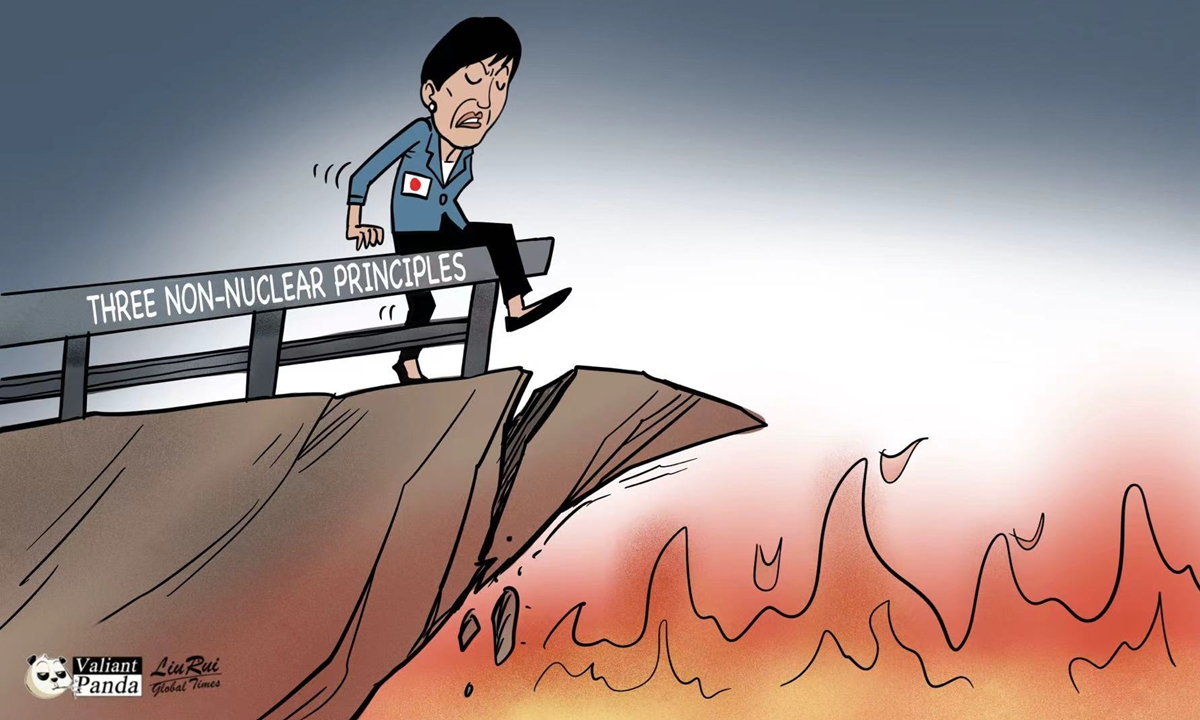
Playing with fire. Illustration: Liu Rui/GT
In 1967, the Japanese cabinet, under then prime minister Eisaku Sato, proposed the
"Three Non-Nuclear Principles," namely not possessing, not producing and not permitting the introduction of nuclear weapons. The principles, confirmed by the Japanese Diet in 1971, have since become essential to Japan's postwar identity: a defeated nation committed to a defensive military stance.
Today, however, this cornerstone of Japan's nuclear policy is cracking under mounting pressure. The Sanae Takaichi administration has stepped up its efforts to revise Japan's three national security documents, and the ruling coalition has repeatedly floated the idea of Japan going nuclear. The pressure is mounting on one principle in particular: the prohibition on introducing nuclear weapons, which appears to be the easiest to breach. And that breach appears imminent.
According to Japanese media reports, the Takaichi administration is considering revising the "no introduction" principle as part of an amendment to the three security documents.
The push to break the "Three Non-Nuclear Principles," starting with the "no introduction" provision, is a key step by Japan's right-wing forces in their salami-slicing of the postwar system. But the costs to the country would be unbearable.
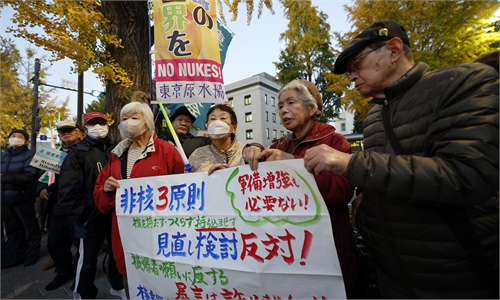
First, it would put the Japanese government on a collision course with the public. For the Japanese people, anti-nuclear pacifism is a deeply held national conviction. A recent poll by the Japan Association for Public Opinion Research found that 76 percent of respondents favored maintaining the "Three Non-Nuclear Principles," while 77 percent opposed any "nuclear sharing" arrangement that would introduce US nuclear weapons. As of August 2026, 128 local assemblies across Japan had petitioned the Diet, urging the government to adhere to the principles. If the Japanese government turns a deaf ear to this national consensus, it will tear apart Japan's post-WWII identity as "a peaceful nation" and fracture the social fabric and political foundation of the country.
Second, it would upend the regional security order. Northeast Asia is already one of the world's most strategically contested regions, and its security dynamic is among the most sensitive. When Japan starts loosening its nuclear constraints, it will inevitably put its neighbors on high alert and trigger a chain reaction across the region, gravely endangering regional security. Moreover, Japan itself would be pushed to the forefront of nuclear rivalry and plunged into an even deeper security dilemma of its own making. This is all the more dangerous considering Japan's large stockpiles of separated plutonium. Japan is the world's only non-nuclear-weapon country with a full nuclear fuel cycle, giving it the industrial and technological capacity to build nuclear weapons. Allowing US nuclear weapons into Japan under the pretext of "extended deterrence" would in reality give Tokyo operational experience and technical know-how to build its own nuclear arsenal, thereby activating its latent nuclear weapons capability - a development that would pose a substantial threat to regional and global security.
Third, it would betray Japan's international treaty obligations. Under the Cairo Declaration and the Potsdam Proclamation, Japan shall be "completely disarmed" and shall not maintain those industries "which would enable her to rearm for war." As a non-nuclear-weapon state party to the Treaty on the Non-Proliferation of Nuclear Weapons, Japan, under international law, is bound by the obligation of "not receiving, producing, possessing or proliferating nuclear weapons." Japan's Atomic Energy Basic Act also stipulates that nuclear energy research, development and utilization shall be restricted to peaceful purposes. Any move to revise the "no introduction" principle - and set Japan on the path to nuclear armament - would severely threaten the post-war international order and destroy Japan's diplomatic credibility.
Breaching the "Three Non-Nuclear Principles" would be a wild gamble on Japan's future and East Asia's peace and stability, and would test the limits of international tolerance.
Japan's ruling authorities would do well to heed their own people's call for peace and their neighbors' legitimate security concerns. They should make sure Japan abides by its international legal obligations and commitments, holds the line on the "Three Non-Nuclear Principles" and remains on the path of peaceful development. This is the only way to safeguard Japan's long-term interests and preserve regional peace and stability.
The author is an observer of international affairs. opinion@globaltimes.com.cn
RELATED ARTICLES