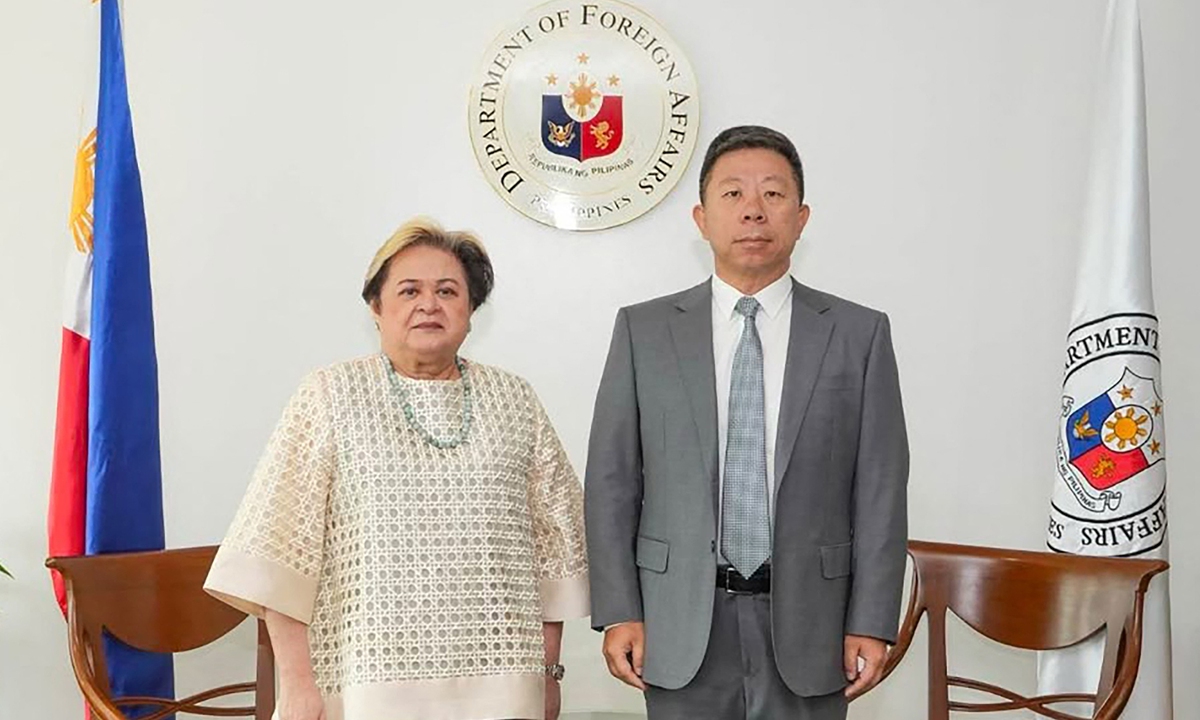
Chinese ambassador to the Philippines Jing Quan (right) and Philippine Secretary of Foreign Affairs (DFA) Ma. Theresa P. Lazaro Photo: VCG
"The Philippines should feel fortunate to have China as a neighbor. If we want to use force, we may easily win. No, we will not choose to use force. And we love peace. We hope that countries in this region - especially those in East and Southeast Asia - will work together to cherish peace and pursue common development. China is willing to share its development experience and technologies with its neighbors, and it hopes that these countries will view China's development as an opportunity rather than a threat."
This is what Jing Quan, the Chinese Ambassador to the Philippines, recently said to the media. Anyone with a normal capacity for understanding can easily perceive the earnest counsel and goodwill behind Chinese side's words. Yet, Manila either cannot - or perhaps chooses not to - grasp this. On Monday, the Philippine Department of Foreign Affairs even put on a show by lodging a formal "representation," protesting what it termed a "threat of the use of force" against the Philippines. Such a distortion of reality - akin to calling a deer a horse - is a carefully orchestrated public opinion stunt; in essence, it is nothing more than petulant, unreasonable behavior. Certain individuals in Manila are all too familiar with this playbook - it is a tactic they employ with practiced ease.
To a large extent, the Chinese side is merely stating a fact. Just imagine if a Latin American country were to send a dilapidated vessel to remain in US territorial waters in the Gulf of Mexico, while claiming the area as its own - the rest of the world would surely conclude that such a country must have an extraordinary amount of audacity. In other words, it is not hard to imagine what the outcome might be for the Philippines if its neighbor were the US rather than China. Given that China is a major power committed to being a good neighbor - handling bilateral frictions with the utmost patience and striving to maintain regional peace - the Philippines should truly count itself lucky.
China has not threatened - and will not threaten - the Philippines with force; however, it will by no means submit to diplomatic extortion by the Philippines. Ambassador Jing Quan's remarks were not made without cause. When asked by the media for his take on Philippine Defense Secretary Gilberto Teodoro Jr.'s characterization of China as a "troublemaker" in the region, Ambassador Jing pointedly noted that the real troublemakers are those who target Chinese-language teachers without justification, arrest Chinese workers, and smear or attack China. His comments were pertinent and candid - stating facts and drawing clear red lines, while also urging the Philippines to refrain from deliberately stoking conflict and undermining a hard-won peace. Rooted in a desire for peace, his words were well-founded, reasoned, and served as both counsel and caution. In truth, it is individuals like Teodoro - who seem intent on creating trouble - that ought to cease their provocations.
Interestingly, also on Monday, the Philippine Malacañang Palace stated that Malacañang remains optimistic about improving ties with China. It seems that Manila is well aware that improving and developing these ties serves the common interests of both sides. Given this, it ought to rein in the irresponsible words and actions of certain individual politicians, rather than allowing them to maliciously exploit China-related issues to undermine the bilateral relationship. Manila should give serious thought to whether it wants to let differences continue to erode the relationship, or whether it prefers to keep a path open for peace and development. The Philippines should do well to heed the words of Ambassador Jing Quan.
RELATED ARTICLES