COMMENTS / INSIDER'S EYE
GT Voice: Chip export boom reveals deepening China-South Korea complementarity
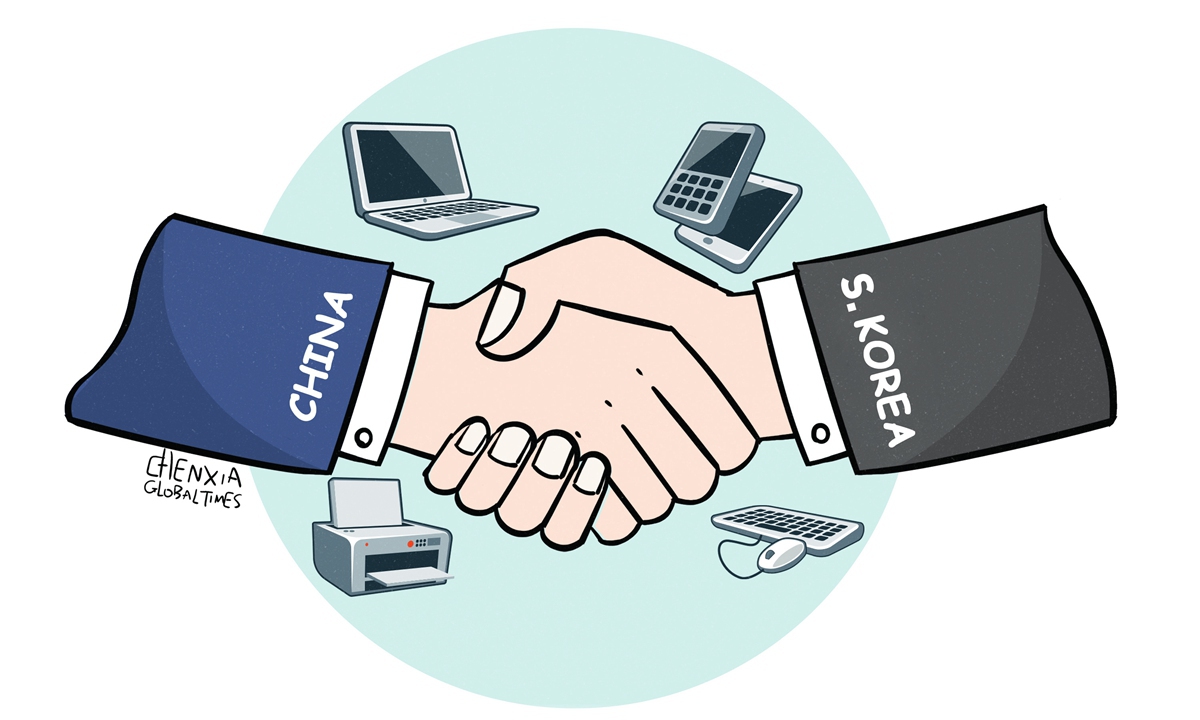
Illustration: Chen Xia/GT
South Korea's exports are becoming a showcase of the global technology industry. During the first 20 days of October, South Korea's semiconductor exports surged 222.5 percent year-on-year to reach $27.5 billion, setting a new record. The chip exports accounted for 44.7 percent of the country's total, up 16.2 percentage points from a year earlier, the Yonhap News Agency reported on Wednesday.
By destination, chip exports to China soared 154.4 percent to $16.6 billion, and exports to the US stood at $10.7 billion.
Viewed over the longer term, this round of South Korea's export growth extends an AI-driven expansion of global computing demand that has been building for years. In 2024, South Korean chip exports rose to $141.9 billion, up 43.9 percent year-on-year. In 2025, the figure climbed to $173.4 billion, up 22.2 percent.
South Korea's semiconductor exports have kept surging this year. In the first quarter, they reached $78.5 billion, up 139 percent year-on-year, and in the first half year, they hit $192.4 billion, exceeding the whole of 2025. The Bank of Korea in August raised the country's economic growth forecast this year to 3.3 percent - an increase of 0.7 percentage points and the highest level since 2021.
The rationale behind this upward revision was that the extraordinary prosperity of South Korea's semiconductor sector was spreading from exports into domestic consumption, investment and other areas of local demand, steering the country's economy onto a more solid trajectory of growth.
The massive jump in South Korea's exports to China stands out. At $16.6 billion, the figure far outpaces the value of shipments to the US. This export pattern reflects two things. On one hand, China's ongoing investment in AI large-language model training, data center construction and digital infrastructure is unleashing enormous demand for memory chips. On the other, Asia's regional semiconductor supply chain retains remarkable resilience despite geopolitical disturbances outside the region.
The deep complementarity between the Chinese and South Korean technology industries rests on solid structural foundations.
China is one of the world's largest semiconductor markets, with integrated circuit imports rising 63.5 percent year-on-year to $499 billion in the first nine months of this year. Samsung and SK Hynix together hold roughly 70 percent of the global memory chip supplies, and both companies' Chinese plants are deeply embedded in local supply chains.
With the world's largest demand market on one side and irreplaceable high-end supply on the other, this deeply intertwined pattern, where each side is present in the other's industrial landscape, is not something that external factors can easily change.
But challenges remain behind the eye-catching data. South Korea's chip exports are mostly concentrated in the memory sector. At the same time, the technology export controls implemented by certain countries pose potential risks too.
This is precisely why both the space and necessity for deeper China-South Korea industrial chain cooperation are on the rise. If South Korea hopes to translate its current export momentum into sustainable long-term growth, relying solely on technological upgrades and product iteration will not be enough. The more important step lies in proactive industrial chain-level planning, deepening coordination with the broader Asian semiconductor ecosystem, and above all, preserving and expanding the depth of cooperation with China.
This is a strategic issue that will determine whether South Korea can retain sufficient room for maneuver in an increasingly fragmented global trade environment.
The 17th round of negotiations on Phase II of the China-South Korea Free Trade Agreement, held in Seoul last week, placed services and investment at the core of discussions. This suggests that the two sides may open greater room for institutional opening-up in information technology, high-end manufacturing and the digital economy, extending semiconductor complementarity currently concentrated in goods trade into other fields.
Over the medium and long term, complementarity between the Chinese and South Korean industrial chains is far from reaching its ceiling. As global technology supply chains continue to face considerable uncertainty, deeper cooperation grounded in market logic and industrial reality will not only sustain South Korea's export curve, but also inject greater stability into the regional economy.
RELATED ARTICLES