Solidifying the foundation of China-ASEAN mutual trust via a shared development vision
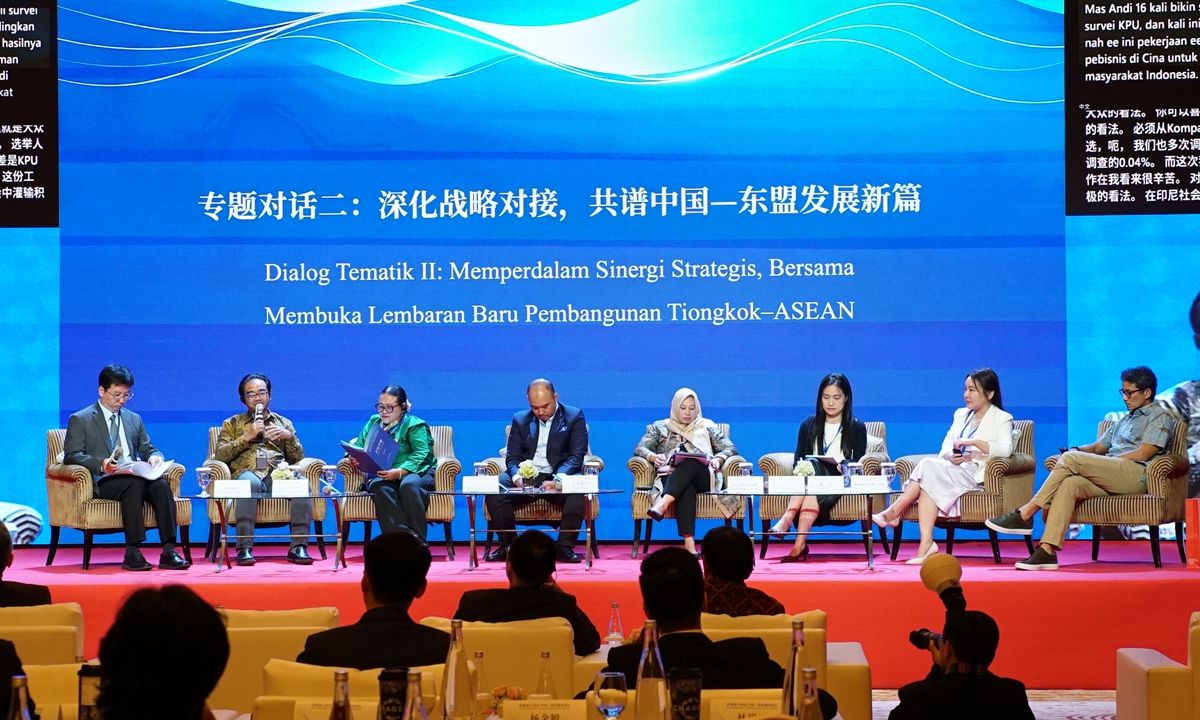
The Panel II of "Global South Dialogue: China-Indonesia Roundtable Forum" is held in Jakarta, Indonesia, on October 19, 2026. Photo: Zhang Han/GT
Editor's Note:The "Global South Dialogue: China-Indonesia Roundtable Forum," hosted by the Global Times, was recently held in Jakarta, Indonesia. More than 150 guests from various sectors in China and Indonesia held in-depth discussions on topics such as building a China-Indonesia community with a shared future, strengthening China-ASEAN regional cooperation and promoting the common development of the Global South. These are the highlights from the discussions during the second expert panel.
Promoting strategic alignment
Shobichatul Aminah, head of the Center for Strategic and Global Studies, Graduate School of Sustainable Development, Universitas Indonesia: 2025 and 2026 mark pivotal years for Asia's development. ASEAN's Community Vision 2045 seeks to build a resilient, innovative, dynamic and people-centered regional community. China's 15th Five-Year Plan (2026-30) centers on high-quality development, covering technological innovation, industrial modernization and green transition. The two sides should explore how the two agendas can reinforce each other through alignment to generate synergies.
Such coordination can be deepened in four directions. First, boost connectivity and economic integration. Beyond physical infrastructure, institutional links, including customs clearance, standards harmonization and digital trade rules, should be improved. While lifting cargo efficiency, partners must also ensure the benefits of connectivity are broadly shared.
Second, advance digital transition, joint innovation and technological collaboration. Our priority should shift to building shared innovation capacity. Work should also cover data security and AI governance, with the ultimate goal of fostering a collaborative digital ecosystem that unlocks innovation for all ASEAN members.
Third, pursue green development and collective resilience. China and ASEAN face interlinked challenges spanning energy, climate change and natural disasters - all of which can be turned into productive avenues for cooperation. The two sides can expand energy investment and scale up financing for green projects.
Fourth, and most importantly, nurture human capital and deliver inclusive public benefits. Higher and vocational education can serve as vital bridges to help younger generations adapt to economic shifts, so ordinary people can tangibly reap the rewards of progress and build a community with a shared future.
Ren Yuanzhe, professor at the Department of Diplomacy and Foreign Affairs Management, China Foreign Affairs University: I began to work in Jakarta at the Chinese Mission to ASEAN in 2023, when Indonesia held the rotating ASEAN chairmanship. ASEAN and East Asian cooperation delivered major strides, with broad consensus and outcome documents reached. I gained a keen appreciation of ASEAN's weight in regional and global governance. I also saw firsthand the inherent closeness and boundless potential of China-ASEAN ties. China-ASEAN cooperation is now entering a new phase that prioritizes strategic alignment, industrial coordination and collaboration in emerging sectors.
The intensifying conflict in the Middle East poses severe food and energy security risks for ASEAN. Our shared expectations lie in energy security and transition, the China-ASEAN Comprehensive Strategic Partnership, alignment between ASEAN Community Vision 2045 and China's 15th Five-Year Plan, plus two-way investment, the digital economy and the green economy. The key is to sustain the positive momentum of China-ASEAN cooperation while strengthening developmental resilience and cultivating new growth drivers.
China-ASEAN trade cooperation offers valuable experience for future strategic alignment. With their unique geographic advantages and abundant resources, ASEAN nations have become a prime destination for Chinese enterprises going global.
Cooperation between China and ASEAN is evolving toward deep industrial and supply chain integration. Chinese firms in ASEAN are forming a more and more complete ecosystem, rather than operating in isolation. This interconnected and symbiotic business relationship serves as a solid foundation and vivid embodiment of the China-ASEAN community with a shared future.
Tightening people-to-people bonds
Sandiaga Salahuddin Uno, former minister of Tourism and Creative Economy of Indonesia and former deputy governor of Jakarta: At present, connectivity between Indonesia and China is growing increasingly deeper and more refined. On this foundation, I believe there is immense room for growth in tourism cooperation. If more young entrepreneurs from both Indonesia and China join hands to develop various tourist destinations and projects, the underlying connectivity is well capable of supporting such collaboration.
During my previous trip to China, I brought a delegation of more than 20 young Indonesian entrepreneurs. No briefing, no matter how good, can compare to on-the-ground observation and experience. We plan to organize these visits on a regular quarterly basis to unearth more tourism cooperation opportunities between our two nations, and propel the sector toward higher-quality, more sustainable development.
My previous visit to the "One-Meter Space" project in Ningbo left a deep impression on me. It serves as a vehicle for integrating the creative economy with culture and plays a significant role in the development of the tourism industry. I believe that the new generation of successful entrepreneurs from both our countries will find it easier to forge bonds of cooperation.
Henny Saptatia Drajati Nugrahani, head of the Department of Global Strategic and Area Studies, Universitas Indonesia: In recent years, I have traveled to China multiple times for academic exchanges, attending conferences on topics such as innovation, poverty alleviation, and sustainable development. Take my latest trip as an example: I stayed in Guangxi for five days before spending another five days in Guangzhou, engaging in in-depth exchanges with participating scholars throughout. This journey further updated my overall perspective on China.
Over this trip, I became friends with nearly 50 Chinese scholars, and we now stay in touch on WeChat, exchanging thoughts on a wide variety of topics daily. Chinese scholars were eager to share their knowledge and insights, introducing me to the situation I needed to understand in detail, such as fishery development, especially smart aquaculture, and other innovative practices.
In my view, China and ASEAN can further strengthen exchanges at the societal level. Throughout the process of getting to know and interacting with each other, both sides need to invest sincerity and emotion, seeking resonance in shared needs. If communication and cooperation between both sides lack an emotional connection, it will be difficult to build a long-term, stable foundation. Only through joint investment and efforts can various exchange activities create broader space for people from all walks of life in both countries to deepen their bonds.
Laying foundations for localization
Anggawira, chairman of the Indonesian Energy, Mineral, and Coal Suppliers Association: I believe that cooperation with China will become a very important part of our respective lives. Just two weeks ago, we led a delegation of around 30 young entrepreneurs to visit Chinese technology and energy companies and learn about their innovations and cooperation plans. My engagement with Chinese friends dates back to 2010, when I was invited to visit China. Over the course of three weeks, I traveled to several cities and took part in exchanges under the ASEAN Plus China, Japan and South Korea (10+3) framework. Such cooperation has continued over the years, including many people-to-people initiatives, and I have consistently worked to advance these efforts further. In my view, China has consistently demonstrated a willingness to deepen cooperation with us across various fields, including energy. I have also been impressed by China's remarkable innovations and development, many of which are now actively entering the Indonesian market. Numerous Chinese companies have established a strong presence in Indonesia and across the broader ASEAN region, with particularly strong performance in the automotive industry. We look forward to building greater consensus and achieving more tangible results in areas such as technological cooperation in the years ahead.
Hang Yajuan, general manager of China National Chemical Engineering Group in Indonesia: Indonesia's strategic location, abundant resources and large domestic market, together with the broader ASEAN region, have long made it one of the preferred destinations for Chinese companies expanding overseas. Both the cumulative two-way investment between China and ASEAN and the cumulative turnover of Chinese enterprises' contracted projects in ASEAN have exceeded $500 billion. This demonstrates the close economic ties between the two sides.
I have been working in the Southeast Asian region since 2017. The most important lesson is that embracing diversity and differences and achieving localization are essential. It is not enough to simply bring capital, technology and industrial capabilities from China. What matters is fully respecting the diversity of the local environment, building a local workforce, developing local supply chains, complying with local regulations, respecting local culture and integrating into local communities. Chinese companies should create local jobs, transfer skills and improve people's livelihoods.
As China's 15th Five-Year Plan and ASEAN Community Vision 2045 are being implemented, significant opportunities lie ahead for both sides. Chinese companies will continue to pursue localization and inclusive development, working hand in hand with Indonesian and ASEAN partners to achieve genuine win-win outcomes.
Wei Ran, founder of TWS Think Tank: Over the past decade or so, we have worked closely with more than 200 Chinese unicorn companies, helping them chart their development paths for the next five to 10 years. Throughout this process, we have focused on the cross-border flow of talent, intellectual capital, industry, and financial capital. Expanding the global governance perspective of the executive teams is the essential first step for a company to embrace an international outlook. The interplay between capital, entrepreneurs, and talent continuously injects vitality into emerging industries across various regions. Whether in Southeast Asia or elsewhere globally, Chinese enterprises must integrate capital, industry, and talent to take root locally and build long-term, symbiotic communities with their partners. This reflects a simple yet invaluable trait often found in Chinese entrepreneurs.
RELATED ARTICLES