Far-sea capabilities on display as China's 48th naval escort formation completes record Gulf of Aden mission
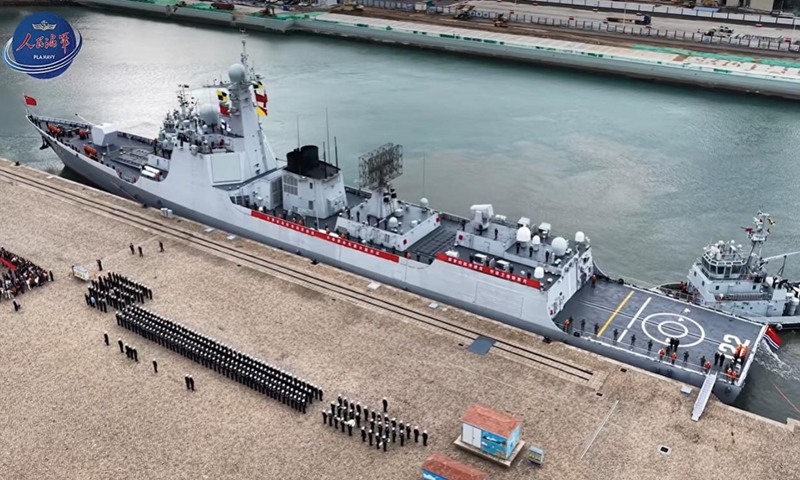
The type 052DL destroyer Tangshan (Hull 122) returns to a naval port in Qingdao, East China's Shandong Province, on October 23, 2026. Photo: Screenshot from the PLA Navy WeChat account
Cheered by crowds of military and civilian well-wishers lining the pier amid music and flowers, the Chinese People's Liberation Army (PLA) Navy's 48th escort taskforce has wrapped up its Gulf of Aden escort mission and returned to Qingdao, East China's Shandong Province. Its 378-day tour at sea stands out as a fresh marker of the service's maturing capacity for sustained far-sea operations, observers and experts say.
Made up of the Type 052DL destroyer Tangshan (Hull 122), the Type 054A frigate Daqing (Hull 576), and the Type 903A comprehensive supply ship Taihu (Hull 889), the 48th escort taskforce set sail from Qingdao on October 11, 2025, and returned on Friday morning.
The deployment lasted 378 days and covered more than 150,000 nautical miles. The taskforce safely escorted 423 Chinese and foreign vessels, safeguarding international sea lanes and contributing to regional peace and stability.
Gulf of Aden escort operations are the PLA Navy's longest-standing and most extensive overseas military practice since its founding, in terms of routine deployment duration, forces employed, and range of activity, safeguarding national strategic interests, said CCTV News.
The 48th taskforce's deployment appears to be the longest yet. In recent years, consecutive escort taskforces have each been at sea for about a year, or at least 300 days, longer than earlier rotations, observers noted.
Experts said the reliability of Chinese naval equipment and the level of personnel training have reached a high standard, sufficient to sustain long-term, routine far-sea presence. The PLA Navy has also formed a comprehensive support system combining ships' own logistics with overseas support nodes. The Djibouti support base can provide rest and resupply for Gulf of Aden escort formations and is a key element of navy building.
Longer deployments, more capability
Throughout the mission, the 48th taskforce combined sailing, training, and improvement, using the open ocean as a training ground. It utilized complex maritime environments and organized targeted drills related to escort operations, including armed rescue missions and round-the-clock helicopter flights, enhancing its ability to carry out diversified missions, according to the PLA Navy.
Beyond escort duties, the taskforce took part in the "Will for Peace 2026" joint maritime exercise in South Africa and the China-Pakistan "Sea Guardian IV" joint naval exercise in Pakistan. It also took part in a parade marking the 50th anniversary of Seychelles' independence, paid friendly visits to Bangladesh, Myanmar, and Malaysia, and made technical stops in Oman, Kenya, Singapore, and other countries, according to China Military Online.
The 378-day voyage is regarded as setting a new record for a single Gulf of Aden escort deployment, said Wang Yunfei, a Chinese military affairs expert. He told the Global Times on Sunday that multiple recent task forces have deployed for noticeably longer than earlier rotations, with three consecutive deployments exceeding 300 days, a clear sign that the PLA Navy's ocean-going adaptability has improved significantly and reached world-class standards.
At the foundation is equipment reliability and seaworthiness. Wang said the formation can continue operating without returning to home port for major replenishment, showing that ship maturity and refined logistics have reached a new level.
Comprehensive ocean-going replenishment is the core support. Long deployments multiply consumption of fuel, fresh water, food and spare parts. The capability of supply ships, along with choices of replenishment timing and location, directly determines how far and how long a formation can operate. Multiple taskforces sustaining 300-plus days shows coordination between supply ships and combat vessels is highly mature, the expert said.
Personnel support is equally critical. A year-long deployment tests the psychology and physiology of officers and sailors. Rotation and rest mechanisms, mental health support and improved living conditions are the soft power that sustains long-term combat capability, Wang said, noting that a taskforce deployment must have all personnel meet the relevant training standards before carrying out missions.
Every post must be ready for any task, training, support, navigation, communications, air and missile defense, to sustain long deployments, he noted.
Wider support network
Beyond the formation itself, the expert said the PLA Navy is gaining more diverse overseas support nodes for far-sea operations. The Djibouti facility plays an irreplaceable role in providing logistics support for Gulf of Aden missions. Separately, the China-Cambodia Joint Support and Training Center at Port Ream represents another regional node within the navy's broader far-sea support architecture.
"China's far-sea support combines accompanying logistics with node-based support, enabling sustained operations of nearly a year," Wang said.
The Djibouti base is a crucial support facility for the PLA Navy, especially for Gulf of Aden escort taskforces. For escort formations, the base serves as a temporary home and a key support site, allowing for brief shore breaks, ship maintenance and personnel recuperation, Song Zhongping, another Chinese military affairs expert, told the Global Times on Sunday.
In the future, the PLA may normalize longer periods at sea with occasional shore breaks, which is a humane consideration and an important way to further boost combat power. Port calls for fresh food, routine supplies, fresh water and other daily necessities all help improve combat readiness, Song said.
Ships carrying Chinese military personnel departed Zhanjiang in South China's Guangdong Province on July 11, 2017, to set up a support base in Djibouti. The establishment of the PLA Djibouti base was a decision made by the two countries, according to the PLA Navy.
The Ream support and training center can also support PLA overseas humanitarian and disaster relief operations and play a positive role in regional security affairs, Song added.
The Cambodia-China Joint Support and Training Center at Port Ream started operating in April, 2025, according to the Xinhua News Agency.
At the ceremony at the time, the Chinese and Cambodian sides emphasized that the construction and operation of the center were the result of mutual respect and equal consultation between China and Cambodia, which is conducive to further strengthening ties between the two militaries, better fulfilling international obligations and providing international public security products.
Ship support alone is point support; adding comprehensive supply ships creates line support; adding training and support bases creates a point-line-plane integrated support system, Song noted. Strengthening this capability will greatly lift the PLA's capacity to undertake international maritime missions and support its blue‑water navy development.
According to CCTV, in 2008, severe pirate hijackings occurred in the Gulf of Aden. On December 26, 2008, the PLA Navy's Type 052B destroyer Wuhan (Hull 169), Type 052C destroyer Haikou (Hull 171) and comprehensive supply ship Weishanhu (Hull 887) formed the first escort taskforce and set sail from a naval port in Sanya, South China's Hainan Province, opening China's naval escort operations in the Gulf of Aden and waters off Somalia.
In recent years, pirate attacks in the Gulf of Aden and off Somalia have declined, indicating that the deterrence efforts of the PLA Navy, along with other international forces, and the joint endeavors of escort task forces, have been effective.
From counter-piracy information sharing and commanders' exchanges on board ships to joint escorts, joint exercises and the embarkation of exchange officers for observation, the PLA Navy has engaged in cooperation with many countries and international organizations. This demonstrates an open, confident and cooperative posture, reflecting China's sincerity and commitment to contributing to world peace and security.
RELATED ARTICLES