Putting people first for shared development, charting new models of South-South cooperation
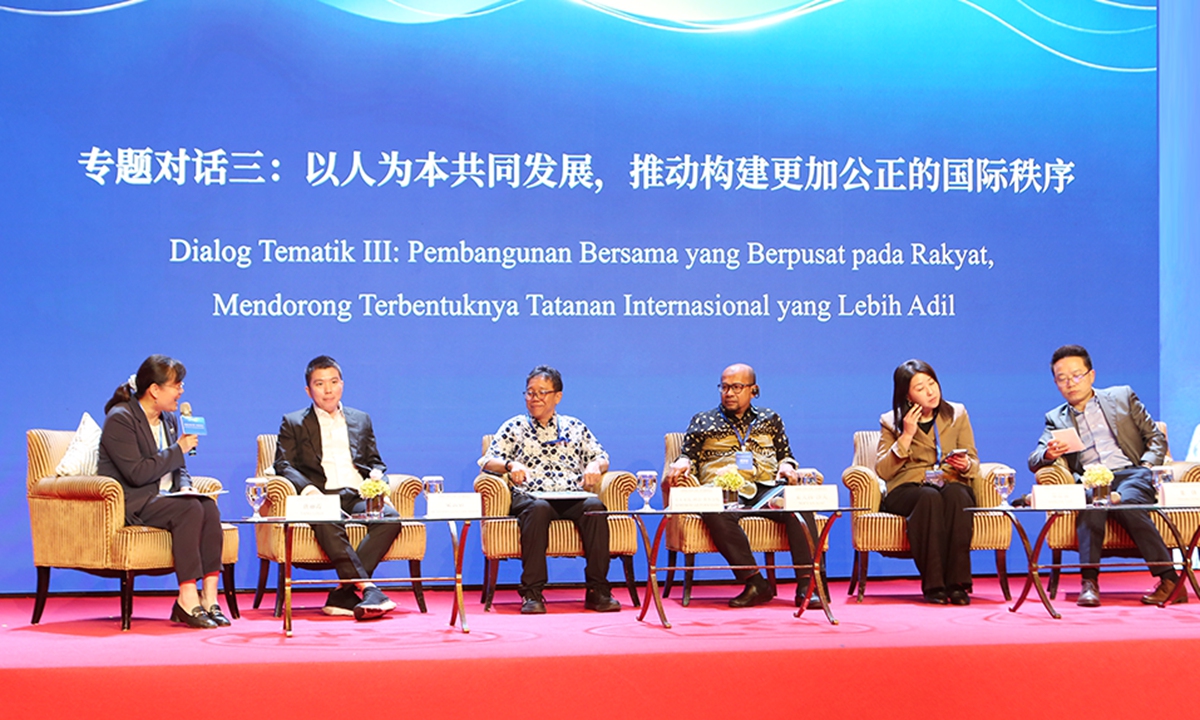
The Panel III of "Global South Dialogue: China-Indonesia Roundtable Forum" is held in Jakarta, Indonesia, on October 19, 2026. Photo: Yu Jincui/GT
Editor's Note:The "Global South Dialogue: China-Indonesia Roundtable Forum," hosted by the Global Times, was recently held in Jakarta, Indonesia. More than 150 guests from various sectors in China and Indonesia held in-depth discussions on topics such as building a China-Indonesia community with a shared future, strengthening China-ASEAN regional cooperation and promoting the people-first common development of the Global South. These are the highlights from the discussions during the third expert panel.
Youth as a key force for cooperation
Anthony Leong, secretary-general of the Indonesian Young Entrepreneurs Association and commissioner of Telkom Indonesia: Digitalization and technology have transformed everything, including the way we shop in our daily lives. What is particularly heartening to see is that people's perspectives on technology and agriculture have also evolved. People are moving beyond conventional views of technology and agriculture to focus on how artificial intelligence is reshaping agricultural paradigms.
Amid an exceptionally unstable global landscape, Indonesia's economy has maintained steady growth. This stands as a major advantage, and we hope to serve not merely as a market, but as builders who forge tighter future partnerships. We must promote the growth of dynamic enterprises and the creation of high-quality jobs.
We indeed need to make a transformation. Starting with the youth of Indonesia and China, the energy of synergy and collaboration needs to be converted into co-creation and value-added partnership. As we advance this process, we might focus on three dimensions: first, how to connect with entrepreneurs; second, how to connect with the market; and third, how to connect with capabilities. When these three come together, corporate cooperation between Indonesia and China will grow increasingly robust, and both sides will jointly enter broader markets, including ASEAN and the global stage.
Tang Lixia, professor and vice dean of the College of International Development and Global Agriculture, China Agricultural University: Drawing upon my insights from field research conducted across multiple locations in China and Indonesia in recent years, I would like to share a few personal reflections:
First, development has no one-size-fits-all solution; it must be deeply rooted in local socio-cultural realities. Sound development cannot simply copy external models; it must respect local culture and social structures. For the broader Global South, drawing on foreign experiences while keeping feet planted in national conditions is a vital prerequisite for achieving people-first development.
Second, youth are a key driving force in China-Indonesia cooperation, and digital technology opens new frontiers for youth participation in development. Young people are no longer just beneficiaries of development; they are the main drivers of innovation. Naturally, youth entrepreneurship also faces real challenges, such as resource scarcity and market uncertainty. Precisely for this reason, China-Indonesia cooperation needs to build more two-way exchange platforms to enable youth to become genuine builders of bilateral friendship.
Third, rural transformation is a shared imperative of our time for China and Indonesia, offering vast potential for equal knowledge sharing. Both face common challenges such as urban-rural divides, rural industrial upgrading and cultural preservation. However, given their differing socio-historical conditions, neither side can simply replicate the other's model. Moving forward, we need equal knowledge dialogues to facilitate reciprocal visits between scholars and grassroots practitioners, exploring rural modernization paths tailored to our respective national conditions.
Fourth, good products serve as a crucial bridge for people-to-people connectivity. While governments establish cooperation frameworks, it is often commercial and cultural products that bring ordinary citizens closer together. Businesses can become an important supplement to state-to-state cooperation.
Technology accelerating rural transformation
Semiarto Aji Purwanto, professor at the Faculty of Social and Political Sciences, Universitas Indonesia: Rural transformation is indeed taking place in both China and Indonesia. The two countries share notable similarities as well as differences in this process.
In terms of similarities, rural life in both China and Indonesia is now closely linked with the market economy. Infrastructure has become increasingly well-developed, allowing residents to travel more conveniently between urban and rural areas. Meanwhile, non-agricultural industries have assumed a more prominent role. From a socio-cultural perspective, the most striking similarity is a deep respect for parents, ancestors and one's rural roots.
As for differences, during my visits to several Chinese villages, I observed that open employment opportunities have been created within the villages themselves. This means the village itself becomes a generator of jobs, enabling urban residents to return to rural living. This differs from the current trend in Indonesia. In Indonesia, although basic road infrastructure is largely in place, it has not yet attracted urban dwellers to move back and settle in rural areas. Nonetheless, Indonesia's rural economy has expanded rapidly, and e-commerce has penetrated villages thanks to road networks reaching deep into rural communities.
Sofyan Sjaf, dean and professor of the Faculty of Human Ecology at IPB University (Bogor Agricultural University) in Indonesia: We have developed an innovative project called "Precision Village Data." The project can bridge the gap between national-level and grassroots-level issues. It also draws on China's experience, particularly how the country has reduced poverty through targeted approaches. One important lesson is the need to identify more precisely which poverty-related problems need to be addressed and support these efforts with empirical data from the grassroots.
Indonesia's needs and our work are not fundamentally different from China's approach. Much of China's strength comes from its rural areas, and we believe the same is true of Indonesia. Many resources, including human resources, are concentrated in rural areas. Therefore, our future cooperation with China Agricultural University will focus on several areas, including strengthening comparative research, exchanging methodologies, developing training programs and promoting the development of rural governance institutions.
In short, data is a powerful tool for rural development, helping strengthen communities' capacity for self-reliance and ensuring that the problems residents face receive attention and solutions at the national level.
Expanding cooperation through mutual respect
Evelyn Tay, senior director of Public Affairs for Asia-Pacific at CHAGEE, a modern tea house: As CHAGEE expands overseas, we remain committed to a core principle: While bringing Chinese tea to the world, we must also ensure that our operations are fully localized in each market. Over the past year and four months or so, we have opened stores in six Indonesian cities, including Jakarta, Surabaya and Bandung. We have made considerable efforts to adapt to local conditions. For example, two months ago, during Indonesia's Independence Day celebrations, we developed a limited-edition flavor specifically for the occasion. We believe that whenever a brand opens stores in a new country, it should respect the local culture and its festivals and develop products that suit local consumers' tastes. This is also a way to demonstrate sincerity.
Going forward, we will pursue localization in more ways, including through cooperation with local manufacturers and agricultural businesses. In the future, we hope to develop more partnerships and introduce Indonesian tea culture and flavors to other parts of the Asia-Pacific region and eventually the world.
Zhang Feng, CEO of Jintan Limited: Our sector, known as the "IP-themed snack," is outpacing the broader leisure food market in domestic growth. We are confident about investing in Indonesia for two main reasons.
First, Indonesia's current stage of development is very similar to that of China when we first started our business. Second, Indonesia has a relatively young population and a large pool of potential consumers, offering substantial market opportunities. When it comes to localization, we believe that respecting local culture is a prerequisite for doing business. Respect for local religious practices and customs is a baseline requirement, while cultural respect must be embedded throughout the entire industrial chain.
After entering Indonesia, we will draw on our strengths in product operations, supply chain management and distribution channels. Rather than simply exporting products, we will integrate our industrial capabilities deeply into the local market. Indonesia has excellent homegrown IPs, such as Bumilangit, and we hope to help commercialize them by leveraging our supporting capabilities and bringing them into households through snack products.
Tang: A people-centered approach means ensuring that the benefits of development genuinely reach ordinary people. It also means that countries in the Global South should strengthen exchanges and learn from one another.
Last year, when we visited IPB University in Bogor, Indonesia, we saw a poster about its "Rural CEO" program in the exhibition hall of the university's main building. The initiative closely aligned with our "Global South Youth Rural Entrepreneurs Initiative." Based on this, we subsequently conducted research for more than a year and continued to expand our network of partners, including discussions with Indonesian government ministries on how to integrate China's poverty alleviation experience with the Golden Indonesia Vision 2045.
In 2020, China eradicated absolute poverty. Today, it has established a nationwide big data system that can accurately identify people at risk of falling back into poverty. Infrastructure development and training programs for young people have also played an important role in empowering rural transformation. From the perspective of the Global South, practical cooperation between China and Indonesia is itself an effort to explore new models of South-South cooperation. Looking ahead, we can advance more small-scale, high-impact projects focusing on communities and young people, among other groups. By continuing to put people at the center of development, we can work toward shared development and prosperity.
RELATED ARTICLES