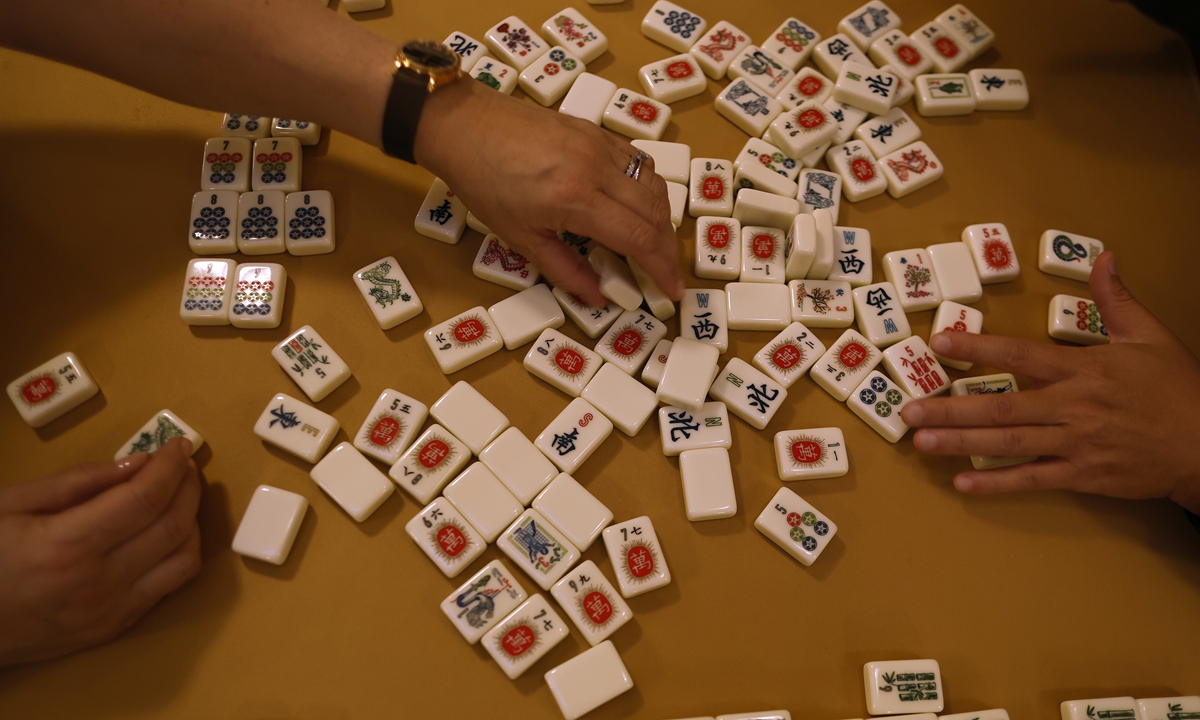
Mahjong Photo: VCG
National Public Radio (NPR) recently reported on the "unexpected" craze for Chinese-made mahjong in the US. At a mahjong factory in Taixing, East China's Jiangsu Province, workers are putting in extra hours, while the owner's phone rings nonstop as orders pour in from across the Pacific. A single mahjong set can fetch $300 to $400 or even more, yet neither US tariffs nor geopolitical tensions in Europe have dampened buyers' enthusiasm. To cater to American customers, Chinese manufacturers have even overhauled their craftsmanship.
However, this isn't an unexpected development. Mahjong arrived in New York in the 1920s, when The New York Times described it as "the new bridge." Although the scope and nature of exchanges between China and the US have changed dramatically over the decades, Americans' enthusiasm for mahjong has endured. According to Yelp, US searches for mahjong clubs jumped 4,467 percent between September 2024 and August 2025, compared with the previous 12 months, and searches for mahjong lessons increased over 800 percent.
China and the US are both vast, diverse societies, with countless avenues for people-to-people exchanges. Chinese consumers engage with American cultural products and services, while American consumers embrace Chinese goods and innovations. Through such interactions, people in both countries gain a broader understanding of one another. Such cultural exchange does not diminish either country's cultural identity; on the contrary, it enriches life in both societies. Students, scholars, tourists and entrepreneurs build connections through their interactions, creating an extensive network of contact between the two societies. It is through these connections that seemingly unexpected links, such as the growing trade in mahjong, emerge.
American vendors mentioned in the NPR report said they are willing to absorb the cost of high tariffs because of the demand and high profit margins. This detail highlights a broader point: Small but tangible connections between ordinary people form one of the most stable and resilient foundations of the relationship between the two countries.
Tariffs and geopolitical tensions cannot prevent people in China and the US from forging new connections around mahjong tables, in classrooms and in their everyday lives. As Americans learn to call chow, pung and kong, and as mahjong tiles made in Chinese factories find their way into American homes, politicians in Washington might do well to step away from the corridors of power, sit down at the table and play a round themselves. They might discover firsthand the genuine warmth and vitality of people-to-people exchanges between the two countries.
RELATED ARTICLES