China seeks input on new rules to protect trade secrets, targeting foreign entities posing risks to national interests
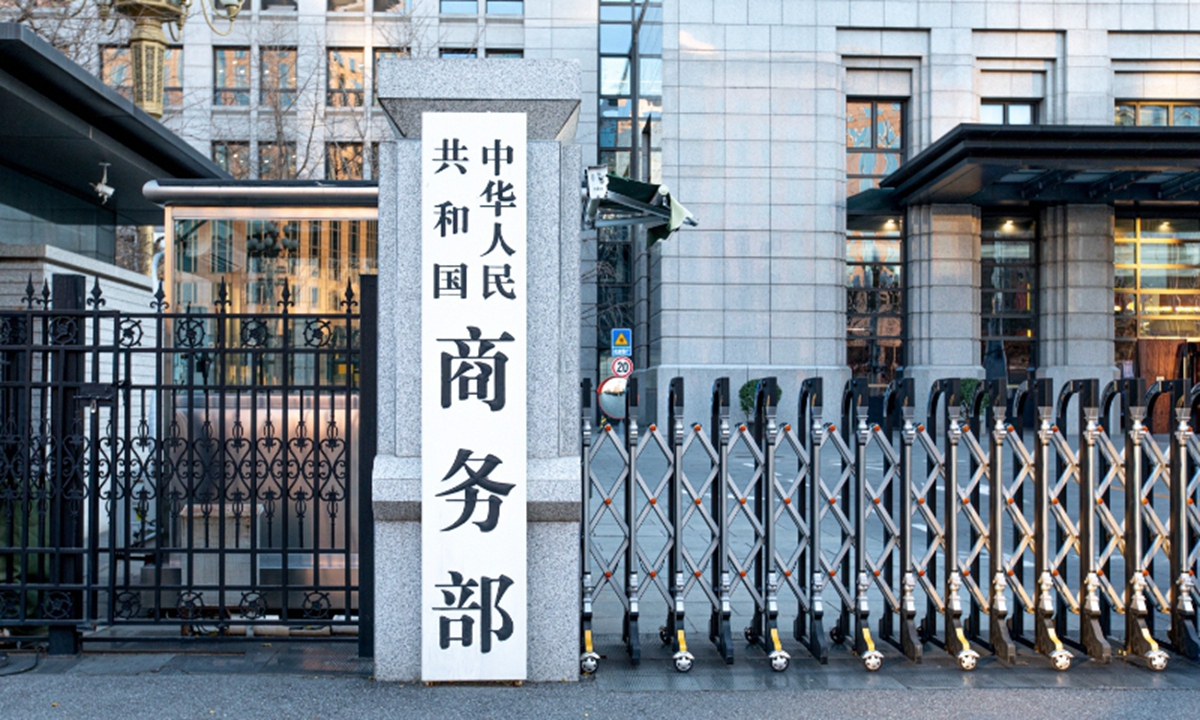
The Ministry of Commerce of China File photo: VCG
China's Ministry of Commerce (MOFCOM) on Monday began to solicit public opinions on draft special regulations to protect Chinese trade secrets, which proposed a range of measures, including restrictions on trade, investment and entry, against foreign entities whose infringement of Chinese trade secrets harms or poses a real threat to China's national sovereignty, security and development interests.
The proposed regulations could further strengthen China's legal framework for protecting trade secrets in cross-border economic activities, providing more targeted tools to safeguard the legitimate rights and interests of Chinese businesses while maintaining normal international trade and investment cooperation, Chinese experts said.
Stronger legal measures
Foreign entities that infringe on Chinese trade secrets in international economic and trade activities and related fields may face restrictive measures if their conduct harms or poses a real threat to China's national sovereignty, security or development interests, according to the draft regulations released on Monday.
These provisions are formulated in accordance with China's Foreign Trade Law, the Anti-Unfair Competition Law and other relevant laws and regulations, with the aim of safeguarding national sovereignty, security and development interests and protecting the legitimate rights and interests of rights holders, according to MOFCOM.
The public consultation will remain open until November 24, according to MOFCOM.
According to the draft, MOFCOM may restrict or prohibit relevant foreign entities from engaging in goods and technology imports and exports and international services trade involving China, and prohibit exports of relevant items to these entities. Other proposed measures include restricting or prohibiting new investment in China, restricting or prohibiting the entry of relevant personnel and means of transport, restricting or revoking work permits and stay or residence status, and imposing fines in accordance with the law.
The draft also authorizes MOFCOM to investigate whether relevant conduct harms China's national sovereignty, security or development interests. Enterprises, organizations and individuals may submit suggestions or report trade secret infringement involving foreign entities.
The draft marks a further step in strengthening China's legal framework for protecting trade secrets in cross-border economic activities, Huo Jianguo, former head of the Chinese Academy of International Trade and Economic Cooperation under MOFCOM, told the Global Times on Monday.
Huo said that unlike existing regulations that mainly address general trade secret infringement, the new draft links trade secret protection to China's national sovereignty, security and development interests. It proposes restrictions on trade, investment and personnel entry against foreign entities whose infringement of Chinese trade secrets harms or poses a real threat to these interests, providing more targeted legal tools to address cross-border trade secret violations, Huo noted.
Also, compared with China's existing Trade Secret Protection Provisions, which took effect on June 1 and focus primarily on preventing and addressing trade secret infringement and maintaining fair competition, the proposed rules establish a more specific framework for addressing foreign entities whose infringement also affects China's national interests.
The draft also provides mechanisms for modifying or cancelling restrictions. Foreign entities that take corrective action, cease infringement, eliminate the danger and compensate for losses may apply for the measures to be modified or cancelled. MOFCOM may decide whether to maintain, suspend, modify or cancel the measures following an assessment.
Under special circumstances, Chinese enterprises, organizations or individuals may also apply to MOFCOM for approval to conduct transactions with restricted foreign entities.
These provisions provide flexibility in implementing the proposed measures while allowing certain transactions to proceed under specified conditions, experts said.
Safeguarding security, fair competition
The proposed regulations come against a backdrop of growing international disputes over intellectual property, advanced technologies and the protection of commercial information, with trade secret issues increasingly becoming a source of friction in international economic relations.
The proposal comes shortly after the US imposed sanctions on five Chinese companies on October 19 over alleged trade secret theft under the so-called Protecting American Intellectual Property Act, according to a MOFCOM statement issued on October 20.
In response, a MOFCOM spokesperson rejected the allegations on October 20, noting that the US had stigmatized Chinese enterprises and imposed sanctions that seriously damaged their legitimate rights and interests.
The spokesperson said the rapid development of Chinese artificial intelligence companies was the result of sustained basic research, innovation investment, independent innovation and open cooperation, rather than alleged trade secret theft.
MOFCOM urged the US to correct its actions, warning that China would take necessary measures to safeguard the legitimate rights and interests of Chinese companies if Washington failed to do so.
While there is no official indication that the latest draft regulations were introduced in response to the dispute, the proposal should be viewed in the broader context of China's efforts to strengthen its legal framework for foreign-related economic and trade activities, Hu Qimu, professor at the Maritime Silk Road Institute of Huaqiao University, told the Global Times on Monday.
As international competition intensifies in advanced technologies such as artificial intelligence and semiconductors, protecting trade secrets and intellectual property has become increasingly important, Hu said, adding that foreign companies engaged in normal and lawful trade, investment and technological cooperation with China would not face restrictions.
"Strengthening trade secret protection is consistent with China's commitment to high-level opening-up," Hu said, noting that effective protection of trade secrets and intellectual property is essential to a stable, transparent and predictable business environment.
Both Chinese and foreign companies need such protection, as a stronger legal framework would help ensure fair competition and provide clearer safeguards for international trade and investment cooperation, Hu said.
RELATED ARTICLES