Japanese firm criticized for evading responsibility over Mongolia grassland fire as experts demand full accountability, China’s costs in compensation talks
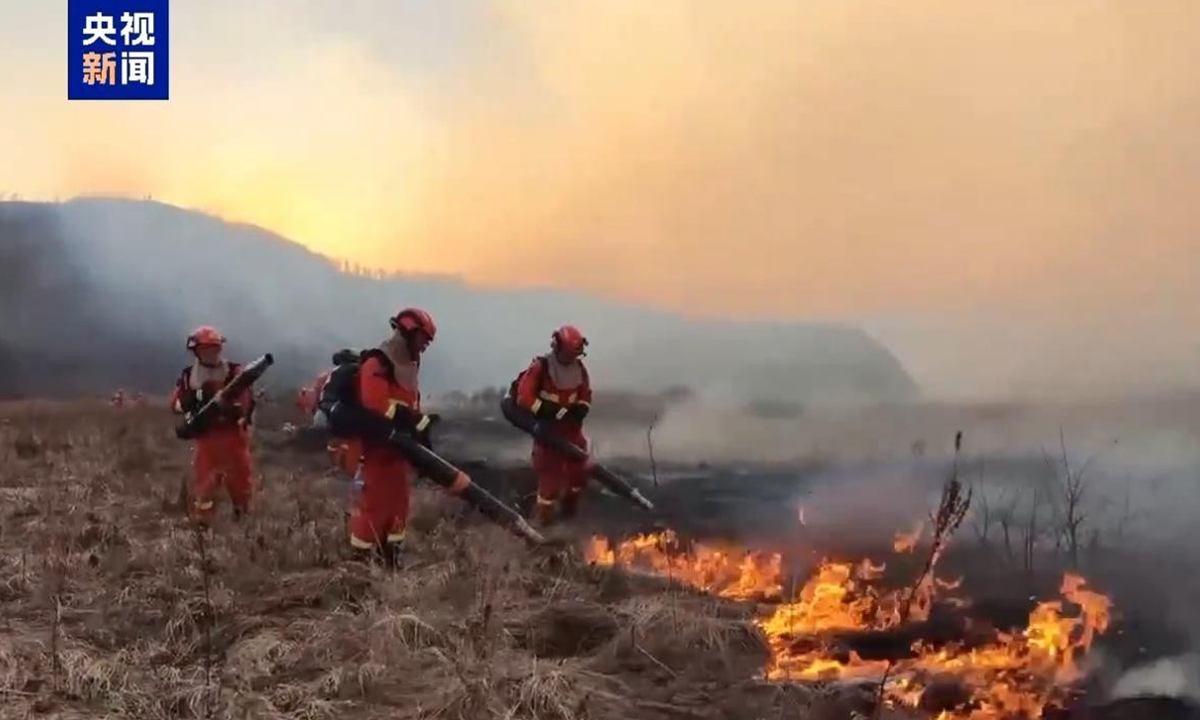
Chinese firefighters contain the blaze and stop it from spreading along the China-Mongolia border. Photo:CCTV News
A massive grassland fire in eastern Mongolia, reportedly triggered by a Japanese executive's activities in a nature reserve, has drawn criticism from Mongolian and Japanese netizens. Both sides reached an agreement, and Japan's Cabinet said on Monday it would assess losses and handle compensation; nevertheless, Chinese experts warned of cross-border risks, saying verbal sympathy was insufficient given Japan's evasion of responsibility and called for China's firefighting costs to be included in compensation talks.
According to Mongolian media outlet mnb.mn, the fire broke out on October 8 in the Numrug Nature Reserve in Khalkhgol soum, Dornod Province, affecting about 79.8 percent of the area. The open flames were extinguished on October 16.
Japanese telecommunications company KDDI acknowledged on October 23 that the fire was linked to activities by Japanese executives at Mobicom, its majority-owned Mongolian telecommunications subsidiary, per Jiji Press. On Monday, Mongolian officials and Mobicom management agreed to establish a working group to assess losses and handle compensation. However, while Mobicom's head of legal affairs said that the company would cover the costs of assessing environmental damage, he also argued that it had obtained the necessary permits to enter the protected area, assa.mn reported.
Also on Monday, Japanese Chief Cabinet Secretary Minoru Kihara issued the government's first official response, saying Japan took "seriously" the damage. He expressed sympathy to the Mongolian people and said Japan would stay in close contact with the Mongolian government and "cooperate to restore the affected areas," according to Jiji Press. However, the statement made no mention of China, which was also affected by the fire.
Liu Zhiyan, a research fellow at the Research Institute for Eco-Civilization of the Chinese Academy of Social Sciences, told the Global Times on Tuesday that the grasslands of eastern Mongolia form an important ecological barrier in Northeast Asia. The fire damaged grasslands and wildlife habitats, worsened soil moisture conditions and exacerbated land degradation and desertification. Smoke and dust generated by the fire could also be carried across borders by air currents, Liu said.
The fire at one point spread toward the Chinese border, prompting China to deploy more than 3,400 personnel along the border and strengthen firefighting arrangements, per CCTV News. China also deployed personnel in advance and established firebreaks to prevent the flames from entering Chinese territory. However, the costs incurred by China in the response have not been mentioned, Liu said.
China's costs in containing the cross-border fire should also be included in accountability negotiations. As the fire was triggered by a Japanese executive, liability should not be limited to damage within the country where the fire originated. Once the danger spreads to a neighboring country, those responsible should bear all costs incurred to eliminate the risks, rather than compensate only for damage within their own borders, Li Jian, a law professor at Shanghai Jiao Tong University, told the Global Times on Tuesday.
The incident has sparked widespread online criticism in Mongolia and Japan. Mongolian social media users have called for those responsible to be held fully accountable and for the damaged reserve to be restored, according to Mongolian news website Zogii.mn.
Under a Facebook post by the Japan Daily, one user wrote, "I hope this Japanese company will pay for the restoration of this wilderness!" Other netizens said that financial compensation and apologies alone could not undo such extensive environmental damage, calling for legal penalties and detailed assessments of harm to soil, vegetation and wildlife.
Japanese netizens also criticized what they saw as double standards in domestic media coverage, questioning why reports of foreigners damaging the environment in Japan received attention while a Japanese company's large-scale ecological damage overseas drew comparatively little coverage.
"An apology and compensation alone cannot restore the environment," one netizen commented. Others warned of cross-border risks, noting that the burned area was twice the size of Tokyo and that dust storms from the affected grasslands could affect both Mongolia and China.
The fire would cast a shadow over close Japan-Mongolia relations, with both sides likely to seek to clarify their respective roles and responsibilities. More importantly, the company had given the impression of downplaying the incident and responding passively, Lian Degui, director of the Center for Japanese Studies at Shanghai International Studies University, told the Global Times on Tuesday.
The company failed to provide timely explanations before public attention grew, only gradually releasing more information after pressure mounted. Japanese media had also helped play down the company's responsibility, Lian said, adding that this was not a responsible approach to resolving the issue.
Lian noted that the company's response has raised questions about its sense of responsibility and crisis management, reflecting an attempt to downplay the incident and evade accountability. Those responsible must be held seriously accountable.
RELATED ARTICLES