Philippine warship ‘trailing’ Chinese aircraft carrier Liaoning? The whole world is laughing: Global Times editorial
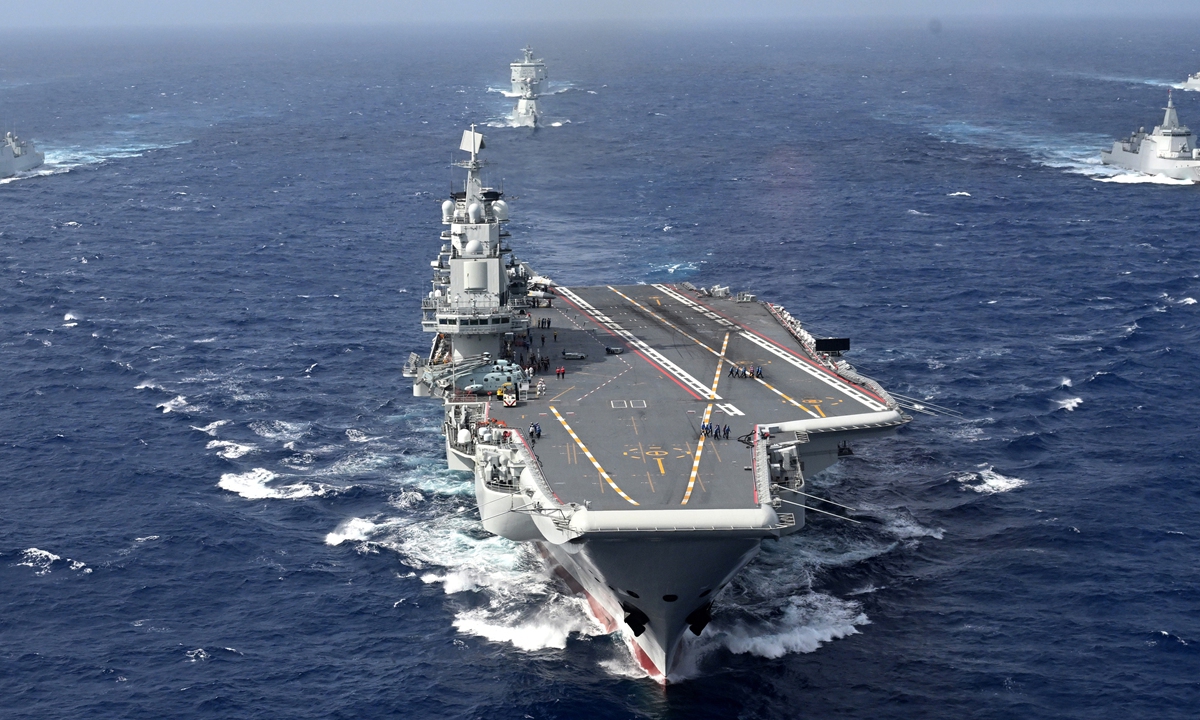
The Liaoning aircraft carrier participates in a dual-aircraft-carrier formation drill on October 21, 2024. Photo: VCG
The Philippine side is well aware of the consequences of recklessly provoking China, yet it has still pressed ahead with this self-staged farce. The root cause is that certain forces in the Philippines want to stir up trouble in the South China Sea to contain China, but lack the confidence and capabilities to back up any substantive confrontational moves. All they can do is resort to this shoddy performance to bluff and create a false impression of strength.
Recently, during a new round of multilateral maritime cooperative activity involving the US, Japan and the Philippines, Manila dispatched a vessel to follow the Liaoning aircraft carrier group. At most, the Philippine vessel trailed the Chinese carrier group from a distance and snapped a few photos. Yet the Philippine side hyped this up as an operation to "track" and "monitor" the Chinese navy. Judging solely by the rhetoric of some Philippine military figures and media outlets, one might assume that Manila had deployed a formidable naval force. But once all the relevant facts are considered, the true nature of this guilty-minded performance becomes clear.
The aircraft carrier Liaoning's training activities in the relevant waters of the Western Pacific are routine arrangements under its annual training plan, consistent with international law and international practice, and not directed against any particular country or target. As the group navigated through the high seas and archipelagic sea lanes, it exercised the rights of navigation and passage guaranteed under international law. Throughout the voyage, the group maintained a professional and restrained posture and did not take any hostile action against the Philippines. Even a Philippine Coast Guard spokesperson had to acknowledge that "the movement could still fall within internationally recognized navigational rights."
The BRP Sarangani, the Philippine vessel involved in the operation, was originally a decommissioned patrol and rescue vessel donated by the Taiwan authorities. Given its size, its so-called "tracking" of a large combat formation such as an aircraft carrier group could amount to little more than symbolic shadowing from a distance. It could neither approach the aircraft carrier group nor gather much valuable intelligence, let alone establish any meaningful monitoring capability. The Philippine side is well aware of the consequences of recklessly provoking China, yet it has still pressed ahead with this self-staged farce. The root cause is that certain forces in the Philippines want to stir up trouble in the South China Sea to contain China, but lack the confidence and capabilities to back up any substantive confrontational moves. All they can do is resort to this shoddy performance to bluff and create a false impression of strength.
Looking deeper, this maneuver is driven both by domestic political calculations in the Philippines and by a desire to appease external powers. Faced with challenges such as sluggish economic growth and mounting pressure on the government, Manila is attempting to divert public attention by hyping up external "threats" and projecting an image of being "tough on the outside," thereby reaping political capital for the administration. Meanwhile, the Philippines has been stepping up military cooperation with the US, Japan and other countries. Publicizing details of its so-called "monitoring" of the Liaoning aircraft carrier group amid joint US-Japan-Philippines exercises serves to demonstrate its value to external allies in maintaining a "forward presence" and to show that it can make tangible contributions, even if that "contribution" amounts to nothing more than a decommissioned small vessel trailing the carrier group from a distance. It is also an attempt to enlist external support to bolster its position in maritime disputes and exploit regional tensions for unwarranted gains. But no matter how inflated the bubble of rhetoric becomes, it cannot deliver real security.
Some in the Philippines also need to carefully consider the costs of their blind faith in courting powers from outside the region. Certain external powers are willing to put the Philippines on the front line because doing so serves their own strategic interests. This does not mean, however, that they are prepared to bear the consequences of every risky move Manila makes. Should an incident occur at sea, Philippine vessels and personnel would be closest to the scene, and the Philippines itself would be the first to bear the risks. Pinning the country's maritime security on the appearance of backing from others not only overestimates the practical value of that retired patrol boat but also underestimates the price the Philippines itself would have to pay if regional tensions escalated.
In fact, what truly threatens regional security is the Philippines' provocations in the South China Sea and its collusion with the Democratic Progressive Party (DPP) authorities in Taiwan island. The Taiwan question is particularly sensitive. Any move that could blur the boundaries of the one-China policy or extend security cooperation into sensitive areas risks triggering major upheaval in the region. On the one hand, Manila reiterates its adherence to the one-China policy; on the other, it allows coast guard equipment from the Taiwan region to enter the ranks of its coast guard. Such double-dealing is playing with fire.
China remains unwavering in its commitment to safeguarding national sovereignty and maritime rights and interests, while consistently advocating negotiations to manage differences. The Liaoning aircraft carrier's voyages into distant waters are a normal milestone in China's defense modernization. Its course will not be altered by the trailing of one or two decommissioned patrol vessels, nor will it be diverted by the clamor surrounding a handful of joint military exercises. Manila must understand that stirring up trouble with the backing of external powers will not bring it genuine security. It will only draw the Philippines deeper into a complex geopolitical game.
RELATED ARTICLES