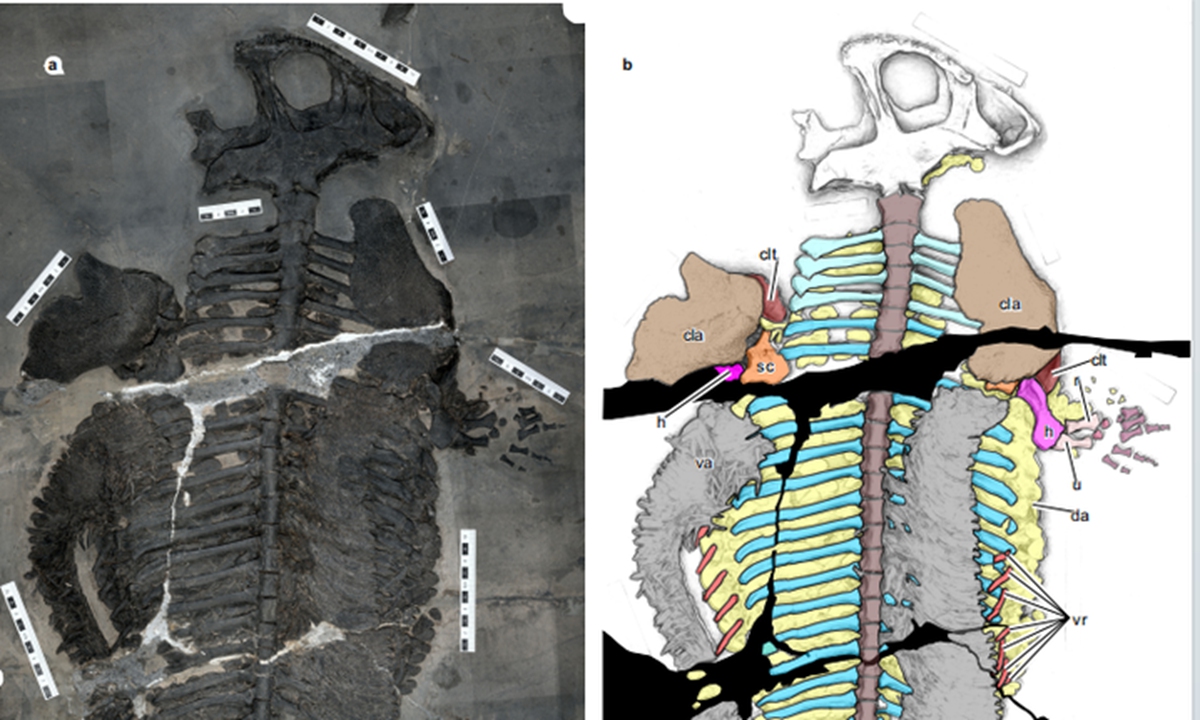
Holotype fossil specimen of Gerrothorax maritimus Photo: Courtesy of Geological Museum of Guizhou
An international team of researchers from Chinese and US universities has discovered fossils of a new amphibian species dating back about 237 million years and confirmed that the animal, known as Gerrothorax maritimus, represents the only known amphibian in Earth's history capable of living entirely in the sea, the Global Times learned from the Geological Museum of Guizhou on Wednesday.
The research was jointly conducted by professor Jiang Dayong from Peking University, professor Ryosuke Motani from the University of California, Davis, and collaborators at the Guizhou Geological Museum. The findings were published in the international journal Nature Ecology & Evolution.
A researcher on the museum's research team told the Global Times on Wednesday that no living amphibians are known to live entirely in the ocean. Whether amphibians in ancient geological periods had adapted to a fully marine lifestyle had remained unclear due to a lack of fossil evidence. The new discovery fills a gap in our understanding of amphibian evolution.
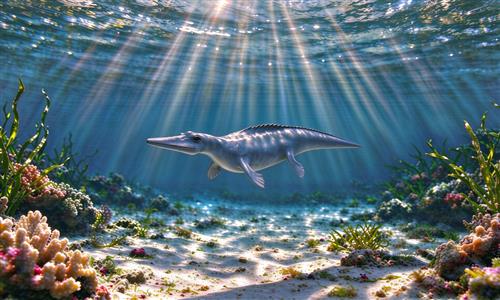
The newly discovered fossils measure 737 millimeters in length and date to approximately 237 million to 235 million years ago. Researchers reconstructed their appearance, describing them as having flattened bodies covered in heavy bony armor, broad, flat heads, wide mouths and robust gill arches.
The fossils were found at a site at least 30 kilometers from a possible island. Their state of preservation suggests that the animals died near where they were buried, while chemical analysis of their bones revealed a strong match with the strontium isotope signature of seawater at the time. Together, these findings indicate that the animals lived and died in a marine environment, the researcher noted.
Jiang said Gerrothorax maritimus is the earliest-known basal amphibian capable of living entirely in a marine environment, the Xinhua News Agency reported.
There are more than 8,000 living amphibian species, including frogs, salamanders and caecilians, but none lives entirely in the ocean. Their permeable skin helps them breathe but can also cause water loss in marine environments, while the high salinity of seawater poses additional physiological challenges. Some living amphibians can tolerate brackish environments where freshwater and seawater mix, and fossils of ancient amphibian species have been found in coastal sediments. However, such evidence had not been sufficient to establish that amphibians once lived entirely in the sea, according to China News Service.
Researchers believe the newly discovered amphibian had a flattened body covered in heavy bony armor, which may have helped reduce water loss.
Its gills and digestive system may have helped regulate salt levels in its body and process swallowed seawater. The shape of its mouth also suggests that it may have fed by sucking prey from the seafloor. However, as soft tissues were not preserved, some aspects of its physiology and reproduction remain unknown.
The research team said the discovery broadens our understanding of amphibian evolution, suggesting that although this group is no longer found in marine environments today, ancient amphibians once used bony armor and other aquatic adaptations to sustain a fully marine lifestyle.
RELATED ARTICLES