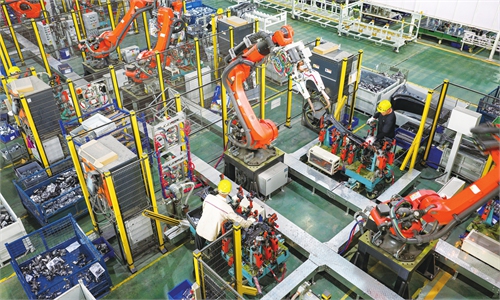
This photo taken on July 4, 2025 shows the laptop production line of the carbon-neutral smart manufacturing factory of Lenovo in north China's Tianjin. (Xinhua/Zhao Zishuo)
According to a recent report by Nikkei Asia, major global PC manufacturers, including HP, ASUS and Acer, are shifting part of their production capacity from Southeast Asia back to China, while deepening collaboration with a new generation of Chinese contract manufacturers. Companies like Dell are also evaluating a similar move.In recent years, brands such as Dell and HP were reported to have quietly weighed the decision to "relocate portions of their capacity away from China," with HP even planning to move up to 70 percent of its production outside China. Yet, a shift is clearly underway. Reuters similarly observed this new momentum, noting that several companies that originally transferred production to dodge US tariffs are now moving some orders back to Chinese suppliers.
Why are these foreign enterprises coming back? Specifically, three primary factors are at play:
First, the surge in global demand for AI computing power has constrained memory chip production capacity, driving up the prices of core PC components. Unable to absorb these costs through profit margins as before, PC makers must seek external solutions to cut overall manufacturing overhead.
Second, production lines previously moved to Southeast Asia exposed shortfalls in cost and efficiency during actual operations. Meanwhile, local ecosystems failed to form complete supply chains, leaving factories reliant on shipping large volumes of components from China.
Third, easing China-US trade tensions has led to the temporary suspension of high US tariffs on Chinese-made PCs, drastically reducing the urgency to offshore production to avoid political risks and duties.
At its core, however, the fundamental driver remains the sheer strength and resilience of China's domestic supply chain. A stable policy environment, a mature workforce, dense networks of component suppliers, well-established logistics and decades of accumulated manufacturing expertise enable Chinese factories to respond to orders faster, coordinate upstream and downstream logistics seamlessly, and keep costs strictly under control. This is a tightly interconnected operational ecosystem built over time, one that cannot be replicated simply by throwing up a few factories and hiring a handful of workers overnight.
Historically, the global PC contract manufacturing market was long dominated by Taiwan-based foundries. In recent years, however, emerging mainland Chinese contract manufacturers, such as Luxshare Precision, Huaqin Technology and Shanghai Longcheer Technology, have risen rapidly. Leveraging mature consumer electronics manufacturing experience and competitive pricing, they secured massive PC orders from HP, Dell and ASUS over the past year, becoming the anchor force absorbing returned capacity. Furthermore, these Chinese manufacturers command established procurement channels for domestic memory chips. Amid global component shortages, they help PC makers secure stable supply lines and alleviate purchasing pressure, further elevating their strategic appeal.
In the past, driven by agendas to contain and suppress China, certain Western media outlets actively hyped narratives of "de-Sinicization." Domestically, anxieties surfaced over whether Chinese manufacturing might be forcibly "decoupled" from the global economy. Yet facts have proven that by focusing on managing our own affairs well and steadfastly pursuing our own path, China's development will always rest upon the most solid foundation. When we continuously refine the quality, efficiency, cost control and supporting ecosystem of our supply chain, there is no need to worry about attracting global business. Clamor for "decoupling and severing supply chains" will ultimately bow to market dynamics and industrial logic. The next China is still China - this wave of re-shoring in the PC industry serves as yet another vivid testament to that truth.
RELATED ARTICLES