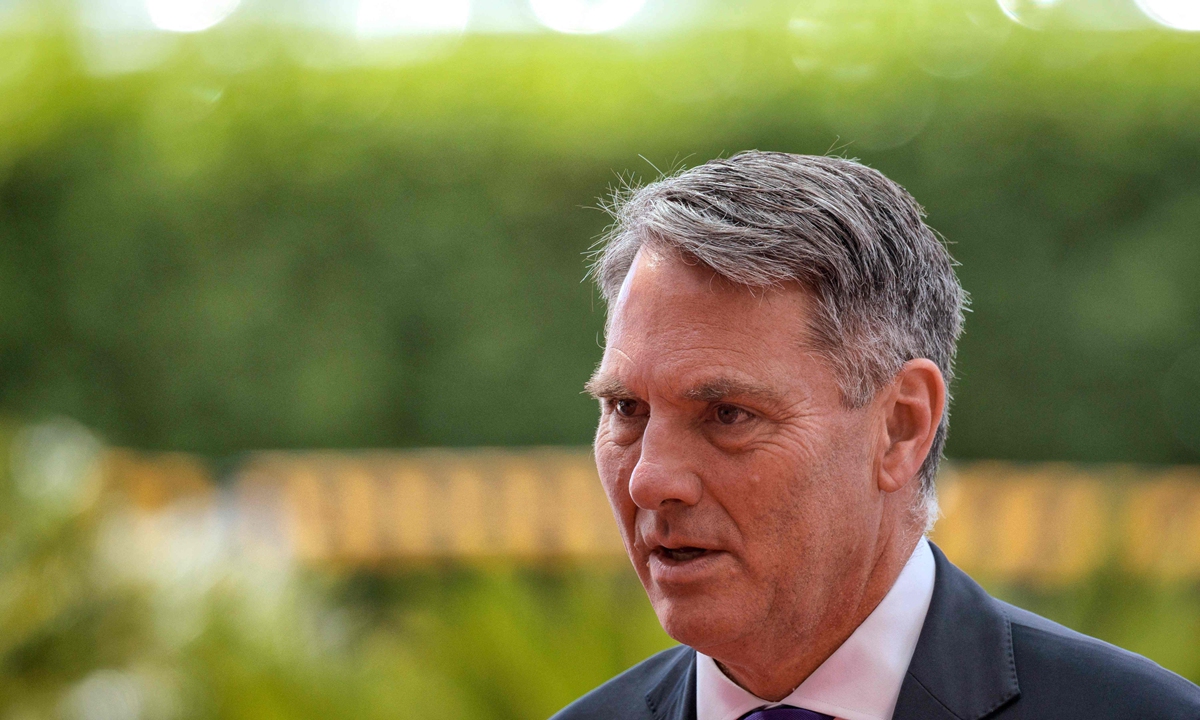
Australia's Defence Minister Richard Marles arrives before the 13th ASEAN Defence Ministers' Meeting-Plus in Cebu, Philippines, on October 29, 2026. Photo: VCG
During the 20th ASEAN Defence Ministers' Meeting in Manila, Australian Defense Minister Richard Marles once again trotted out the same old script: making unsubstantiated claims about "China's military buildup" and trying to use that as a pretext to push for closer ties among the so-called Squad - a small circle comprising the US, Japan, the Philippines and Australia.What Marles is essentially claiming boils down to this: China's defence development amounts to "applying pressure," while Australia's own military build-up is about "upholding the rules." These are blatant double standards. The regional "pressure" narrative reads more like a tailor‑made talking point for exclusive defence cliques.
Yu Lei, a professor at the School of Northeast Asian Studies, Shandong University, noted that by making up claims about China's military, Marles is trying to force Southeast Asian nations to take sides. This seeks to erode the ASEAN-centric multilateral security architecture, replace Southeast Asia's open and inclusive regional order with bloc-driven confrontation and secure legitimacy for Australia's own military buildup.
Yu further pointed out that Southeast Asian countries pursue an open, inclusive ASEAN-centered order and stand for safeguarding their autonomy and national interests through multilateral consultations. "The approach of making up threats while pushing for small military blocs will not only fail to win the support of Southeast Asia, but will also undermine Australia's sovereignty, interests and regional credibility."
In fact, China has consistently adhered to the principles of amity, sincerity, mutual benefit and inclusiveness in its neighborhood diplomacy. It emphasizes the need to base its actions on the United Nations Charter and international law, opposes the instrumentalization and bloc-based use of "rules," and advocates building an Asia-Pacific community with a shared future through dialogue and cooperation, rather than "suppressing" other countries' legitimate rights to development through security alliances.
China's defense spending accounts for less than 1.5 percent of its GDP. It is significantly lower than that of major military powers like the US, and is also below the global average. In contrast, Australia is vigorously advancing the AUKUS nuclear submarine program, investing tens of billions of Australian dollars to procure nuclear-powered submarines and long-range strike capabilities, expanding military bases in the north, and frequently conducting joint exercises with extra-regional forces in the South China Sea and waters surrounding the Philippines. It's clear who is putting pressure on regional peace and stability.
What truly brings uncertainty to these waters are the frequent close-proximity activities of non-regional naval vessels and aircraft, as well as exclusionary defense arrangements intended for confrontation. Southeast Asian nations can clearly see who has been flip-flopping on the South China Sea issue, who is building bridges and roads in the Mekong subregion, who fuels militarization, who pushes for an exclusive restructuring of the regional security architecture, and who is committed to open and inclusive regional cooperation.
For more than 30 years since China and ASEAN established their dialogue relationship, China has consistently participated in regional affairs with a constructive attitude, which in itself is the most concrete interpretation of "rules." Since 2020, China and ASEAN have consistently been each other's largest trading partners, and landmark projects such as the China-Laos Railway have delivered tangible benefits to local people. By contrast, security arrangements involving Australia often leave Southeast Asia with nothing but the roar of military exercises and the burden of defense spending.
If Marles truly cares about the region, he should respect the right of countries to independently choose their own security paths, rather than trying to tell them what to do. In fact, it is clear Marles' rhetoric does not reflect any genuine concern for regional security, but rather anxiety over his own problematic defense agenda. It is becoming increasingly difficult to justify the hundreds of billions of Australian dollars invested in AUKUS nuclear submarines to the Australian people. Manufacturing claims about threats won't help with that.
RELATED ARTICLES