To understand the new 'Made in China' era, the West must shed prejudices: Global Times editorial
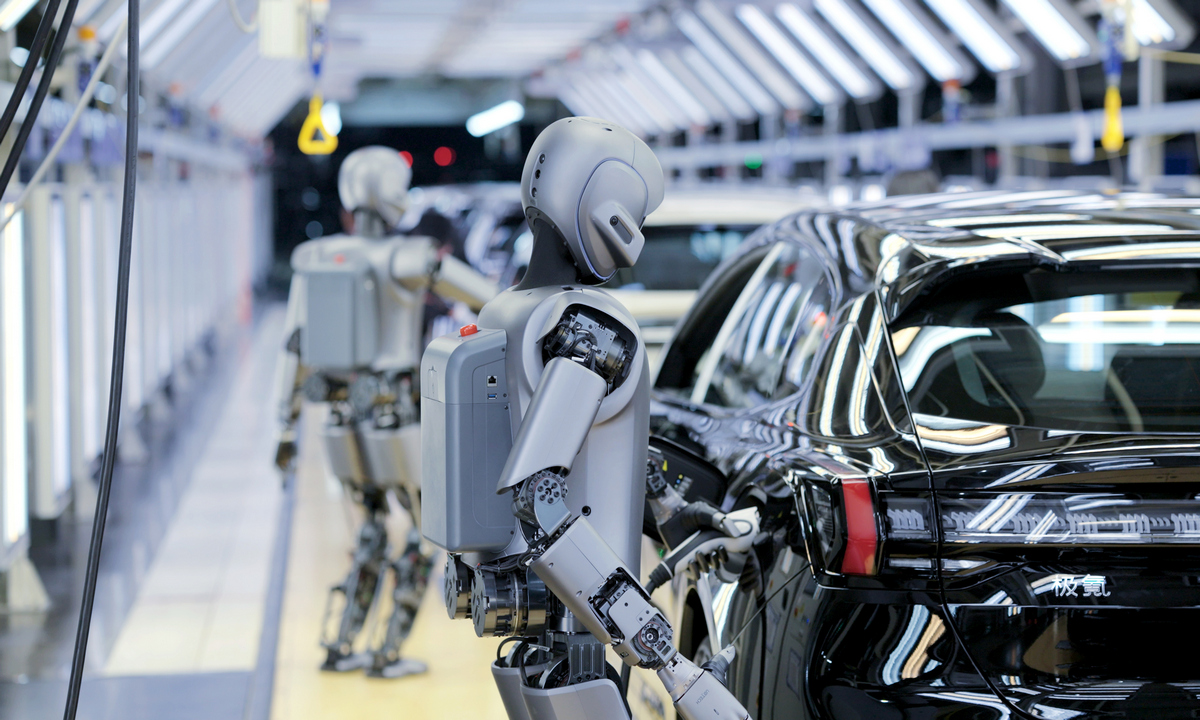
Dozens of UBTECH industrial humanoid robots carry out training tasks at a smart factory in the Qianwan New Area in Ningbo, East China's Zhejiang Province, on March 1, 2025. Photo: VCG
The new face of "Made in China" is a transition from advantages of scale to systemic strengths, from cost competitiveness to innovation prowess, and from exporting goods to exporting capabilities. What the West truly needs to update is its entrenched mind-set of viewing China's development as a "zero-sum threat."On Thursday, Reuters published an article titled "Welcome to the new 'Made in China.'" Coining the term "new 'Made in China,'" the piece observed that Chinese manufacturing is expanding from cheap clothing, furniture, and toys into automobiles, complex machinery, high-end chemicals, and data center equipment. However, reading between the lines, the report remains accustomed to attributing China's competitiveness to subsidies, low prices, and "overcapacity."
What does the new "Made in China" truly look like? Detaching oneself from an understanding of industrial ecosystems and competitive dynamics easily leads to the fallacy of "the blind men and the elephant" - mistaking a single leg for the entire creature.
China's manufacturing sector is increasingly serving as the "factory of factories" supporting global industrial production. The strength of Chinese manufacturing is demonstrated not only in finished consumer products, but even more so in its capacity to provide critical equipment and foundational inputs for global production. Today, from precision control boards and specialized cabling to high-end machine tools and industrial robotics, Chinese manufacturing has become an indispensable component of global industrial upgrading and AI computing infrastructure.
In the first three quarters of 2026, equipment manufacturing contributed nearly 90 percent of China's export growth. This vividly confirms a broader transition: China is steadily evolving from a provider of consumer goods into a pivotal supply-side hub for global productive capacity, while the bedrock of its competitiveness has upgraded from single-product price advantages to the systemic operational efficiency of an entire industrial ecosystem.
The competitiveness of Chinese manufacturing has forged ahead through thorough market competition and continuous innovation. While subsidies may influence short-term costs, they can never replace a firm's long-term accumulation built through the process of market trial and error, process refinement, and rapid responsiveness to demand. Supported by an ultra-large domestic market, full-chain industrial integration, and a vast pool of engineering talent, new technologies in China swiftly transition from laboratory concepts to mass production before diffusing into adjacent sectors.
Manufacturing competition itself has escalated into a contest of cross-industry technology transfer: perception and localization technologies developed for new-energy vehicles are spilling over into smart equipment, while the consumer robotics sector has pivoted from price wars toward competition over quality and brand reputation.
Overseas consumer perceptions of Chinese products are similarly shifting - from "low price" to "technologically advanced and reliable." Brand premiums are increasingly determined by the speed of innovation and user acclaim. Dismissing the growth of Chinese manufacturing simply with terms like "subsidies" and "dumping" is not only factually incorrect, but also misreads the trajectory of global industry.
Chinese manufacturing is evolving from exporting individual products to delivering comprehensive solutions. Research and development, design, manufacturing, digital operations and maintenance, and after-sales services are becoming deeply integrated. Industrial equipment manufacturers now provide customers with remote monitoring, preventive maintenance, and full lifecycle management, while logistics equipment companies integrate forklifts, warehousing systems, and digital platforms to improve customers' overall production efficiency.
What Chinese companies deliver is no longer just individual pieces of hardware, but also the operation of entire production lines and support for complete production systems. The focus of value creation is consequently shifting toward system integration and long-term services.
Meanwhile, China continues to advance institutional opening-up, making it clear that goods manufactured in China that meet domestic product standards are eligible for relevant government procurement support policies on an equal basis, regardless of whether their producers are domestic or foreign-invested enterprises. This latest round of upgrading is also opening up broader opportunities for global companies to participate in the Chinese market and leverage China's comprehensive industrial ecosystem.
Trade barriers cannot override the economic forces that underpin industrial competitiveness. Tariffs may alter trade routes, but they cannot conjure up mature supply chains, a well-established pool of engineering talent, or deeply integrated industrial capabilities. Erecting barriers against Chinese intermediate goods and production equipment would instead raise the overall costs of industrial investment and technological upgrading in the countries imposing them. For countries determined to revitalize domestic manufacturing, shutting out cost-effective production inputs would not only fail to deliver the intended benefits but could also undermine the competitiveness of their domestic companies in third-country markets.
The new face of "Made in China" is a transition from advantages of scale to systemic strengths, from cost competitiveness to innovation prowess, and from exporting goods to exporting capabilities. Every country has the right to develop its manufacturing sector, and every country has opportunities to participate in the international division of labor and benefit from technological progress.
What the West truly needs to update is its entrenched mind-set of viewing China's development as a "zero-sum threat." Only by approaching competition with an open mind can countries create room for cooperation, and only by respecting objective economic laws can they turn the global trend of industrial upgrading into tangible opportunities for mutual benefit and win-win outcomes.
RELATED ARTICLES