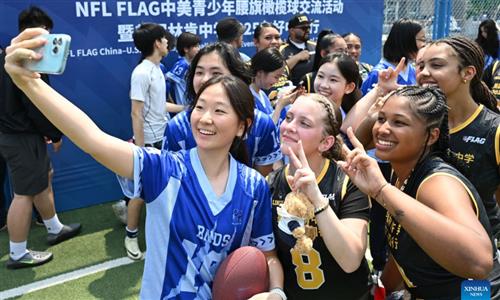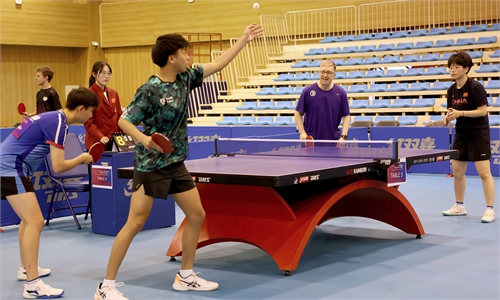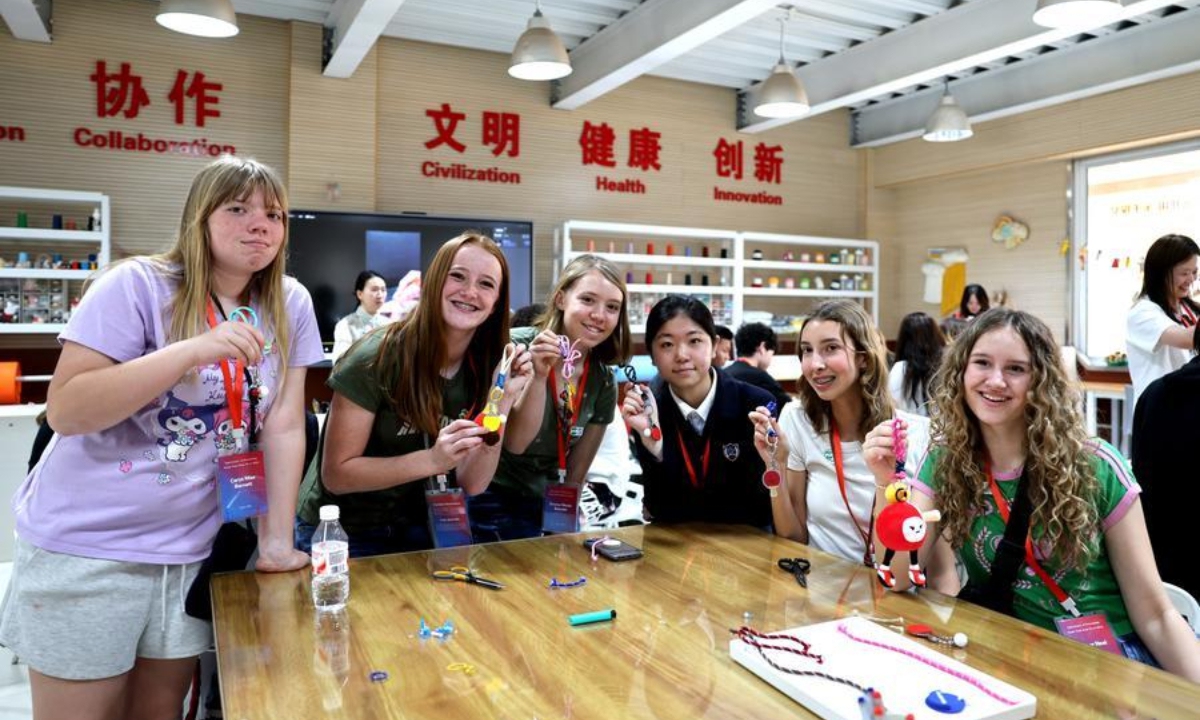
Students from the US show their handicrafts at a school in Shijiazhuang, North China's Hebei Province, on April 11, 2026. Photo: Xinhua
The US Department of War's recent designation of Confucius Institutes in the US as a national security threat has added friction to China-US educational and cultural exchanges. At a recent press briefing, Chinese Foreign Ministry spokesperson Guo Jiakun rejected the move as an act of stigmatization and reaffirmed the mutual benefits of educational cooperation between the two countries.
This raises a broader question: How can China and the US deepen mutual understanding amid growing complexity in their relationship? Concerns about specific programs should be assessed on the basis of evidence and addressed through clear rules, while preserving opportunities for legitimate educational and cultural exchange.
From a Chinese perspective, educational and cultural engagement is more than a supplement to bilateral diplomacy. It helps build mutual understanding, cultivate trust and sustain cooperation between societies with different historical experiences, cultural traditions and social systems. Such engagement cannot resolve every strategic disagreement, but it can help both sides understand the context in which the other's decisions are made.
For decades, educational exchanges have connected generations of Chinese and Americans. Chinese students have studied at American universities, and American students and scholars have traveled to China to study the Chinese language, explore its history and understand its contemporary development. These experiences have shaped individual careers and created personal and professional networks that support bilateral relations.
Firsthand experience provides insights that media reports or secondhand analysis alone cannot offer. In a September article, Rush Doshi of the Council on Foreign Relations and Rosie Levine of the US-China Education Trust warned that the US was losing its ability to train future China specialists. Their warning highlights a practical reason to sustain exchanges: Informed policymaking depends on people who understand the other country's society, institutions and perspectives. That expertise remains essential even when the two governments disagree on major issues.
The September summit between President Xi Jinping and US President Donald Trump in Washington created a window of opportunity to strengthen cooperation in this area. President Xi called for translating the new vision of a constructive China-US relationship of strategic stability into action, striving for a relationship where "cooperation is the mainstay, competition is kept within proper limits, differences are managed and peace can be expected, and chart the right path for the two major countries to get along." The two leaders agreed to build a constructive relationship of strategic stability based on respect, fairness and reciprocity. This common understanding provides important political guidance for the future development of the bilateral relationship.
A cultural event during the visit illustrated how such engagement can make a difference. Peng Liyuan, wife of President Xi, and Melania Trump, wife of US President Trump, visited the National Museum of Asian Art, and watched American teenagers sing Chinese songs together. Peng encouraged them to continue studying the Chinese language and culture and to become envoys of friendship between China and the US. Such occasions can spark curiosity and personal connections; their lasting value depends on continued learning and interaction.
During the visit, President Xi said 100,000 young Americans will be invited to visit China for exchanges and study over the next five years. The initiative demonstrates China's willingness to open its door wider for a younger generation and give them the opportunity to experience the country firsthand. Its long-term contribution will depend on the quality of those experiences and the relationship participants maintain afterward.
Summit diplomacy has created momentum, but lasting progress requires institutions to carry it forward. Both countries could give greater attention to long-term academic partnerships, reciprocal student and faculty exchanges, joint research in areas of shared interest, and cooperation among think tanks and cultural institutions. These efforts should expand opportunities for students and scholars from both countries to study, teach and conduct research in each other's countries.
Equally important is continuity. Exchanges are most valuable when they foster sustained relationships rather than end with a single visit. Universities, think tanks and other participating institutions could provide follow-up opportunities through joint projects, language study and alumni networks.
Political agreements can create openings for cooperation, while sustained people-to-people engagement helps provide a durable social foundation necessary to support that cooperation. The aim should be to make educational and cultural exchanges a stable part of bilateral relations, capable of continuing through periods of disagreement.
China and the US will continue to have differences. Yet differences need not stop their peoples from learning about each other, nor should they overshadow the many areas where cooperation can produce shared benefits. Strengthening educational and cultural ties would be a practical investment in mutual understanding and in a more resilient and constructive relationship.
The author is an associate research fellow at the Central Compilation and Translation Bureau. opinion@globaltimes.com.cn
RELATED ARTICLES