China-Peru FTA Upgrade Protocol enters into force on Sunday, to boost bilateral economic, trade ties
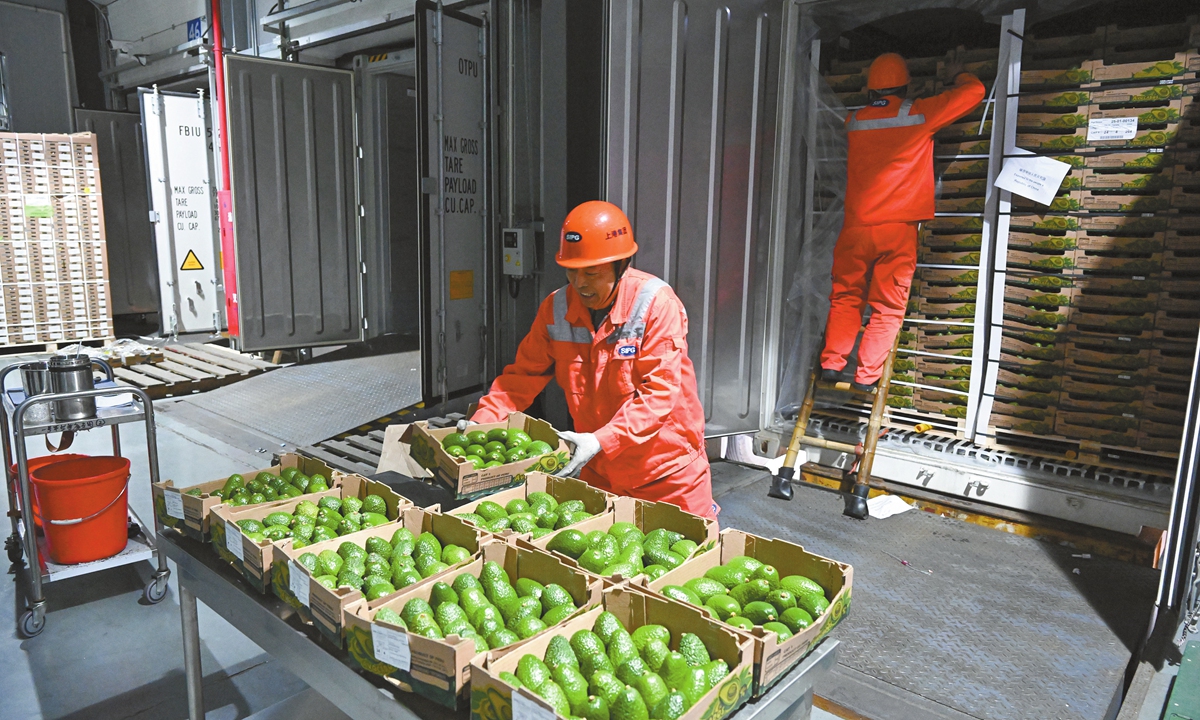
Port workers load fresh Peruvian fruit from Chancay Port in Peru, which arrived at Shanghai's Yangshan Port, onto trucks for distribution on December 19, 2024. Photo: VCG
The free trade agreement (FTA) Upgrade Protocol between China and Peru entered into force on Sunday, according to a statement seen on China’s Ministry of Commerce (MOFCOM).
The entry into force and implementation of the protocol will boost China-Peru economic and trade ties, accelerate the two countries’ comprehensive strategic partnership, create a more favorable business environment and trade and investment opportunities for enterprises on both sides, and bring more tangible benefits to the peoples of the two countries, MOFCOM said.
Observers expect the protocol to get Peru-produced blueberries, avocados, grapes and fishery products onto Chinese supermarket shelves and dining tables more quickly, while opening a faster lane for Chinese exports of autos and parts, steel, and electronic and telecom equipment to Peru. They also see the Chancay Port – a landmark cooperation project under the Belt and Road Initiative (BRI) – emerging as a door-to-door hub, with multimodal links and clearer logistics rules helping mineral ores and agri-fishery cargo move more smoothly between the two countries.
China and Peru launched FTA upgrade negotiations in November 2018 and signed the Upgrade Protocol on November 14, 2024. Through joint efforts, the two sides recently confirmed that each has completed its respective domestic approval procedures, and the Upgrade Protocol entered into force on Sunday.
The protocol upgrades the original agreement by improving seven existing chapters — rules of origin, customs procedures and trade facilitation, sanitary and phytosanitary measures, intellectual property, trade in services, temporary entry of business persons, and investment. It adds five new chapters on standards and conformity assessment cooperation, competition policy, electronic commerce, global supply chains, and environment and trade, according to a report by the China Central Television (CCTV).
Among them, the global supply chains chapter — covering such areas as encouraging multimodal transport and promoting foreign-trade logistics corridors and infrastructure — is an innovative step by the two sides under the FTA, underscoring their commitment to jointly safeguarding the stability and smooth flow of supply chains. The standards and conformity assessment cooperation chapter establishes a dedicated cooperation mechanism and sets out a list of intended areas of cooperation, which will provide a platform for mutual recognition of standards and related collaboration between the two countries and help lower trade costs for their enterprises, the MOFCOM statement said.
The two sides have also agreed to launch negative-list negotiations on trade in services and investment within two years of the Upgrade Protocol’s entry into force, to further raise openness in these areas between the two countries and continue unlocking the potential of their trade and investment ties.
The China-Peru FTA was signed in April 2009 and officially entered into force in March 2010. It was China’s first comprehensive FTA with a Latin American country, and has played a major role in boosting bilateral economic and trade ties. In 2025, bilateral trade volume between China and Peru reached $50.4 billion in 2025, nearly seven times the $6.4 billion recorded in 2009.
China and Peru are comprehensive strategic partners with highly complementary economies. China is Peru’s largest trading partner, its largest export market and its largest source of imports, while Peru is China’s fourth-largest trading partner in Latin America and an important investment destination.
The Upgrade Protocol also marks a concrete step by China to uphold the rules-based multilateral trading system, and demonstrates China’s resolve to work with other countries through free trade negotiations to safeguard multilateralism and free trade, MOFCOM said.
Global Times
RELATED ARTICLES